
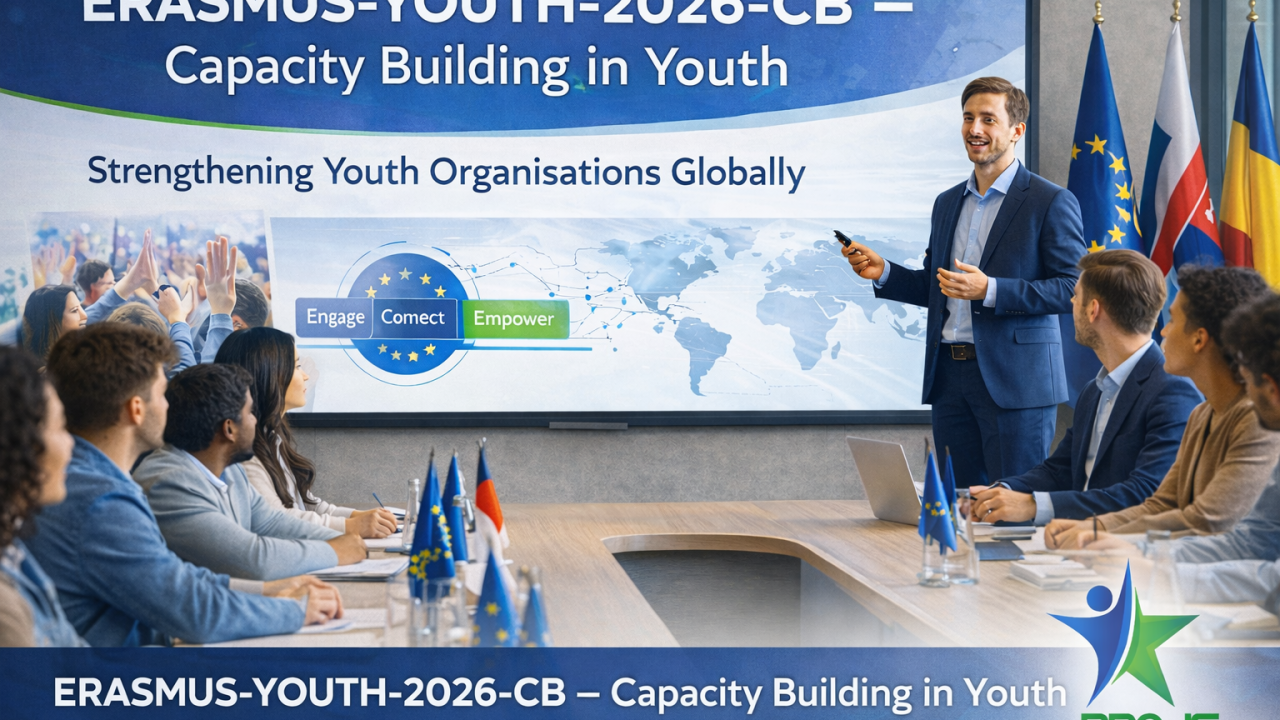

📌 ERASMUS-YOUTH-2026-CB – Capacity Building in the Field of Youth Deadline: 26 February 2026, 17:00 (Brussels Time)
Below is a “95+ score focused” summary and writing strategy that aligns with a strict evaluator perspective—exactly the style you prefer.
1. Framework of the Call (2026)
Purpose and Rationale
Capacity Building Projects in the field of Youth bring together youth organisations from EU Programme Countries + associated countries and eligible third countries with the following goals:
-
Strengthen international cooperation and policy dialogue in the youth field
-
Use non-formal learning as a mechanism for capacity development
-
Establish long-term institutional, governance and programme capacity especially within youth organisations in partner third countries
-
Generate results aligned with:
The expected impact is clearly defined: projects must demonstrate tangible empowerment and improved capacity in democratic participation, entrepreneurship, innovation, inclusion and solidarity—particularly in youth organisations from non-programme third countries.
Who Can Apply? Consortium Structure
Coordinator / Beneficiaries:
-
The coordinator must be:
-
Other public/private organisations may join as partners but cannot act as coordinator
Minimum partnership composition:
-
At least 4 beneficiary organisations
-
At least 1 organisation from an EU Member State or Programme Country
-
At least 2 organisations from two different eligible third countries within the same region (e.g., both from Western Balkans, but each from a different country)
Important: Cross-regional cooperation is not allowed. You must choose one region (WB / NE / SMC / SSA) and remain within it.
Duration, Budget & Funding Logic
-
Project duration: 12, 24 or 36 months
-
Grant type: 100% lump-sum model, funding rate 80%
-
Maximum EU contribution:
Budget is presented per work package, and evaluators assess “best value for money” instead of real costs. If approved, lump-sum becomes fixed.
2. Key Tone and Innovations in the 2026 Call
2.1. Integration with External Action & Youth Policy
The 2026 Programme Guide strongly connects Capacity Building projects to:
-
EU Youth Strategy 2019–2027
-
Youth Action Plan in EU External Action (2022–2027)
This means the project must not be simply “a good youth project”; instead, it should:
-
Increase democratic participation of young people in partner countries
-
Strengthen entrepreneurship and innovation capacity
-
Link youth work with local development, employability and economic participation
-
Demonstrate alignment with EU external cooperation objectives
The tone is clear: proposals must show how capacity development contributes to strategic youth empowerment, not just activities.
2.2. Clarity in Expected Impact
Expected impact criteria states that projects should:
-
Contribute measurably to Engage – Connect – Empower pillars
-
Be grounded in outcomes of Youth Goals, Youth Dialogue and European Youth Work Agenda
-
Demonstrate progress in:
-
Build local connections leading to employment, entrepreneurship and social innovation
The era of “some training – some youth camp – one platform idea” is over. The 2026 call demands policy-linked, capacity-focused, impact-driven logic.
2.3. Horizontal Priorities: Green, Inclusive, Digital & Value-Based
The four mandatory cross-cutting themes:
-
Environmental sustainability: green methods, eco-conscious activities
-
Inclusion & diversity: real accessibility for youth with fewer opportunities
-
Digital dimension: virtual collaboration, blended approaches, use of European Youth Portal
-
Shared values and citizenship: human rights, democratic culture, anti-discrimination, media literacy
These cannot appear as “extra paragraphs”; they must be integrated into the DNA of the project architecture.
3. Award Criteria (100 Points) & Thresholds
Evaluation in four sections:
CategoryMax ScoreRelevance30Quality of design & implementation30Quality of partnership & cooperation20Impact20
Minimum thresholds:
-
Total ≥ 60/100
-
At least 15/30 in Relevance & Quality
-
At least 10/20 in Partnership & Impact
Tie-break order: Relevance → Quality → Impact.
3.1. Relevance (30 points)
Evaluators examine:
-
Alignment with objectives of Capacity Building in Youth
-
Contribution to EU core values (dignity, democracy, equality, human rights, non-discrimination)
-
Evidence-based needs analysis
-
Clear and realistic objectives directly linked to beneficiaries
-
Innovation or complementarity to existing initiatives
-
Clear demonstration that capacity development strengthens youth organisations in:
For Region 9, youth exchanges & participation must be linked to capacity goals.
3.2. Quality of Project Design and Implementation (30 points)
Evaluators seek:
-
Clear description of phases (preparation – implementation – monitoring – dissemination)
-
Coherence between needs → objectives → activities → outputs
-
Work Package structure clarity and resource logic
-
Strong non-formal learning methodology
-
Recognition of learning outcomes (Youthpass / Europass)
-
Quality assurance & risk management plan
-
Cost-effectiveness and efficient use of resources
-
If mobility included: transparent selection, safeguarding, security measures
For Region 9, mobility safety and visa planning are inspected carefully.
3.3. Quality of Partnership & Cooperation (20 points)
Evaluators look for:
-
A complementary mix of organisations with relevant expertise
-
Clear and fair distribution of roles and responsibilities that demonstrates active contribution from all partners
-
Effective coordination and communication mechanisms, including:
A critical point: Youth organisations from third countries must not appear as passive beneficiaries. They should be positioned as co-leaders, decision-makers, and owners of results.
3.4. Impact (20 points)
Evaluation considers:
-
Quality of the Monitoring & Evaluation (M&E) framework
-
Impact at three levels:
-
Quality of dissemination and communication plan
-
Open access to produced materials and digital tools
-
Sustainability of results beyond project lifetime at:
For Region 9, mobility impact on local and multi-level ecosystems is particularly assessed.
4. Key Writing Priorities for a 95+ Score Proposal
Below are strategic writing recommendations aligned with evaluator expectations:
4.1. Make “Capacity Building” Concrete
The proposal must clearly answer:
-
Who is gaining capacity? (youth NGOs, youth councils, community youth hubs, public youth departments)
-
In which dimensions?
-
How is capacity strengthened?
Every objective, result and activity should include 1–2 sentences explaining how capacity increases → this directly boosts Relevance & Impact scores.
4.2. Contextualise Countries, Regions & Challenges
By region (WB / NE / SMC / SSA), the proposal must include:
-
Youth profiles using national/local indicators (NEET rates, youth unemployment, social participation barriers)
-
References to EU regional strategies and Youth Action Plan objectives
-
Concrete challenges of youth organisations such as:
This demonstrates that the proposal is not a generic youth project but is grounded in real socio-political context.
4.3. Show Non-formal Learning in WP Logic
A recommended work package structure:
-
WP1 – Management, Quality & Risk
-
WP2 – Needs Assessment & Capacity Mapping
-
WP3 – Capacity Building Programme (training, job shadowing, mentoring, toolkit development)
-
WP4 – Youth Participation & Pilot Actions (local initiatives, labs, youth advisory boards, digital platforms)
-
WP5 – Dissemination, Networking, Policy Dialogue & Sustainability
For Region 9, youth mobility activities must be placed in a separate WP or sub-WP as stated in the Guide.
4.4. Place Non-formal Learning + Youthpass at the Core
In the Quality criteria, non-formal learning and recognition of learning outcomes each receive points separately.
Activities must specify:
-
Which competence frameworks are targeted:
-
Which youth work methodologies will be used:
-
How these connect to Youthpass learning outcomes
This strengthens both Quality and Impact scoring.
4.5. Open Licensing, Digital Dissemination & Sustainability
The Award Criteria clearly emphasize Open Educational Resources (OER) and open licensing.
Therefore, the proposal should guarantee that:
-
All toolkits, training modules, MOOCs, video series, podcasts, guides and digital content developed in the project will be:
-
Content will be hosted on:
-
A long-term maintenance and update roadmap must be included
Writing these clearly increases the Impact & Sustainability scores significantly.
4.6. Partnership Design Should Highlight “Third Country Leadership”
To score 18–20 points in Partnership Quality:
-
Third country organisations need to be in leadership roles
-
They must coordinate certain WPs such as:
-
Programme country partners should act mainly as capacity transfer actors, providing:
The proposal should also include:
-
A Steering Committee
-
A Youth Advisory Board
-
Local Youth Hubs or similar participation mechanisms
Writing these in a visually structured way often influences evaluators positively.
4.7. KPIs Should Reflect Capacity Development Logic
In Impact, evaluation improves when KPIs go beyond participation counts.
Introduce three-level indicators:
Institutional capacity indicators
-
Number of youth organisations developing new strategic plans, M&E systems, volunteer policies
-
Organisations adopting sustainability/quality frameworks
Youth-level indicators
-
Number of young people actively engaged in youth structures and retention duration
-
Number of youth-led initiatives, campaigns or startups emerging from the project
Policy-level indicators
-
Number of policy recommendation documents developed
-
Number of local/national policy meetings held
-
Number of youth contributions integrated into public decision processes
A KPI set written in this structure strengthens Quality of Design + Impact.
Final Summary
ERASMUS-YOUTH-2026-CB is perfectly aligned with your existing youth project profile, but unlike standard KA220-YOU, it is more political, capacity-focused, and impact-oriented.
The 26 February 2026 call expects proposals to emphasise:
-
External action alignment
-
Youth strategy integration
-
Institutional strengthening
-
Employability, entrepreneurship and innovation capacity
The funding logic supports projects that build long-lasting youth ecosystems rather than short-term activities.
Next Possible Step
If you wish, we can now develop:
📌 A full 36-month CBY project template 📌 WP structures aligned with your partner network 📌 Detailed logical framework + expected impact narrative 📌 Draft concept note tailored to Region Western Balkans / East Neighbourhood / Sub-Saharan Africa / South Mediterranean
-We’re ready to partner on your Erasmus+ Sport project & Centralised Calls—use our proposal-writing experience to strengthen your application Contact: Ali ULUSOY happykidstr@gmail.com |
WhatsApp: +90 530 363 3120
Ready to Win Centralised Calls? Start with Project Factory! Why Project Factory as Your Solution Provider? https://drive.google.com/file/d/10H8fn-O8G2z43UONl5--GVCadPG9pMPV/view?usp=sharing