In Horizon Cluster 2 calls, the most common mistake is to treat a project idea as “text production” and miss the real game. These calls do not fund well-written sentences; they fund mechanisms that work in real settings, measurable impact logics, and credible implementation capacity. That is why what we call “preparation” starts much earlier than opening a Word file and drafting an introduction. Preparation is the process of clarifying the project’s scientific and practical core, justifying the consortium, controlling data–ethics–IP risks, and producing evidence in line with the evaluation logic. In short, preparation is turning a project idea into a “submittable product.”
1) What Is Preparation (Not a checklist—an engineering process) It is misleading to think of preparation only as administrative items such as “meetings, documents, timeline.” In Horizon, preparation builds three things at the same time: (i) an evidence-based definition of the problem and clarity on the intended change, (ii) an intervention mechanism that can plausibly produce that change, and (iii) an evaluation design that makes the mechanism measurable. When these three pieces are not solid, applications are typically read as “well-intentioned but vague,” and they lose points. Preparation therefore converts a project idea from a “statement of intent” into a real-world “model package” that can work outside the proposal.
2) The First Preparation Step: Not Reading the Topic, but “Locking” the Topic In Cluster 2, it is not enough to read the topic text and say “we fit this.” The first step is to lock what claim the topic wants tested and what type of output it will recognise as “acceptable.” Especially under headings like DEMOCRACY-10, the evaluator’s lens quickly becomes: “Which behaviour will this project change, in which context, through which mechanism, and how will it measure that change?” If the topic expects field pilots and scaling, your preparation must be woven around “pilot design + measurement framework + institutional adoption pathway.” If the topic requires policy and practice together, producing academic outputs alone is not preparation—it can even create risk.
3) State-of-the-Art Preparation: Not a literature review, but a “gap map” What the evaluator wants to see is not “we read the literature,” but a clear gap map of the form: “existing initiatives have typical measurement limits, and we bring a design that will overcome them.” At this stage, preparation should aim to produce a one-page “evidence landscape”: which intervention families (e.g., media literacy trainings, fact-checking campaigns, behavioural nudges) measure which outputs, where they stumble, and what methodological leap your project proposes. Once the gap map is written, the “beyond state of the art” claim emerges naturally—you do not have to force a generic “innovation” sentence.
4) Outcome Lock: The heart of preparation is answering “What will change?” The most critical part of preparation is to define the project’s primary outcome construct clearly. For example, “democratic resilience” is not, by itself, an outcome; it is an umbrella concept. In preparation, you must lock which measurable constructs sit under that umbrella and which are primary versus secondary. Otherwise, the project looks like it says many things but measures very little. Good preparation narrows the primary outcome, connects secondary outcomes through a coherent causal chain, and defines, from the outset, the toolset capable of measuring each. The goal is not “to measure more,” but to measure the right thing.
5) Evaluation Design Preparation: Not a method label, but a logic In Horizon, evaluation design should not be a paragraph appended at the end of the text. Preparation embeds the evaluation logic into the project architecture. If you are testing an intervention under DEMOCRACY-10, relying on a weak scheme such as “pre-test/post-test satisfaction surveys” can make a strong idea look like a weak implementation. Preparation clarifies the comparative design (which groups, under which conditions, with what comparison logic), the data-collection timing (baseline–midline–endline), the mixed-methods configuration (quantitative + qualitative + digital trace data), and the ethics/GDPR framework from the beginning. This way, the project looks strong not “because it will be measured,” but because it is measurable by design.
6) Consortium Preparation: Not finding partners, but proving “Why this consortium?” Partner search is often reduced to LinkedIn messages and OID exchanges—this is insufficient for Horizon. In preparation, the consortium is built as a “capacity claim.” Each partner’s role must be justified not merely as “they will run workshops,” but because they carry a necessary part of the project mechanism. Municipalities provide pilots and adoption pathways; libraries or youth centres offer trusted community infrastructure; academia builds the measurement and methodological backbone; NGOs deliver access to target groups and a rights-based approach; media/technology actors enable integration of scalable tools. Good preparation establishes this complementarity map early and reduces it into clear sentences that can be directly transferred into the evaluation narrative.
7) Pilot Preparation: Pilot ≠ event; it is “field evidence of a working model” In many applications, pilots remain at the level of “we will implement in city X.” But pilot preparation is the project’s real exam: What will participant flows look like Which internal processes will be activated Which tools will be used What outputs will be produced Which metrics will define success When these answers exist—even as drafts—during preparation, the project looks implementable. Pilot diversity (different countries, different target groups, different institutional capacity levels) must also be part of preparation, because a transferability claim becomes convincing only when tested across varied contexts.
8) Data–Ethics–IP Preparation: Not late-stage box-ticking When ethics and data protection are treated as formalities, the proposal weakens. Preparation builds GDPR compliance, protocols for working with sensitive groups, consent processes, data minimisation, and secure storage from day one. Similarly, IP and Open Science/FAIR is not the sentence “we will publish openly”; it includes decisions such as how datasets will be anonymised, which outputs will be shared under which licences, and—if platforms/tools are developed—what sustainable access model will apply. When these decisions are made during preparation, the text becomes coherent almost automatically.
9) When does “writing” start in preparation Good preparation makes writing easy, because the narrative becomes a text that “shows the design” rather than “tries to persuade.” Writing does not begin only at the end of preparation; it begins at key preparation milestones. When the gap map is ready, Ambition can be written. Once the outcome is locked, the Excellence backbone forms. As pilot drafts mature, Implementation takes shape naturally. When the adoption/scaling pathway is clear, Impact starts to flow on its own. Writing becomes not “sentence production,” but the structured presentation of preparation outputs.
10) Common preparation mistakes One frequent mistake is keeping the project idea too broad and building an “everything included” frame. This creates priority diffusion and makes it unclear what the project is actually testing. The second is weak measurement: strong idea + weak measurement = low credibility. The third is designing pilots like events; a pilot is a testbed that must produce results. The fourth is treating the consortium as a collection of CVs; in reality, the consortium is the mechanism’s distributed capacity.
11) Conclusion: Preparation = risk reduction + score increase Preparation does not only increase proposal quality; it reduces delivery risks during implementation. Good preparation clarifies what will be done, how it will be measured, and which organisation carries which responsibility. In Horizon Cluster 2, “winning” projects often win not because they are more creative, but because they lock the idea correctly, build the measurement logic early, and justify the consortium convincingly. Running after the deadline only magnifies errors if preparation is missing; but if preparation is complete, the final week becomes an editing week.
The era of writing is over: Winning Horizon Cluster 2 requires “preparation discipline”
The moment you enter Horizon Cluster 2 (Culture, Creativity and Inclusive Societies), you must leave behind an old reflex: “If I write well, it will work.” These calls do not pay for polished paragraphs; they pay for measurable interventions that function in real settings, models that institutions can adopt, and consortium capacity that tests these models credibly. Therefore, “preparation” is not a pre-step of proposal writing; it is the project itself. The text is simply the paper-based projection of a well-prepared mechanism.
This year, I focused on six project ideas that share the same backbone but represent different “intervention types” within Cluster 2. Three target democratic participation and lifelong civic capacity in the broader Cluster 2 logic; three sit under DEMOCRACY-10 and aim to make digital and media literacy a measurable component of democratic resilience. The reason to think of all six together is simple: rather than getting trapped in a single theme and trying to be “everything for everyone,” building a portfolio that tackles the same problem with different tools increases both scientific clarity and implementation strength.
Why these six ideas Because all of them force “intervention design”
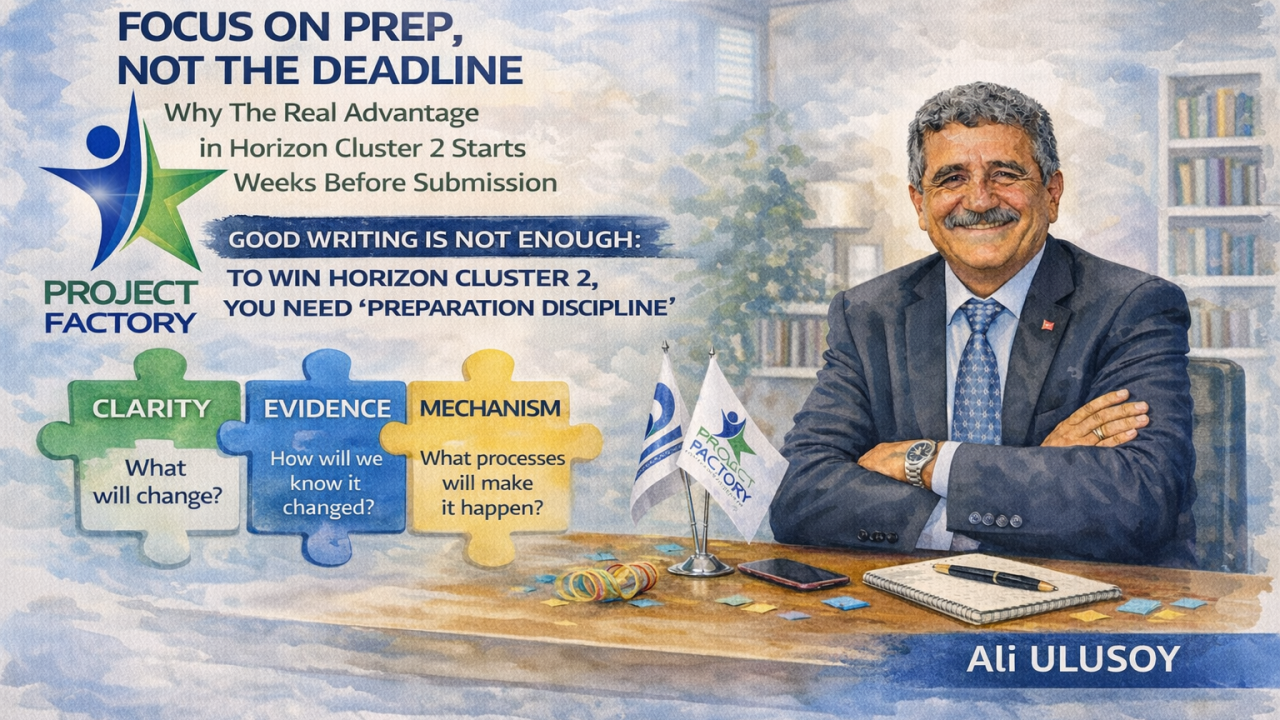
The first reason I selected them is that they are not projects that can be “sold with text,” but projects that must be “proved with mechanisms.” In Cluster 2, the biggest point loss comes from broad promises tied to vague targets. These six ideas force me, from the start, into three questions: What will change Which mechanism will produce that change How will we know it changed This is precisely the value of preparation discipline.
The second reason is that each idea naturally contains the issue of institutional adoption in the field. Cluster 2’s invisible test is: when the project ends, will there only be a report, or will there be a structure that can enter a municipality’s guidelines, an adult education provider’s programme, or a library’s service model I chose all six so they can answer that question.
The third reason is portfolio logic. I wanted a coherent set where I can bring together different actors—municipalities, adult learning providers, libraries, youth centres, journalists, platforms, NGOs, and academia—through a consistent role map. Because a “consortium” is not a sum of CVs; it is the distribution of an intervention’s components across institutions.
1) CIVIC-TECH Lifelong Pathways: Civic competence is not a “course”—it is a journey This idea takes seriously the fact that civic capacity develops outside formal schooling. People already build competence when they engage in municipal processes, organise neighbourhood solidarity, or participate through digital deliberation tools. The problem is that this learning remains invisible, unmeasured, and unrecognised. I selected CIVIC-TECH Lifelong Pathways because it proposes to structure that invisible learning as a journey—starting with participatory budgeting, deepening through deliberation tools, and maturing through community moderation skills.
From a preparation perspective, this idea forces two disciplines: first, clarifying the difference between “learning outcomes” and “democratic participation outcomes”; second, building a realistic adoption pathway explaining why local authorities would institutionalise it. This is not about writing; it is about designing internal processes—exactly what Cluster 2 rewards.
2) Participation Without Barriers: Accessibility is not a slogan; it is an operational standard Barriers to democratic participation are often acknowledged in policy texts but remain unsolved in practice: language barriers, disability-related access issues, socio-economic exclusion. What attracts me here is that the solution is not framed as an “awareness campaign,” but as a measurable barrier-removal model that can function.
I selected this project because it closes one of Cluster 2’s strongest point-breaking risks from the start: “You have target groups, but you do not have a real access and trust-building plan.” Participation Without Barriers forces preparation to go into the field: accessible formats, support mechanisms, uptake measurement in local pilots, and institutionalisation into protocols. This is not “good intention”—it is a “working system” demand.
3) Micro-Credentials for Democratic Participation: If participation is not recognised, it is not sustainable I selected this idea because it touches a core dilemma: people volunteer, organise communities, and participate digitally—yet that effort is rarely recognised as a competence. Unrecognised competence does not produce sustainable motivation. A micro-credentials approach can bridge this gap: translate participation components into assessment rubrics, ensure quality assurance, and pilot adoption with training providers and local authorities.
In terms of preparation discipline, this project is “hard.” Micro-credentials mean claims: measurability, verifiability, portability. By choosing it, I am forcing myself into a rule: without an outcome lock, you cannot write a single paragraph. Rubrics and adoption pilots must be designed to work in real contexts, not on paper. That is exactly what Cluster 2 values—methodology backing the claim.
The DEMOCRACY-10 trio: Moving literacy from “lessons” to “behaviour and infrastructure”
My intent in choosing three DEMOCRACY-10 ideas was to move digital and media literacy away from standalone training modules and rebuild it through behaviour change and community infrastructure. The most expensive mistake in fighting disinformation is the assumption that “if people know, behaviour changes.” Often knowledge exists without behavioural change—or behaviour exists without community support.
4) Resilient Citizens Lab: Which intervention actually works This idea puts the “what works better?” question at the centre. Many literacy initiatives exist, but many are weak in measurement design or fail to demonstrate real-world scalability. I selected Resilient Citizens Lab because it targets two key gaps: an intervention catalogue and a resilience outcomes measurement framework.
Preparation-wise, it prevents me from writing state-of-the-art as a list. Here, state-of-the-art must become a gap map: which intervention families measure what, where are the limits, and which measurement boundary will we cross This idea imposes discipline on preparation—not on wording.
5) Community Fact-Checking Ecosystems: Verification is not an individual skill; it is a community function In my view, this is the most “systems”-focused response to DEMOCRACY-10. When verification practices are designed as something individuals do alone, they are not sustainable. But when libraries, youth centres, NGOs, and journalists work as a local ecosystem, verification can become a community norm.
I selected this because it answers two strong evaluator concerns: “scale” and “trust infrastructure.” It also naturally creates the consortium role map: library = trusted place, youth centre = access, journalists = verification standards, NGO = inclusion and rights-based approach, academia = measurement. You do not have to invent “why this consortium?” later—the idea generates it from the start.
6) Behavioural Literacy Nudges: Knowledge is not enough; habits must change My reason for selecting this is straightforward: the disinformation ecosystem runs on speed and impulse. So “information provision” alone is insufficient; we need design interventions that influence behaviour at micro-decision moments. If designed within an ethical framework, nudges can be both measurable and scalable.
Preparation-wise, this project forces the “ethics + impact” balance from day one. Nudges, if poorly designed, become easy to criticise. That means: if you do not take ethics, data protection, transparency, and manipulation risks seriously during preparation, the project will look weak no matter how good the text is. Choosing this idea pushes me from box-ticking into real design decisions.
What do you gain by preparing all six together
Each idea is strong on its own, but the real advantage appears when you develop them as a set: you can build a shared preparation backbone. The tools differ, but the same three locks apply across all: outcome clarity, evaluation design, and adoption pathways. This enables parallel preparation: similar consortium typologies, a consistent ethics/GDPR approach, a comparable pilot logic—while deploying different intervention packages. It increases both quality and speed. And ironically, “speed” here is not rushing; it is reduced delay because preparation discipline removes friction.
Final word: In Cluster 2, preparation replaces text
Today, competition in Cluster 2 is not between paragraphs written in the last week; it is between preparation decisions made over the last months. Topic lock, state-of-the-art gap mapping, outcome construct clarity, evaluation design, consortium role mapping, realistic pilots, and adoption pathways—none of these are decorative text. They are the project.
I selected these six ideas for precisely this reason: they force me not to manufacture sentences, but to build mechanisms. Because Cluster 2 funds mechanisms, not wording—and I prefer to play the game where it is actually funded.
______________________________________________________________________________
If you'd like to meet Ali Ulusoy, who has been working on building ecosystems and sustainable project structures for many years, you can send him a message via LinkedIn or contact him directly via email. 👉 Connect, let's talk.
- -We can add value to your projects with our organizations in Türkiye and Estonia. Would you like to benefit from our contribution in writing your Horizon Europea projects
- Ali ULUSOY
- Proje Fabrikası Kurucusu / President of Project Factory
- Engelsiz ve Mutlu Yaşam Derneği Başkanı / President of Barrier Free and Happy Life Association
- happykidstr@gmail.com https://projehaberleri.com/
- Stay Connected WhatsApp: +90 530 363 3120
- Facebook: mahalleninalisi Twitter / X: Happykidsturke2 LinkedIn: happykidsturkey