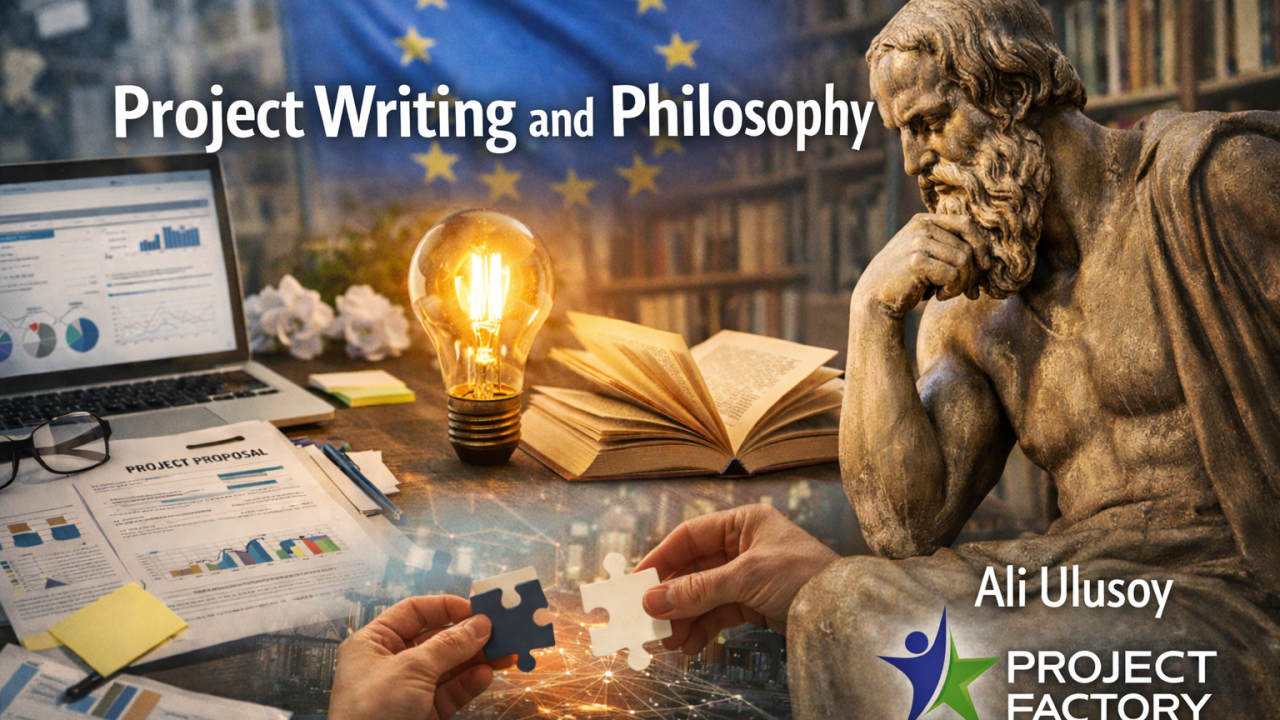
Project writing is often perceived as a matter of “filling in forms”: placing the right sentence in the right box, providing the right number in the right place, choosing the correct keywords. Yet a strong project text is, in reality, the outcome of a well-structured way of thinking. Philosophy does exactly this: it clarifies concepts in order to make sense of the world, justifies a claim, tests coherence, anticipates objections, and ultimately answers the question of why. For this reason, there is a powerful—though not immediately visible—kinship between project writing and philosophy.
In calls such as Erasmus+ SPORT-SCP, this relationship becomes even more evident. It is not sufficient to state that “we will carry out activities.” One must construct a coherent chain of problem–need–solution–output–result–impact around a single priority, link this chain to EU policy language, and align it with the award criteria in the evaluator’s mind. This requires methodical thinking—in other words, philosophical discipline.
1) A Project Idea Is a “Claim”: Ontology and the Test of Reality
In philosophy, ontology asks the question: what exists In project writing, its equivalent is: what truly exists on the ground, and what is missing A strong project writer begins by constructing reality correctly. A poorly defined reality renders even the most brilliant solution meaningless. The statement “disadvantaged groups cannot access sport” may be a starting point, but it is ontologically weak: which disadvantage, which form of access, which barriers, and in which context
When the gap between “what is” and “what should be” is not defined through evidence, a project turns into a declaration of intention rather than a credible intervention.
The single-priority rule of SPORT-SCP further sharpens this ontological requirement. One cannot claim that “everything exists.” A single axis must be selected, and the world must be described from that perspective. Philosophy teaches us something very clear here: the goal is not to multiply reality, but to sharpen it. The text should not give the impression of “saying many things,” but of “saying exactly what matters.”
2) Project Writing Begins with Epistemology: The Source and Reliability of Knowledge
Epistemology asks: what do we know, and how do we know it In project writing, this question lies at the heart of needs analysis. Evaluators do not test your goodwill; they test your knowledge regime. Where does this need come from What is your evidence Field observation, national statistics, EU reports, previous project findings
For this reason, strong texts do not merely say “there is a problem.” They say, “there is a problem because…” and anchor the argument in evidence.
A philosophical perspective adds another layer: evidence is not only numerical; it has context. The same data carries different meanings in different countries. Strong writing connects the European scale—EU policy frameworks and shared trends—with the local scale—city, neighbourhood, or target group—within the same paragraph and in a natural flow. As a result, the project moves away from oscillating between “generic European statements” and “local anecdotes” and instead rests on a single, coherent line of knowledge.
3) Logical Discipline: The Problem–Solution Chain Is Argument Theory
In philosophy, an argument is a coherent bridge between premises and conclusions. In project writing, this bridge appears as the problem–need–solution–output–result–impact chain. Weak projects decorate this chain; strong projects lock it.
If “inclusion” is the chosen priority, every paragraph must reinforce that axis: training design, activity formats, partnership structure, digital tools, dissemination, and sustainability must all serve the same logic. Mentioning inclusion in one section, shifting to digital transformation in another, and then moving on to green priorities constitutes a philosophical category error. Evaluators detect this intuitively—and the score drops accordingly. A single priority, in essence, means running the entire argument on a single backbone.
4) The Ethical Dimension: Project Writing Must Be Not Only “Compliant” but “Right”
Ethics in project writing operates on two levels. First, the project topic itself is ethical: areas such as inclusion, anti-discrimination, safe environments, child protection, and disability rights require rights-based language and methodology. Second, the process of project writing is ethical in itself: avoiding data exaggeration, not presenting impact as wishful thinking, defining partner roles realistically, and not reducing target groups to mere labels.
Philosophy reminds us that people are not merely “target groups”; they are ends in themselves. In sports projects in particular, presenting disadvantaged groups as decorative evidence may strengthen a proposal technically, but it weakens it ethically. This fragility eventually emerges during implementation: participation declines, trust erodes, and sustainability collapses. Ethics, therefore, is not optional—it is a core component of project quality.
5) Teleology: The “Why” Question and the Hierarchy of Objectives
Teleology is the philosophy of purpose. In project writing, it is the art of constructing a hierarchy of objectives. In a SPORT-SCP project, if the relationship between the general objective and the specific objectives is unclear, the text fragments. “Organising activities” may be an action, but it cannot be an objective. An objective refers to the change produced by that action.
Philosophical thinking translates objectives into the language of outcomes. “Coach training” is not a task; what behavioural or institutional change does it generate A “digital platform” is not an output; how does it transform coordination, accessibility, participation, and monitoring “Dissemination” is not a list; which decision-maker is reached, with which message, supported by which evidence, and at what time
When teleology is properly constructed, the project text describes transformation rather than a to-do list. And this is precisely what evaluators seek: meaningful change achieved with limited resources.
6) Hermeneutics: The Evaluator Is Your Interpretive Partner
Hermeneutics is the philosophy of interpretation. In project writing, it translates into the ability to read the evaluator’s mind. When you write a project, you actually produce two texts: the application itself, and the “project image” that forms in the evaluator’s mind. If that image is unclear, the score declines.
For this reason, project writing is not only about saying the right things, but about saying them in the right order, with the right density, and through the right transitions. Paragraph transitions function like those in philosophical texts: one sentence makes the next inevitable. The text must flow, but without losing evidence, indicators, and mechanisms along the way. Project writing is therefore both literary and engineering work.
SCP templates and prompt logic serve precisely this function: stabilising the backbone of the text and reducing interpretative ambiguity.
7) Pragmatism: “Does It Work?” and Bringing Design to the Field
Pragmatism evaluates ideas based on their consequences. In project writing, this principle appears as feasibility. Evaluators are less impressed by elegant wording than by whether the mechanism is likely to function. This is why work package design, KPIs, risk management, and sustainability are philosophically questions of testability.
A strong project text implicitly answers the question: why will this method work In an inclusive sports programme, for example, accessibility arrangements, volunteer training, safeguarding approaches, micro-solutions that reduce participation barriers, and continuous monitoring and improvement cycles must appear together. This signals that the project is a functioning system rather than a theoretical construct.
Pragmatism also highlights budget coherence. If the scale of activities does not align with the budget package, philosophical consistency collapses. The question is not “we ask for €250,000,” but “why this scale is appropriate for this level of impact.”
8) Stoicism: Risk, Uncertainty, and the Calm Strength of the Text
Stoic philosophy advises accepting what cannot be controlled while perfecting what can. In projects, this is precisely the essence of risk management. Weather conditions, participation fluctuations, partner capacity differences, and local permit procedures are unavoidable uncertainties. Weak texts either ignore risk or adopt a tone of panic. Strong texts are calm, foresighted, and solution-oriented.
A stoic stance in project writing means restrained claims. Instead of inflating impact, it sets verifiable targets. Instead of dramatizing risks, it clearly explains mitigation mechanisms. Instead of idealising partnerships, it clarifies governance models. This creates trust—and trust translates into points.
9) Philosophy of Language: If Concepts Are Unclear, the Project Is Unclear
Certain words are often treated as magical in project texts: “awareness,” “empowerment,” “innovation,” “sustainability,” “dissemination.” Philosophy of language teaches us that meaning emerges through use. If you speak of awareness, what behavioural change are you targeting If you claim sustainability, which organisation, with which resources, will maintain which mechanism If you claim innovation, how does it differ from existing practice, and in what dimension
When these concepts remain undefined, the text becomes eloquent but opaque. Yet evaluators are not reading to admire sentences; they are reading to make decisions. Project writing, therefore, is an exercise in accountability for concepts.
10) Conclusion: The Project Writer Is the Philosopher of the Call
A project writer is not merely someone who reads the call; they are someone who deciphers the thinking behind it. The spirit of Erasmus+ SPORT-SCP texts is clear: addressing a shared European problem through a single priority axis, using a measurable and transferable model. This is a philosophical mode of problem-solving: clarifying concepts, presenting evidence, constructing arguments, anticipating objections, testing methods, and grounding impact.
For this reason, “project writing and philosophy” is not a metaphor—it is a methodological proposal. What raises a project’s score is not more decorative language, but more accurately reasoned sentences. And accurate thinking reveals itself through clear, restrained, and powerful writing.