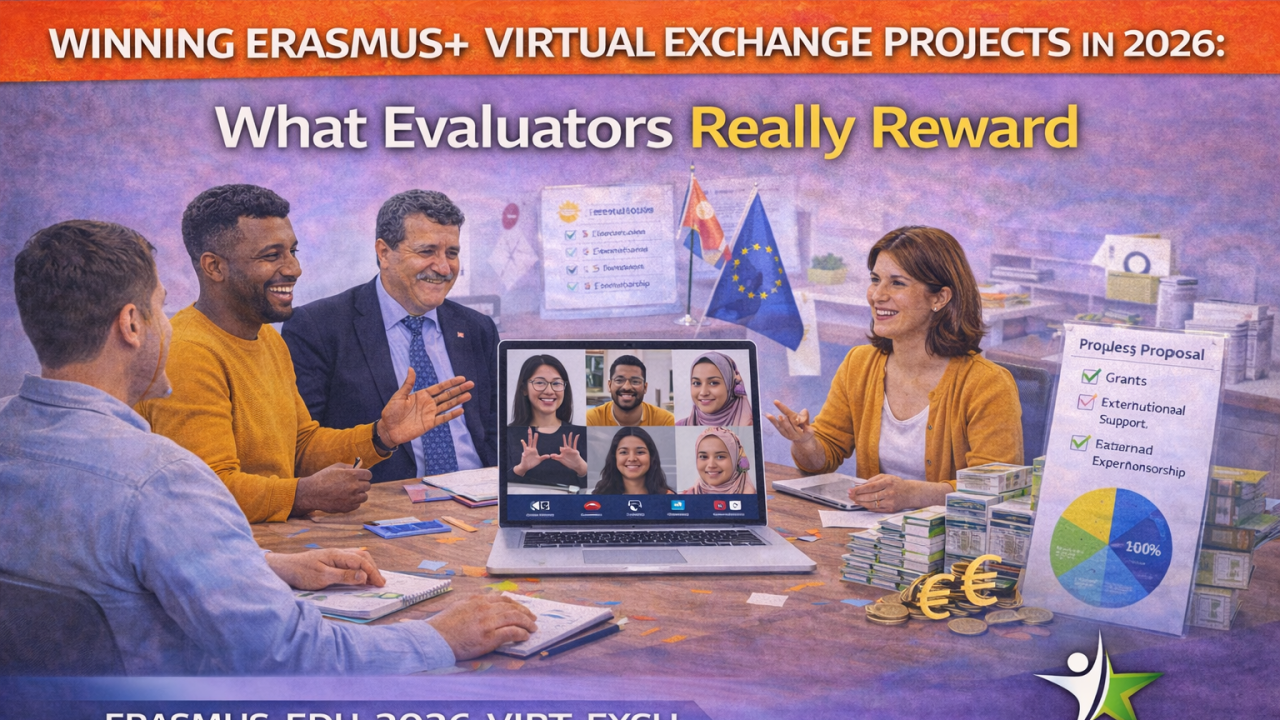
The ERASMUS-EDU-2026-VIRT-EXCH call is a strong opportunity for organisations that want to scale intercultural dialogue and meaningful cooperation without relying on physical mobility. Yet many proposals still fail for the same reason: they treat Virtual Exchange as a “digital event” rather than a structured capacity-building pathway that changes how institutions operate and how participants engage.
The strongest proposals start long before platforms or tools are selected. They begin with a disciplined baseline assessment that clarifies what is missing and why action is needed: facilitation gaps, digital readiness, inclusion barriers, quality assurance weaknesses, and under-developed international collaboration routines. When this baseline is presented through measurable indicators, the project necessity becomes difficult to question, and the evaluator can see a credible starting point for institutional change.
From there, high-scoring proposals avoid one-off interactions and instead design Virtual Exchange as a structured learning journey. Evaluators tend to trust projects that show a clear sequence: preparation and onboarding, facilitated sessions, reflection and consolidation, and follow-up tasks that turn dialogue into learning evidence. This structure signals intentional design and protects quality. It also connects directly to another decisive factor: the professional role of the facilitator. Successful projects do not assume that online dialogue will manage itself. They describe how facilitators will be prepared, how moderation frameworks will be applied, how inclusive participation will be ensured, and how safeguarding and conflict-sensitive communication will be handled. In evaluator terms, facilitation is not a soft add-on; it is the quality engine.
In the 2026 context, Virtual Exchange is also expected to be genuinely inclusive, not only in ambition but in implementation. Strong proposals embed access and inclusion by design, combining outreach strategies with accessible formats, realistic participant support, and facilitation methods that prevent quieter voices from disappearing. If inclusion is stated but not operationalised, the project reads as risky. If inclusion is operationalised, the project reads as credible.
Another frequent weakness in Virtual Exchange proposals is partnership logic. Evaluators do not reward geography; they reward complementarity. A competitive proposal uses the baseline diagnosis to shape the consortium and shows why each partner is there: who contributes facilitation capacity, who brings pedagogical expertise, who ensures digital delivery quality, who reaches target groups, and who carries evaluation and dissemination responsibilities. When roles are justified through capacity gaps and not vague collaboration statements, the partnership becomes convincing.
Impact is where many projects lose points—not because they have no impact, but because they cannot demonstrate it. Proposals that score well integrate monitoring from day one, rather than attaching it at the end. They explain how learning and participation quality will be evidenced through baseline, interim, and final measurements; how behavioural or competence shifts will be observed; and how qualitative evidence (reflection logs, case stories, facilitator observations, participant feedback) will complement quantitative indicators. In Virtual Exchange, counting participants is not enough. Evaluators look for proof that interaction produced measurable learning and institutional uptake.
European added value becomes visible when results can travel. Projects that are designed only for the consortium tend to look limited; projects that are designed for replication tend to look European. That is why strong proposals emphasise transferability through modular session designs, facilitator toolkits, adaptable templates, and open-use resources. When outputs are clearly reusable by other organisations and other countries, dissemination turns into real added value rather than promotion.
The proposals most likely to succeed also treat Virtual Exchange as a strategic instrument inside institutions, not a side experiment. They connect project activities to long-term institutional priorities such as internationalisation, digital transformation, inclusion strategies, youth participation models, or curriculum innovation. This alignment tells evaluators that the project will not disappear when funding ends, because Virtual Exchange will be embedded into routine practice. That long-term embedding becomes even stronger when the project is positioned within wider ecosystems—education networks, youth platforms, civil society alliances, or policy dialogues—so that the initiative is not isolated and the results are more likely to be adopted beyond the partnership.
Finally, there is a practical reality that evaluators often sense immediately: delivery risk. Great ideas can still underperform when the proposal lacks execution discipline, quality assurance routines, and evaluator-ready logic. This is where choosing an experienced strategic partner matters. Working with a partner such as Project Factory strengthens Virtual Exchange proposals by translating ambition into a clear work-plan architecture, measurable indicators, quality assurance processes, replication-ready outputs, and evidence-based impact logic. This reduces implementation uncertainty and increases evaluator confidence—two factors that frequently separate funded projects from “good but not selected” applications.
Virtual Exchange in 2026 is not about running online meetings. It is about building safe, facilitated, inclusive, measurable, transferable and institutionally embedded exchange processes that create sustainable value across borders. When the project is designed with that discipline, the proposal reads like a fundable plan—because it is one.
If your organisation is preparing for ERASMUS-EDU-2026-VIRT-EXCH and wants to shape an evaluator-ready project with strong facilitation logic, measurable impact, and replication pathways, Project Factory is ready to join as a strategic partner.
--We’re ready to partner on your Erasmus+ Sport project & Centralised Calls—use our proposal-writing experience to strengthen your application Contact: Ali ULUSOY happykidstr@gmail.com |WhatsApp: +90 530 363 3120Ready to Win Centralised Calls Start with Project Factory! Why Project Factory as Your Solution Provider https://lnkd.in/d3it6pdc