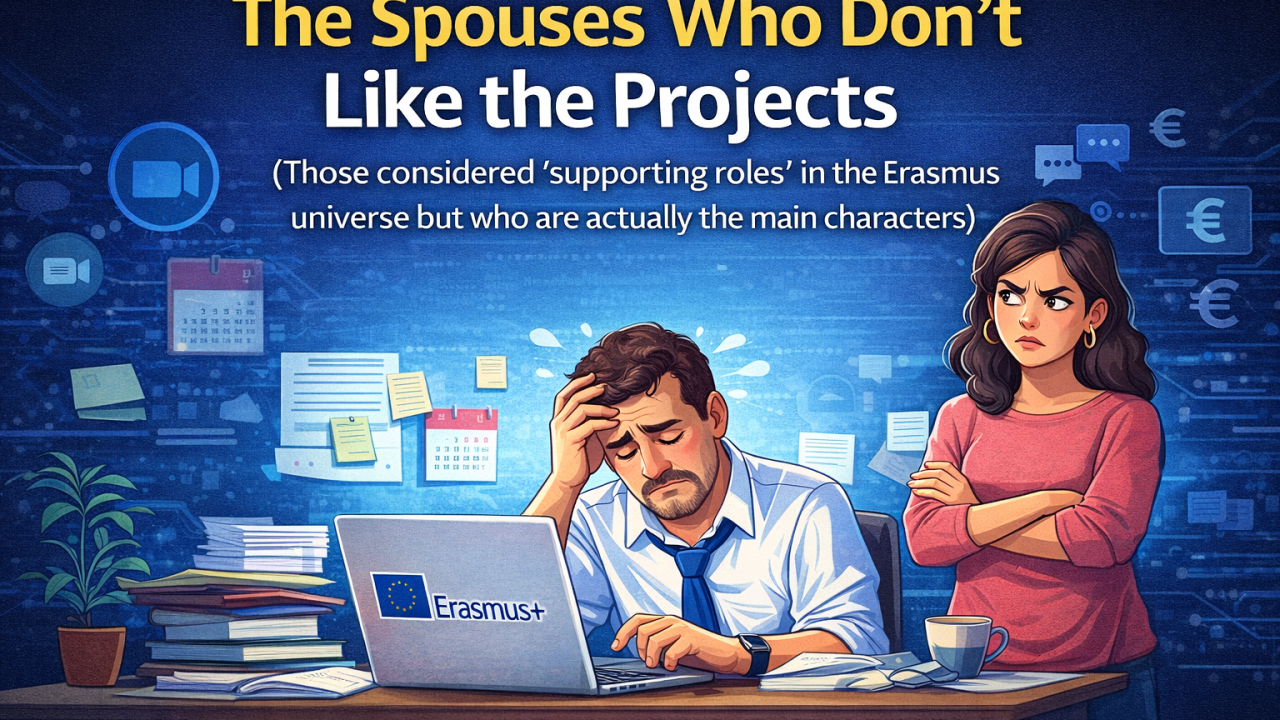
(Those considered “supporting roles” in the Erasmus universe, but who are actually the main characters)
Writing an Erasmus+ project is not “just writing a text.” You know that too. It is the art of needs analysis, goal chains, work package design, budget mathematics, partnership diplomacy, and staring at the ceiling on the final night wondering, “Why did I choose this?” But this story also has invisible heroes: the spouses who don’t like projects.
Yes, you heard that right. The category we call “the spouse who doesn’t like projects” is, in fact, the most realistic risk analysis item in the entire project cycle. Like an external auditor. They never go to the field, but they sniff out everything. And they deliver an evaluation more effective than any “dissemination activity”: with a single sentence, they can collapse your entire strategy. For example:
“Is this project Zoom again?”
If a spouse says this, the project’s sustainability has officially entered the review phase.
This piece humorously explains how project writers struggle at home “as much as in the field,” how “domestic persuasion” can be as demanding as “partner searching,” and why some spouses truly dislike projects. But let’s not just laugh and move on: this is a serious “human resource management” issue in the Erasmus ecosystem. Because if a project writer cannot find peace at home, they cannot even write the “impact” section. And even if they do, they themselves cannot be the expected result in the “expected results” section.
If you’re ready, let’s begin.
1) When the Project Writer Walks Through the Front Door: “Work Package 0” Begins
No one talks about it in the project cycle, but there is a hidden WP at home: WP0 – Expectation Management with the Spouse and Crisis Prevention.
You walk in through the door, your eyes reduced to two pixels from staring at screens all day. As you drop your bag, you speak automatically:
“Today was very intense…”
And your spouse replies from a higher level:
“I know it was intense. Because I’ve never seen a day of yours that wasn’t.”
At this point, spouses split into two groups: those who like projects and those who don’t. The project-loving spouse listens to your sentence like a “supportive report.” The project-hating spouse, however, behaves like an “independent evaluator.” Their question is clear:
“When will this intensity end?”
And you switch to Erasmus language:
“When this call is over…”
But your spouse already knows: calls never end. One call ends, “dissemination” begins. That ends, “follow-up” starts. Then come “new partnerships.” Somewhere in life, there is always a “deadline.” And this is the real concern of the project-hating spouse: there is no space left in the household calendar to write “us.”
2) When “Needs Analysis” Is Done at Home: Overly Realistic Results
For the project writer, needs analysis means reading the outside world. For the spouse, needs analysis means reading the inner world. While writing your project, you say:
“The needs of this target group are very clear.”
And your spouse turns to you and says:
“Your needs are also very clear: sleep.”
Some spouses dislike projects for exactly this reason. Because the project writer is always running to meet other people’s needs. Women’s entrepreneurship in rural areas, young people’s digital skills, inclusive sports access for persons with disabilities… Wonderful. But one day your spouse says:
“You manage to be there for everyone… so why can’t you be there for me?”
This sentence sits right at the heart of the “Relevance” criterion in domestic evaluation. Because the project writer sometimes forgets the target group at home. Yet the most sustainable partnership is the one at home.
3) Why Spouses Get “Irritated” by Projects: It Starts Innocently, Then Becomes Systemic
Spouses who don’t like projects are not enemies of projects at the beginning. It usually starts innocently:
“How nice, you’re going to Europe.”
Then comes “laptop at dinner.” Then “Zoom on weekends.” One day, when your spouse sees you with your laptop in the middle of the living room, they say:
“Do you live in this house, or at the EACEA branch office?”
From that point on, your spouse no longer sees the project as “a job,” but as “a being that has moved into the house.” A laptop is not just a laptop; it’s a call. Zoom is not just Zoom; it’s a coordination meeting. The email notification sound is not just an email; it’s a “partner crisis.”
The common trait of project-hating spouses is this: they perceive the project not as “work,” but as “the third person in the household.” Sometimes it gets even more dangerous: the project becomes your rival in your spouse’s eyes. And that rival’s name is “Deadline.”
4) The Translation Problem Between Project Writer Language and Spouse Language
The project writer speaks a different language. Spouses call it “Erasmus-speak.” For example:
You: “We revised WP3 today.” Spouse: “What did you do?” You: “WP3.” Spouse: “Is that my name?”
Or:
You: “One of the partners delayed the deliverable.” Spouse: “You’re delaying me too.”
When you say “deliverable,” you think of a document. When your spouse hears “deliverable,” they think of a person. You say “output,” your spouse gets tired even of the word “output.” Because in marriage, “output” usually means “get out of that computer already.”
As this language gap grows, your spouse develops a reflex against the project. After a while, the word “project” becomes a trigger word at home. In some households, the word “project” even enters the list of banned words. Encrypted conversations begin instead:
“You know… that thing…”
Erasmus+ literature calls it “conflict management.” The spouse calls it “don’t test my nerves.”
5) The Biggest Fear of a Project Writer’s Spouse: “Are You Doing This for Free Again?”
The hidden trauma of project-hating spouses is this: project writers sometimes exaggerate voluntary work. Because the project writer’s world is built on “sacrifice.” From day one, you run after “impact.” Your spouse, however, measures “impact” at home:
“What did this bring you?”
And you reply in an idealistic tone:
“It brought a great network.”
When spouses hear the word “network,” they think of two things: First, the internet connection might be weak. Second, there is probably no money again.
The project-hating spouse is not against the project’s “social benefit.” But there is also the “household bills” part. When this balance is not established, the spouse’s antipathy toward the project increases. Because from their perspective, the project sometimes means “a lot of effort, little return.”
Your spouse summarizes it like this:
“You’re saving Europe, but who’s saving the grocery store?”
This sentence is the household’s financial sustainability plan.
6) The “Partner Search” Process: Not Jealousy, but a Search for Meaning
For the project writer, finding partners is normal. For the spouse, “new people, new meetings, new messages” can sometimes feel like a world with unclear meaning. A notification pops up on your phone, you suddenly smile and say, “Yes, yes, great.” Your spouse looks at you:
“Who’s that?”
You respond casually:
“A partner from Portugal.”
Spouse:
“What do you have to do with Portugal?”
You:
“Project.”
Spouse:
“Project I sometimes want to talk to you too.”
This is not about jealousy. It’s about the “meaning of sharing.” Your spouse wants to share your excitement, but project language leaves them outside. You see a “call”; your spouse wants you to hear the “call” at home.
Some project-hating spouses do not hate the project itself; they hate being a “supporting character” because of the project. That’s why some spouses are not angry at the project, but at not being part of it.
7) When Zoom Meetings Start at Home: The “Secret Evaluator” Awakens
Spouses watch Zoom meetings for a while. At first, they are curious. Then they get bored. Then they comment. Then they become a “secret evaluator.”
You speak in the meeting:
“Dissemination strategy…”
Your spouse whispers from behind:
“First, do the dishwashing strategy.”
This is domestic “quality assurance.” Because the spouse does not measure the project’s quality management; they measure your life management.
When Zoom ends, your spouse sometimes says:
“No one made a decision in that meeting.”
You: “It was a coordination meeting.”
Spouse: “The house needs coordination too.”
Thus, spouses unknowingly learn “project governance.” Some project-hating spouses observe so well that they give you feedback like a real evaluator:
“You talked a lot, but there was no clear outcome.”
This sentence is a painful truth for the project writer. Because in evaluator language, it means: “Clarity and coherence need improvement.”
8) The Hidden Heroics of the Project Writer’s Spouse: Deliverables That Are Never Written
Even project-hating spouses actually serve the project. Unknowingly.
You write until two in the morning. Your spouse quietly brings you tea. You say “thank you.” Your spouse does not want “thanks”; they want “a normal life.”
In projects, deliverables are written. But the deliverables at home are not: Taking care of the child while you’re in a meeting, running the household while you’re on a deadline, carrying your stress, saying “okay” when you say “I’m done”…
These deliverables have no name. But their impact is huge. They are not written in the project’s “risk mitigation” plan, but they make the project possible.
Some spouses dislike the project because they know they have a share in its success, but no one sees it. When the project is accepted, congratulations go to you. The spouse thinks silently:
“If it weren’t for me, that project would never have been written that night.”
They are right.
9) The Lie of “The Project Is Over” and the Spouses’ Memory
Project-hating spouses have excellent memory. After every call, you say, “This is the last one.” The spouse takes a mental note. Then, three months later, a new call opens. You excitedly say:
“Ali! This call is perfect for us!”
The spouse, calmly:
“You said the same thing last time.”
This is a domestic “evidence-based” approach. The spouse looks at your past performance. They know the realization rate of your “I won’t do it again” sentence.
That’s why spouses’ trust in projects can erode. Because projects arrive saying “they will end,” but they become “permanent.” Some spouses therefore see the project as a “lifestyle.” You, however, still behave as if you’re in a “temporary phase” with the project. This perception gap is the biggest conflict at home.
10) The Solution: Not Making the Project Loved, but Making It “Harmless to the Home”
This text is humorous, but it also has a solution side. Expecting a project-hating spouse to love the project is sometimes unrealistic. But it is possible to make the project harmless to the home.
What spouses want most is not “respect for the project,” but respect for themselves. As a project writer, what you need to do is not turn the project into something that dominates family life.
Sometimes a small sentence changes everything:
“This week, I’m reserving two evenings just for us.”
This sentence is the household’s “sustainability plan.”
And there is this: even if your spouse does not love the project, they need to love your work. Because the project is part of your identity. Spouses often do not dislike the project itself, but the project taking you over.
In other words, what your spouse really wants is this:
“Write the project, but don’t lose me.”
This sentence is the marriage’s “impact statement.”
11) The 7 Types of Project-Hating Spouses
Not every project-hating spouse is the same. Just as we segment target groups in the field, we can do it at home too.
Type one: “The Deadline Watcher.” Always asks, “When will it end?” Type two: “Zoom Allergic.” Leaves the room when they hear Zoom. Type three: “The Budget Accountant.” Asks, “What’s the return on this?” Type four: “The Attention Seeker.” Goes silent when the project is mentioned. Type five: “The Silent Supporter.” Doesn’t like the project but loves you. Type six: “The Secret Evaluator.” Doesn’t read the text but evaluates your stress. Type seven: “The Project-Traumatized.” Has been left alone too much because of projects.
Knowing these types matters because each has different needs. But they all share one common expectation: remaining “human” at home.
12) Conclusion: The Project Writer Is Human, and the Spouse Is Not a Project
Projects add value to human life. But sometimes projects consume human life. This consumption does not happen only to the project writer; it happens to the spouse too. Because the spouse watches your exhaustion. That’s why you should not see project-hating spouses as “obstacles.” They are often the balance mechanism of your life.
Perhaps the project-hating spouse is the best risk manager. The best sustainability consultant. The strongest advocate of a “human-centered approach.”
And sometimes, the truest sentence a spouse says about a project is this:
“I don’t have to love the project. I love you. Just don’t lose yourself.”
That single sentence defeats all Erasmus jargon.
– Mahallenin Projecisi

- We can add value to your projects with our organizations in Türkiye and Estonia. Would you like to benefit from our contribution in writing your central projects
- Ali ULUSOY
- Proje Fabrikası Kurucusu / President of Project Factory
- Engelsiz ve Mutlu Yaşam Derneği Başkanı / President of Barrier Free and Happy Life Association
- happykidstr@gmail.com https://projehaberleri.com/
- Stay Connected
- Facebook: mahalleninalisi Twitter / X: Happykidsturke2 LinkedIn: happykidsturkey