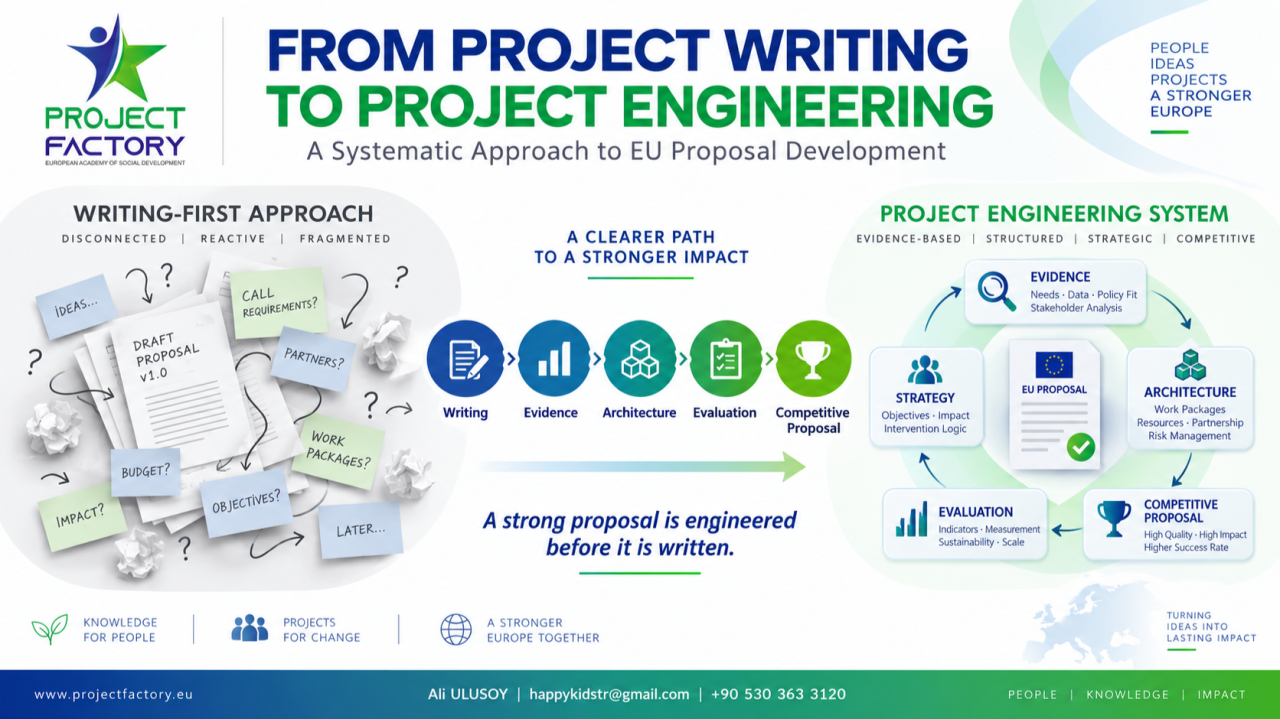
For many years, EU project development has often been treated primarily as a writing task.
A call is identified, a project idea is discussed, partners are brought together, responsibilities are distributed, and eventually someone starts writing the application.
I increasingly believe that this approach is no longer sufficient.
A competitive European proposal should not begin with writing.
It should begin with project engineering.
By project engineering, I mean a structured process in which a proposal is gradually built through evidence, programme intelligence, intervention logic, partnership architecture, measurable results and evaluator-oriented quality control.
Writing is only the final expression of that process.
The Problem with Starting from the Application Form
One of the most common mistakes in project development is opening the application template too early.
The form immediately creates pressure to answer questions such as:
What is the problem
Why is the project needed
Who are the target groups
What will the partners do
What impact will the project create
But if these questions have not already been answered through research, evidence and design, the proposal writer is effectively trying to invent the project while writing it.
This often results in generic needs analyses, weak intervention logic, unrealistic indicators, overlapping partner roles and dissemination sections that are poorly connected to the actual project.
For this reason, over time I have moved towards a different approach.
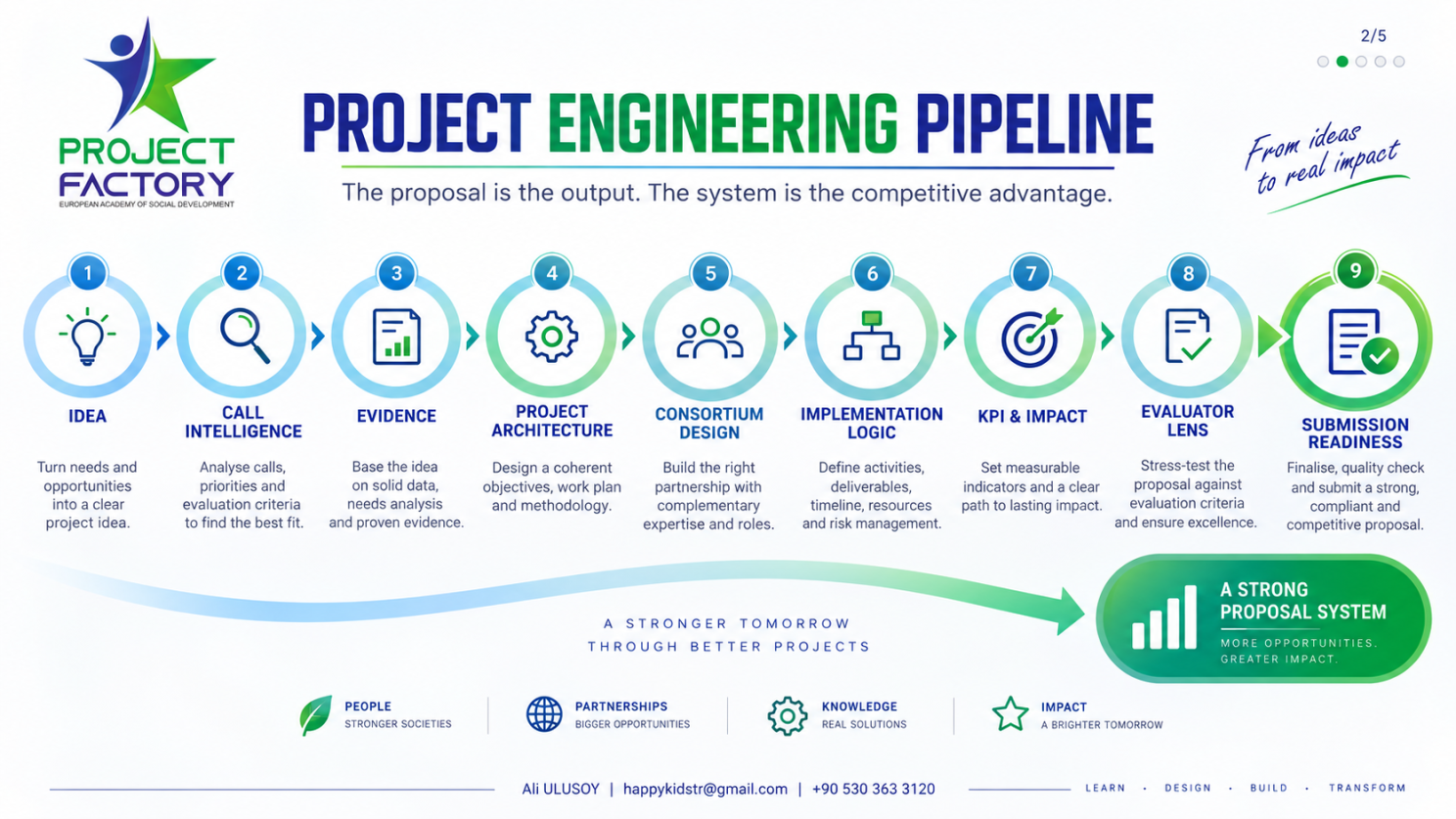
My working logic can be summarised as:
Idea → Call Intelligence → Evidence → Project Architecture → Consortium Design → Implementation Logic → KPI & Impact Framework → Evaluator Lens → Submission Readiness
Each stage should strengthen the next.
1. An Idea Is Not Yet a Project
A project usually begins with an idea.
But even a very good idea is not automatically a fundable project.
The first question should therefore not be:
“Can we write a project about this?”
It should be:
“Is there a clearly evidenced European problem here that this programme is actually designed to address?”
At this stage, ideas should be challenged rather than protected.
Some should be strengthened.
Some should be merged.
Some should be postponed.
And some should simply be abandoned.
A disciplined project development system must be capable of saying no to weak ideas before significant time and resources are invested.
2. Call Intelligence Comes Before Proposal Writing
A project cannot be designed independently from the funding programme.
Every EU programme has its own policy logic, priorities, target groups, expected results and evaluation culture.
For this reason, I treat call analysis as a separate project development stage.
This means looking not only at eligibility conditions and deadlines, but also at:
- programme priorities;
- expected European added value;
- award criteria;
- target groups;
- intervention logic;
- budget model;
- expected outputs and outcomes;
- relevant policy developments;
- related EU strategies and frameworks.
The project should then be shaped at the intersection of a real need and the actual logic of the call.
A strong project is not an idea forced into a funding programme.
It is an intervention that naturally fits the programme.
3. Evidence Must Come Before Claims
One of the most important principles in my current approach is simple:
Do not make a strong claim unless you can explain the evidence that supports it.
A needs analysis should not rely only on general European statistics.
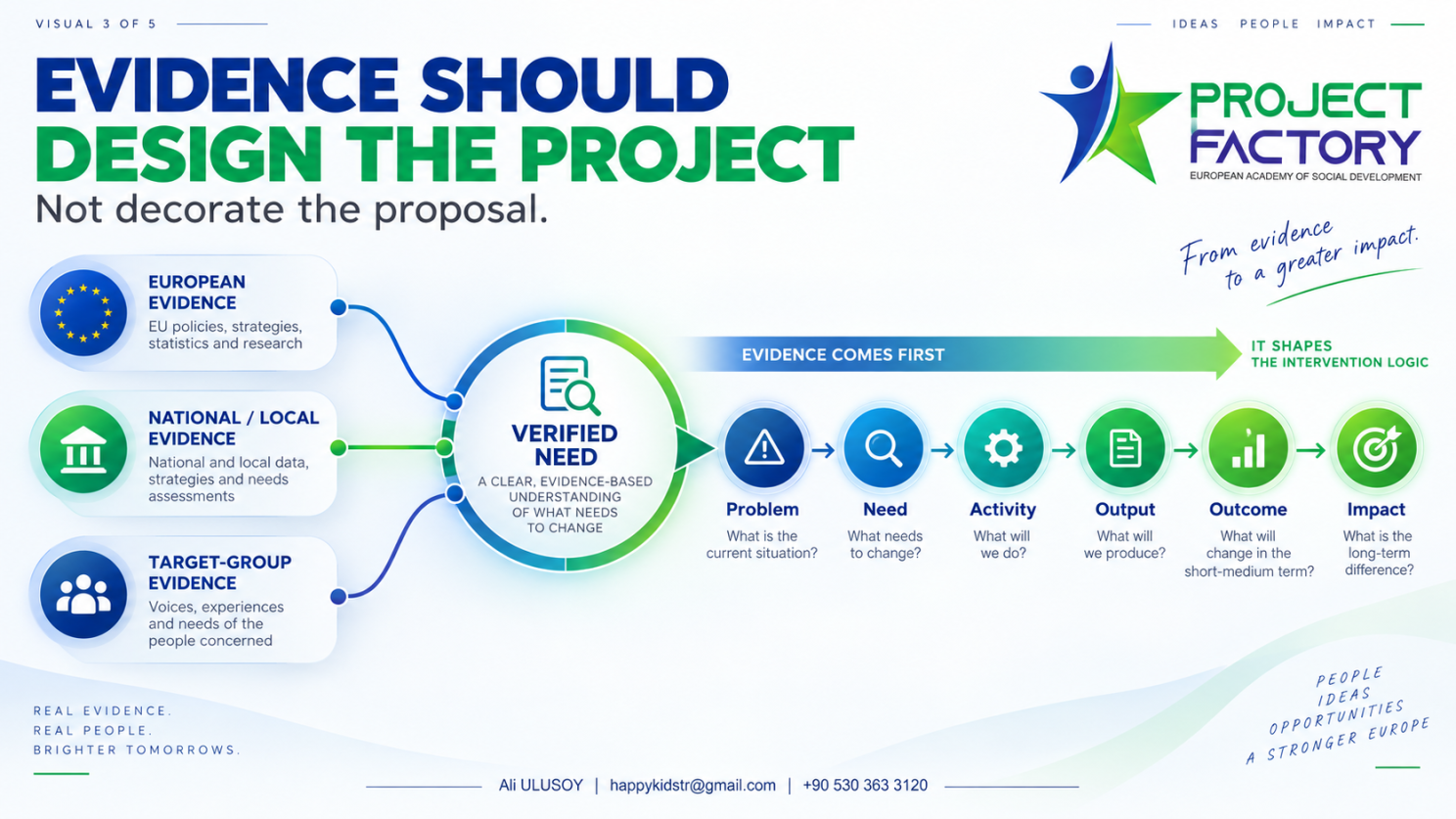
Ideally, it should combine different levels of evidence:
European evidence + national/local evidence + target-group evidence
This evidence may include:
- research reports;
- policy documents;
- surveys;
- interviews;
- focus groups;
- stakeholder consultations;
- organisational data;
- findings from previous projects.
The aim is not to make the proposal look academic.
The aim is to ensure that project activities respond to demonstrated problems rather than assumptions.
In other words:
Evidence should design the project.
It should not merely decorate the proposal.
4. Build the Intervention Logic Before Building the Work Packages
Before activities are divided into work packages, the project should have a clear causal chain.
For example:
Problem → Need → Activity → Output → Outcome → Impact
If this logic is weak, even an attractive project can become difficult to evaluate.
Every major activity should answer three questions:
Why are we doing this
What measurable result will it produce
How will that result contribute to the project objective
This approach also helps prevent a common problem in European projects: impressive lists of activities that are only weakly connected to measurable outcomes.
5. Consortium Design Should Follow Project Needs
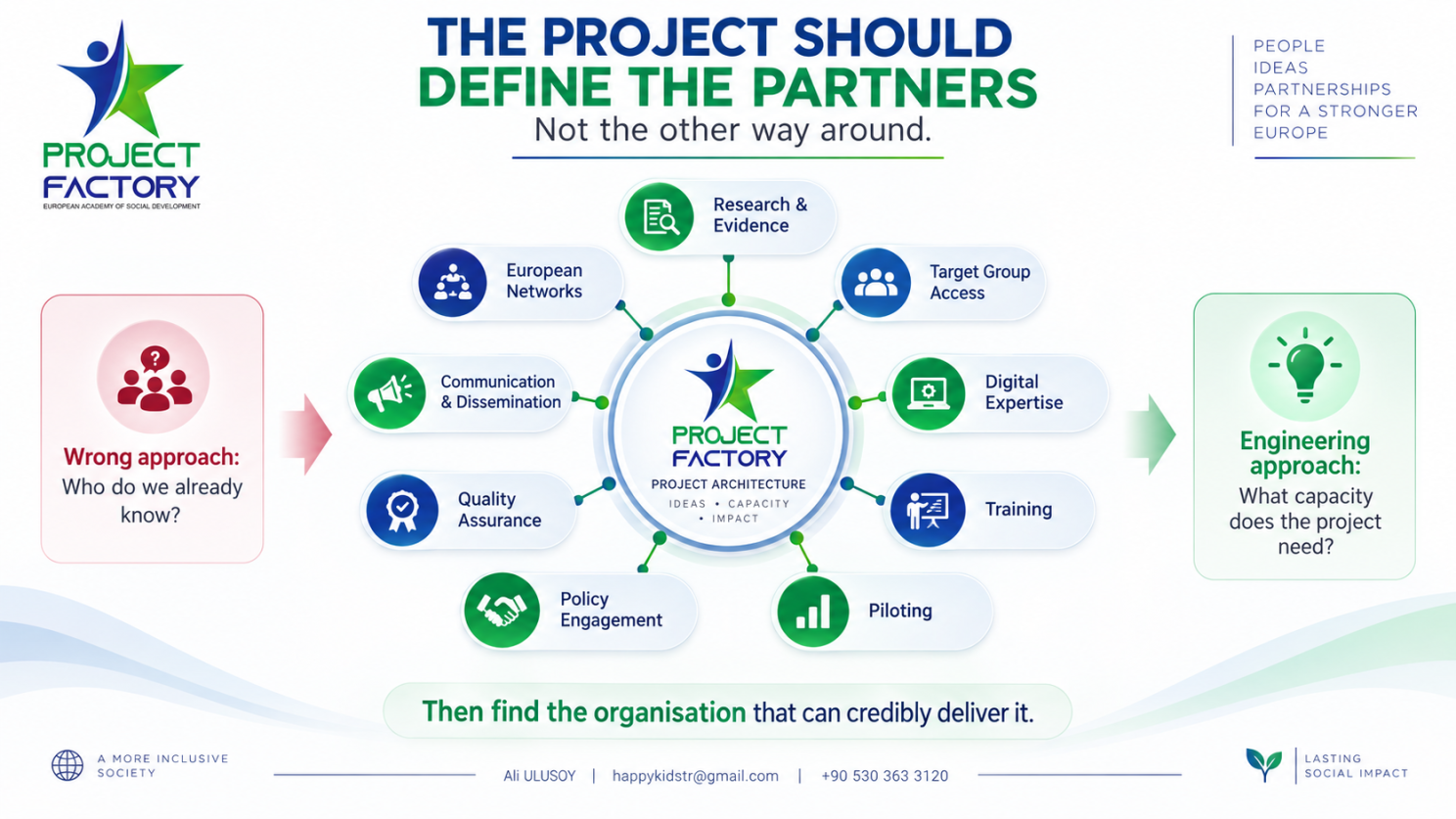
Another important principle is that partners should not define the project.
The project should define the partners.
A consortium should not consist simply of organisations we already know.
Each partner should have a clear reason for being in the project.
A strong consortium may require different capacities, for example:
- research and evidence generation;
- access to target groups;
- technical or digital expertise;
- training capacity;
- policy engagement;
- communication and dissemination;
- piloting environments;
- quality assurance;
- European networks.
The first question should therefore be:
“What capacity is required to deliver this part of the intervention?”
Only then should we ask:
“Which organisation can credibly provide that capacity?”
This produces stronger complementarity between partners and reduces artificial task allocation.
6. Numbers Create Accountability
European proposals frequently use words such as:
increase, improve, strengthen, enhance, empower, support and promote.
These are useful ambitions, but they are not enough.
A strong proposal must translate them into measurable commitments.
Instead of saying:
“The project will improve digital skills.”
the project should eventually answer:
How many participants
Which skills
Measured how
Compared with what baseline
What level of improvement is expected
At what point in the project
What evidence will demonstrate achievement
This is why KPI design should not be left until the final editing stage.
Indicators are part of project architecture.
They force the project team to define what success actually means.
7. Impact Should Be Designed, Not Promised
Impact sections are often written too late.
This leads to generic statements such as:
“The project will have a long-term European impact.”
But impact is not a sentence.
It is a mechanism.
A credible impact strategy should distinguish between several levels:
participants → organisations → local ecosystem → sector → European level
It should also explain what happens after the funding period ends.
Who will continue using the results
Which organisations will integrate them into their regular work
What will remain publicly accessible
Who will maintain digital outputs
Can other organisations replicate the methodology
How will external stakeholders access or reuse the results
Sustainability becomes credible when responsibility, ownership and continuation mechanisms are visible.
8. The Evaluator Lens Changes the Way We Write
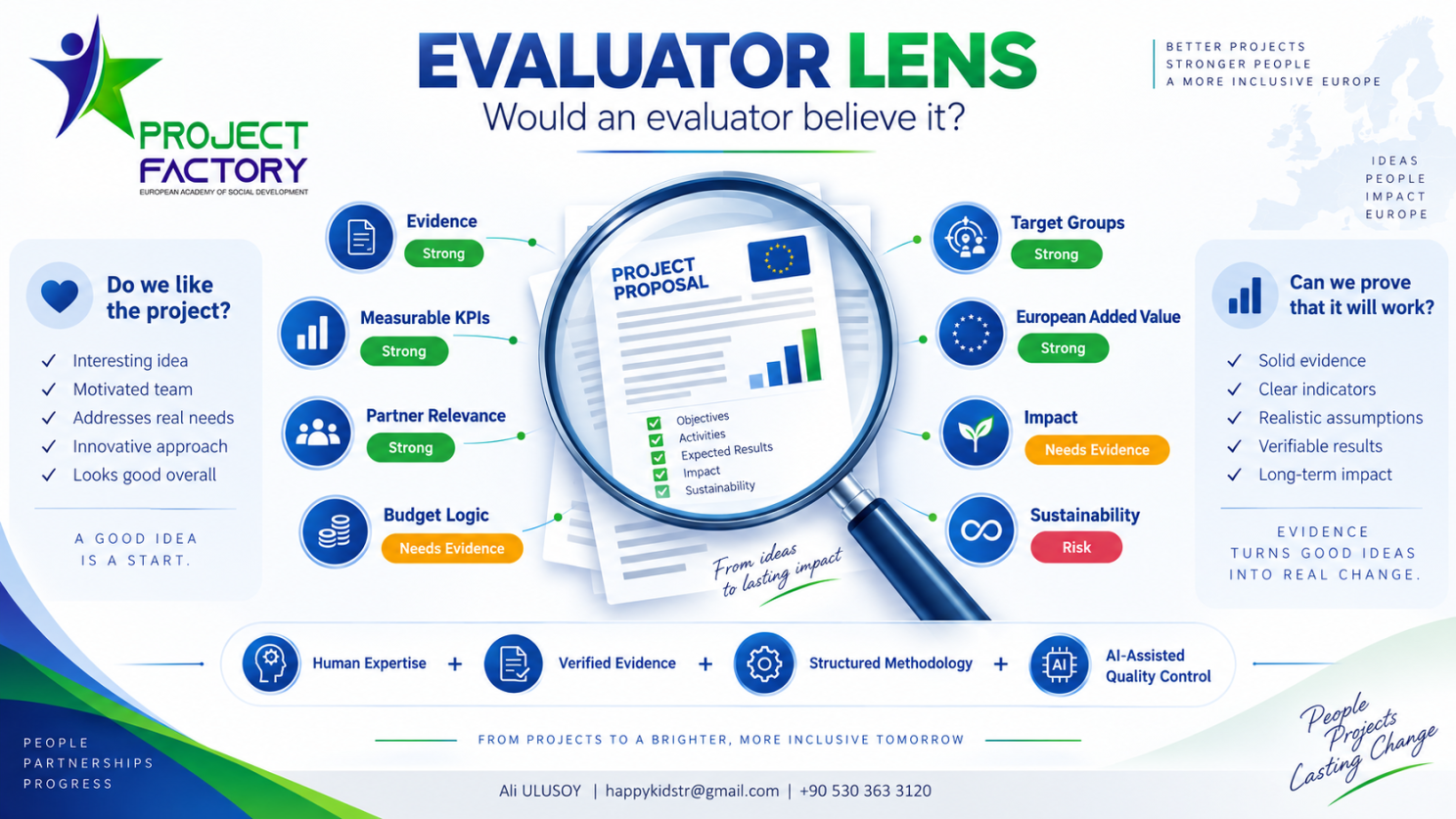
One of the most useful changes in my own project development process has been to stop reviewing proposals only as authors.
At certain stages, we deliberately change roles.
Instead of asking:
“Do we like this project?”
we ask:
“What would an evaluator criticise?”
That produces very different questions.
Where is the evidence
Is this indicator actually measurable
Why is this partner necessary
Does the budget reflect the activities
Is the target group sufficiently defined
Is the European added value real
Can this outcome really be verified
Is sustainability operational, or merely rhetorical
I increasingly regard evaluator simulation as an essential quality-control stage.
A proposal should ideally survive several levels of criticism before submission.
9. AI Can Support the System, but It Should Not Replace Project Thinking
Artificial intelligence is rapidly changing proposal development.
Used correctly, it can support:
- research synthesis;
- consistency checks;
- indicator refinement;
- risk analysis;
- cross-section comparison;
- evaluator simulation;
- language improvement;
- repetition detection;
- quality-control workflows.
But AI should not become the project designer.
It cannot replace genuine needs evidence, organisational knowledge, stakeholder relationships, implementation capacity or strategic judgement.
For me, the useful model is not:
“AI writes the proposal.”
It is:
Human expertise + verified evidence + structured methodology + AI-assisted quality control
These are fundamentally different approaches.
10. From Individual Skill to Institutional System
Perhaps the most important lesson I have learned is that proposal development should not depend entirely on one experienced writer.
If the entire process remains inside one person’s head, it becomes difficult to scale, transfer and reproduce.
The real challenge is therefore to transform experience into a system.
A mature project development structure should gradually create repeatable processes for:
opportunity identification, call intelligence, evidence gathering, concept development, partnership architecture, proposal design, evaluation and submission readiness.
At that point, proposal development becomes less dependent on improvisation.
It becomes an institutional capability.
A Final Thought
A high-quality proposal is not created when someone starts writing.
It begins much earlier.
It starts when we identify the right problem.
It becomes stronger when evidence validates that problem.
It becomes credible when the right organisations are assigned the right roles.
It becomes measurable when outcomes and indicators are defined.
It becomes competitive when the entire design is examined through the evaluator’s eyes.
And only then should the writing begin.
For this reason, I increasingly prefer the term:
Project Engineering
rather than simply:
Project Writing
Because in competitive EU programmes, the quality of the final text is important.
But the quality of the system behind the text is even more important.
Ali ULUSOY Project Factory happykidstr@gmail.com +90 530 363 3120
Who is Ali Ulusoy
Ali Ulusoy is a lawyer, project developer, social entrepreneur and founder of Project Factory, working on the design and development of European Union projects, international partnerships and social innovation initiatives.
His work focuses on transforming project development from a simple writing exercise into a more systematic process based on evidence, call intelligence, project architecture, consortium design, measurable impact and evaluator-oriented quality control.
Through Project Factory and its partner organisations in Türkiye and Europe, he works particularly in the fields of:
- Erasmus+
- Horizon Europe
- CERV and other EU programmes
- Social inclusion and disability
- Youth, education and lifelong learning
- Sport and grassroots participation
- Digital transformation and artificial intelligence
- Entrepreneurship and employability
- Democratic participation
- Green transition and sustainability
A major part of his current work is building what can be described as a project engineering system: a repeatable methodology that connects ideas, evidence, partners, project design, impact measurement and proposal quality into one structured development process.
What can we do together
We can work together in several practical ways.
1. Develop EU project proposals We can identify suitable funding opportunities and transform strong ideas into competitive proposals with clear objectives, work packages, indicators and impact logic.
2. Build international consortia Project Factory can help connect universities, NGOs, SMEs, training organisations, municipalities, sport organisations and other institutions across Europe.
3. Create joint project pipelines Instead of working on a single application, we can build a 12–24 month cooperation pipeline around shared priorities and target groups.
4. Strengthen your project ideas before writing We can jointly assess whether an idea is relevant, evidence-based, fundable and aligned with the selected call before investing significant time in proposal writing.
5. Develop evidence and needs-analysis systems We can design surveys, stakeholder consultations, focus groups, evidence packs and needs analyses that make project proposals more credible.
6. Improve consortium and partner roles We can define which competencies the project actually needs and then identify the most suitable organisations for each role.
7. Apply an evaluator perspective Draft proposals can be reviewed through structured evaluator lenses to identify weak evidence, unclear indicators, weak sustainability, unrealistic roles or missing European added value.
8. Support universities and project offices We can cooperate with universities, TTOs and international offices as an external EU project development partner, helping them develop project pipelines, partner networks and proposal systems.
9. Develop project management and implementation systems For accepted projects, we can support implementation planning, KPIs, evidence collection, dissemination, quality assurance and sustainability.
10. Explore long-term strategic cooperation The strongest model is often not a one-off proposal, but a continuing partnership built around people, ideas, projects and measurable social impact.
In one sentence
Ali Ulusoy and Project Factory help turn good ideas into structured, evidence-based and internationally competitive European projects.
Ali ULUSOY Project Factory happykidstr@gmail.com +90 530 363 3120