Introduction
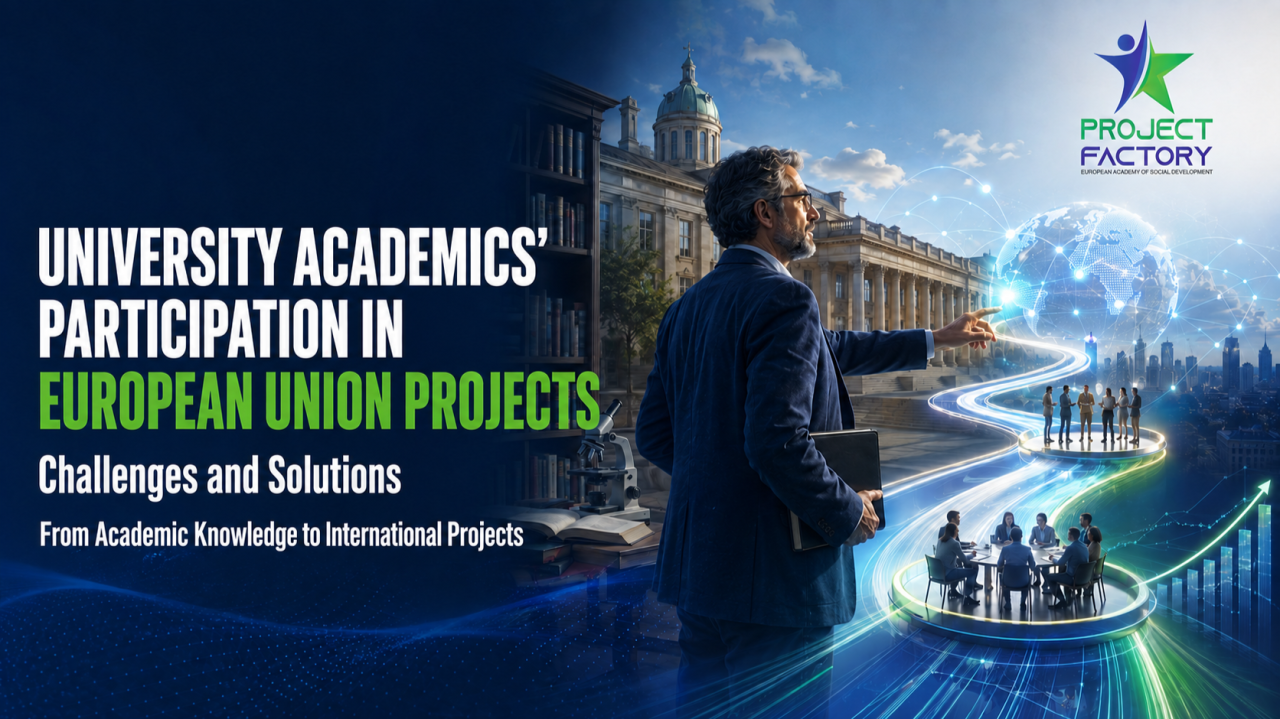
Universities are among the most important actors in European Union projects due to their capacity to produce scientific knowledge, analyse societal challenges, develop innovative methods, and educate highly qualified human resources. Nevertheless, many academics are unable to participate sufficiently in international project processes despite having strong academic backgrounds and valuable research ideas.
This situation is often explained as “academics not knowing how to write projects.” Yet the problem is not limited to proposal-writing techniques. Lack of time, burdensome bureaucratic procedures, difficulty identifying the right call, inability to transform a project idea into a fundable model, limited access to international partners, budget preparation, insufficient institutional support, and the implementation burden after a project is approved create interconnected barriers.
Therefore, the solution is not to expect academics to examine hundreds of pages of call documents and manage the entire project process on their own. A sustainable support system should be established that brings together academics’ scientific expertise with project development, consortium building, budgeting, and implementation capacity.
1. The Gap Between an Academic Idea and a Fundable Project

An academic research idea is not the same as a project idea that can be funded by the European Union. Academics are generally successful at defining a problem scientifically and developing research questions. However, in addition to scientific quality, European Union projects expect a concrete intervention model.
A project proposal must clearly answer the following questions:
- Which societal or sectoral problem will be addressed
- Which groups are affected by the problem
- Why are existing practices insufficient
- What innovation does the proposed method introduce
- In which countries and with which institutions will it be implemented
- What will change by the end of the project
- Which indicators will be used to measure this change
- How will the results be sustained after the project ends
While academic studies often focus on analysing a problem, European Union projects require a comprehensive structure extending from analysis to implementation and measurable impact.
Proposed solution: Project transformation workshops
Academics’ research topics should not be transferred directly into lengthy application forms. Instead, short and structured project transformation workshops should first be organised.
During these workshops, the academic idea should be addressed through the following chain:
Area of expertise → Problem → Evidence → Target group → Solution model → Pilot implementation → Output → Outcome → Impact
At the initial stage, preparing a two-page concept note instead of a five- to seven-page application form allows the idea to be assessed more quickly. Suitable concepts can then be developed into detailed proposals.
2. Difficulty Identifying the Right Programme and Call
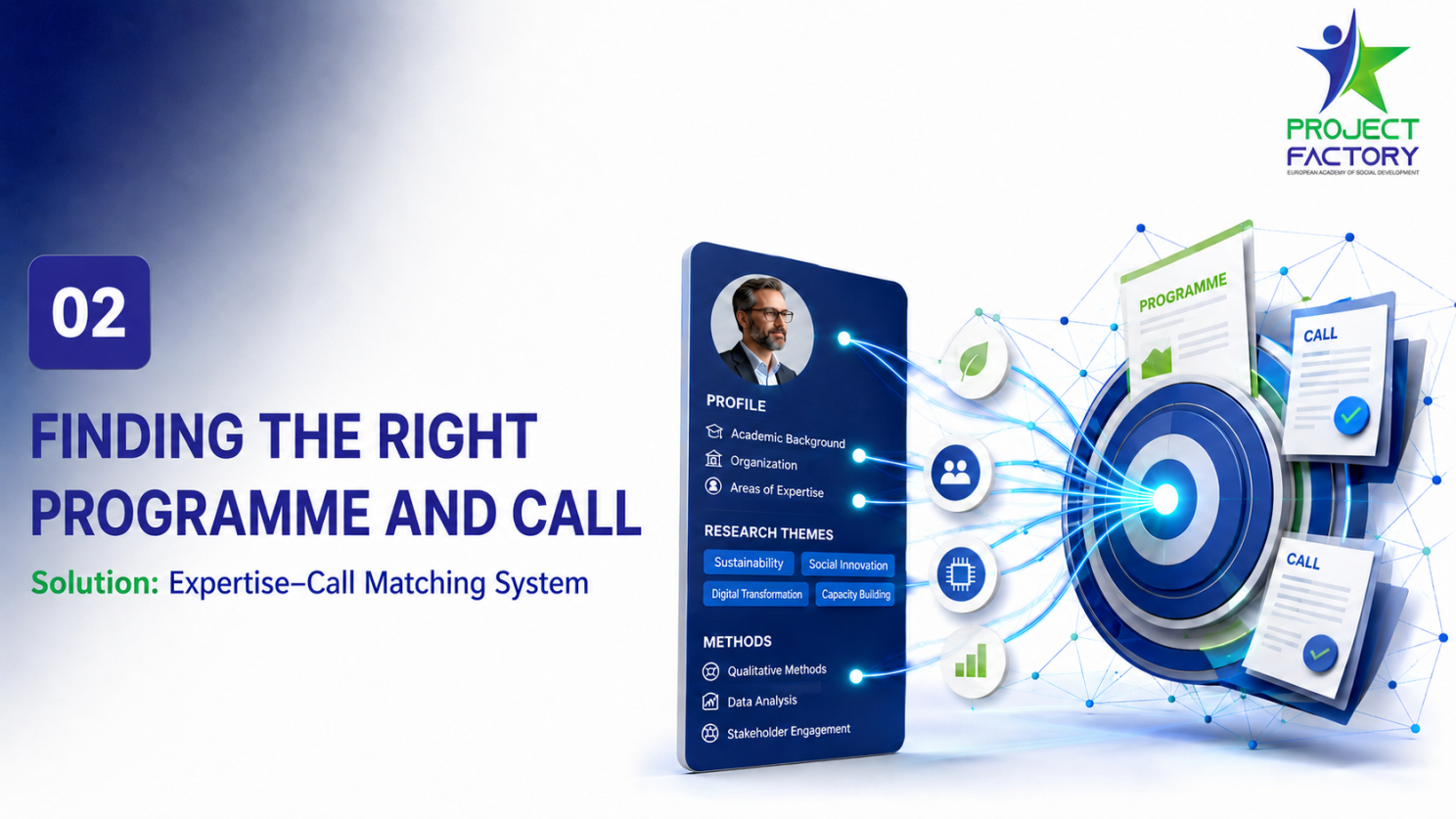
The European Union funding system consists of Horizon Europe, Erasmus+, EU4Health, Digital Europe, Interreg, COST, and many other programmes. Each programme has different objectives, target groups, eligibility conditions, partnership structures, and evaluation criteria.
Having a strong idea does not mean that it is suitable for every programme. Even a strong project idea may fail if submitted to the wrong programme. Academics often become aware of calls too late, focus only on the call title, or discover eligibility requirements at an advanced stage of proposal preparation.
Proposed solution: An academic expertise–call matching system
Universities should establish a system that does more than announce calls; it should match academics’ expertise with relevant opportunities.
A short project profile can be created for each academic, including the following information:
- Area of academic expertise,
- Priority research topics,
- Methods they can apply,
- Data and research infrastructure available to them,
- Target groups they can work with,
- National and international connections,
- Pilot implementation capacity,
- Roles they can undertake in a project.
These profiles should be matched regularly with open calls. This would allow academics to focus only on opportunities that closely align with their expertise instead of having to monitor every funding programme.
3. Lack of Time and Academic Workload

Academics work under intense pressure, balancing teaching, examinations, thesis supervision, scientific publications, administrative duties, and personal responsibilities. Preparing a European Union proposal requires systematic work over weeks and sometimes months.
Preparations that begin in the final weeks before a deadline place considerable pressure on academics. As a result, many academics withdraw even when interested in a project idea because they believe they cannot allocate the time required by the process.
Proposed solution: A project team based on shared roles
Academics should not be expected to write the entire proposal on their own. The project preparation process should be divided among different areas of expertise.
Area of responsibilityProposed leadScientific content and methodologyAcademicCall analysis and eligibilityProject development teamNeeds analysis and evidenceAcademic and research teamConsortium buildingInternational project teamWork packages and activity planJoint working groupImpact, dissemination, and sustainabilityProject experts and stakeholdersBudget and administrative documentsProject office and finance unitFinal quality controlReview team applying an independent evaluator’s perspective
Under this model, the academic retains scientific leadership without having to bear the entire administrative and technical burden alone.
4. Project-Writing Language Differs from Academic Writing
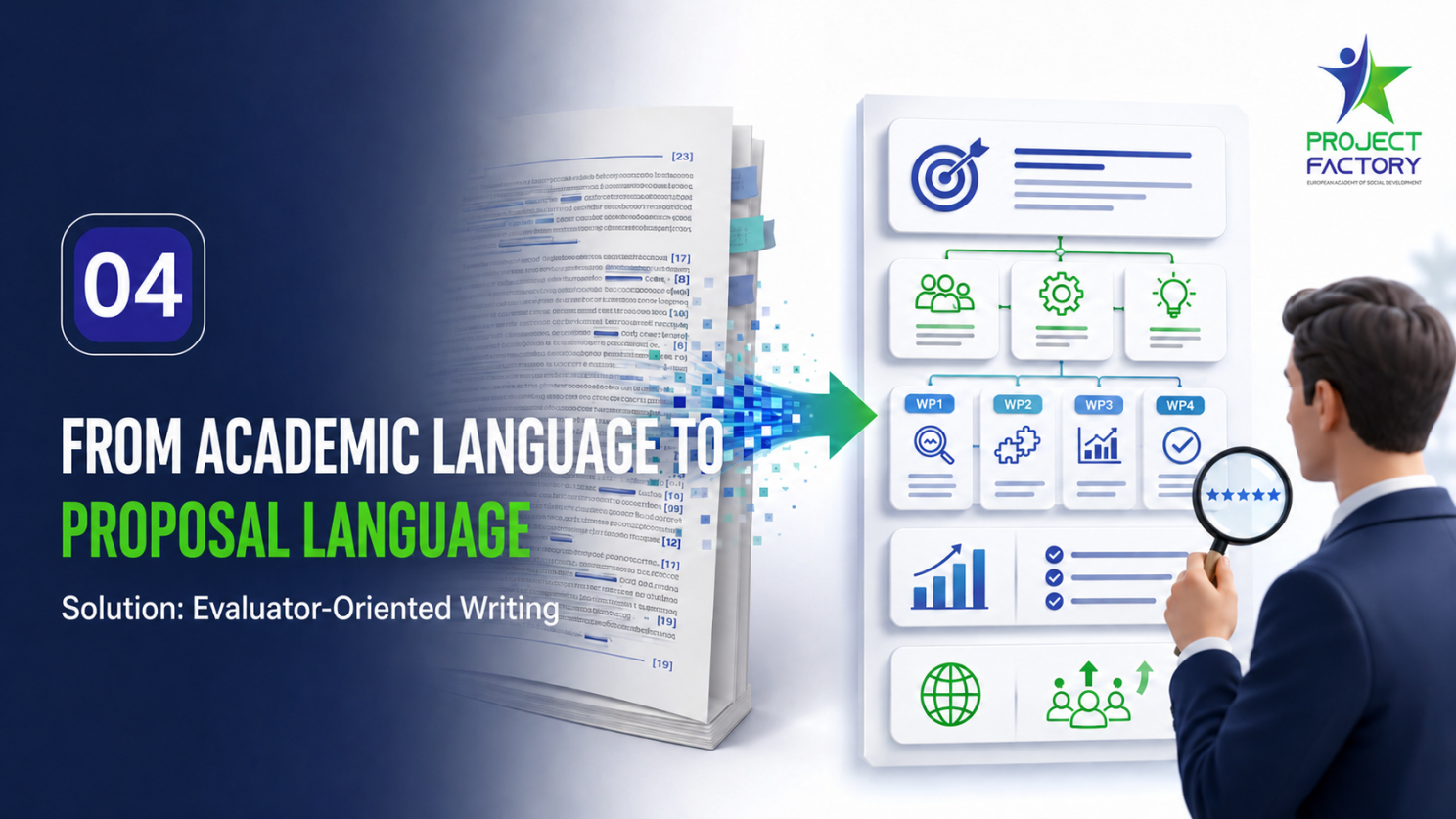
Academic articles emphasise the theoretical framework, literature, methodology, and scientific discussion. European Union project proposals, by contrast, centre on clear objectives, activities, responsibilities, deliverables, indicators, risks, and expected impacts.
Consequently, even very strong academic texts may receive low scores if they are not written in line with project evaluation logic. Evaluators consider not only the scientific merit of an idea but also its feasibility, European added value, the complementarity of the partners, and how the results will be used.
Proposed solution: An evaluator-oriented writing system
The proposal should not answer only the question, “What do we want to do?” Each section should also take the evaluator’s likely questions into account:
- What evidence supports the claims
- Are the objectives measurable
- Are the activities sufficient to achieve the objectives
- Does every partner have a genuine and necessary role in the project
- Is the budget aligned with the activities
- Are the risks identified realistically
- Will the results be used after the project ends
- Why is cooperation among European countries necessary
Before submission, the proposal should be scored against the call’s official evaluation criteria, and weak sections should be rewritten.
5. Lack of Reliable Evidence and Needs Analysis
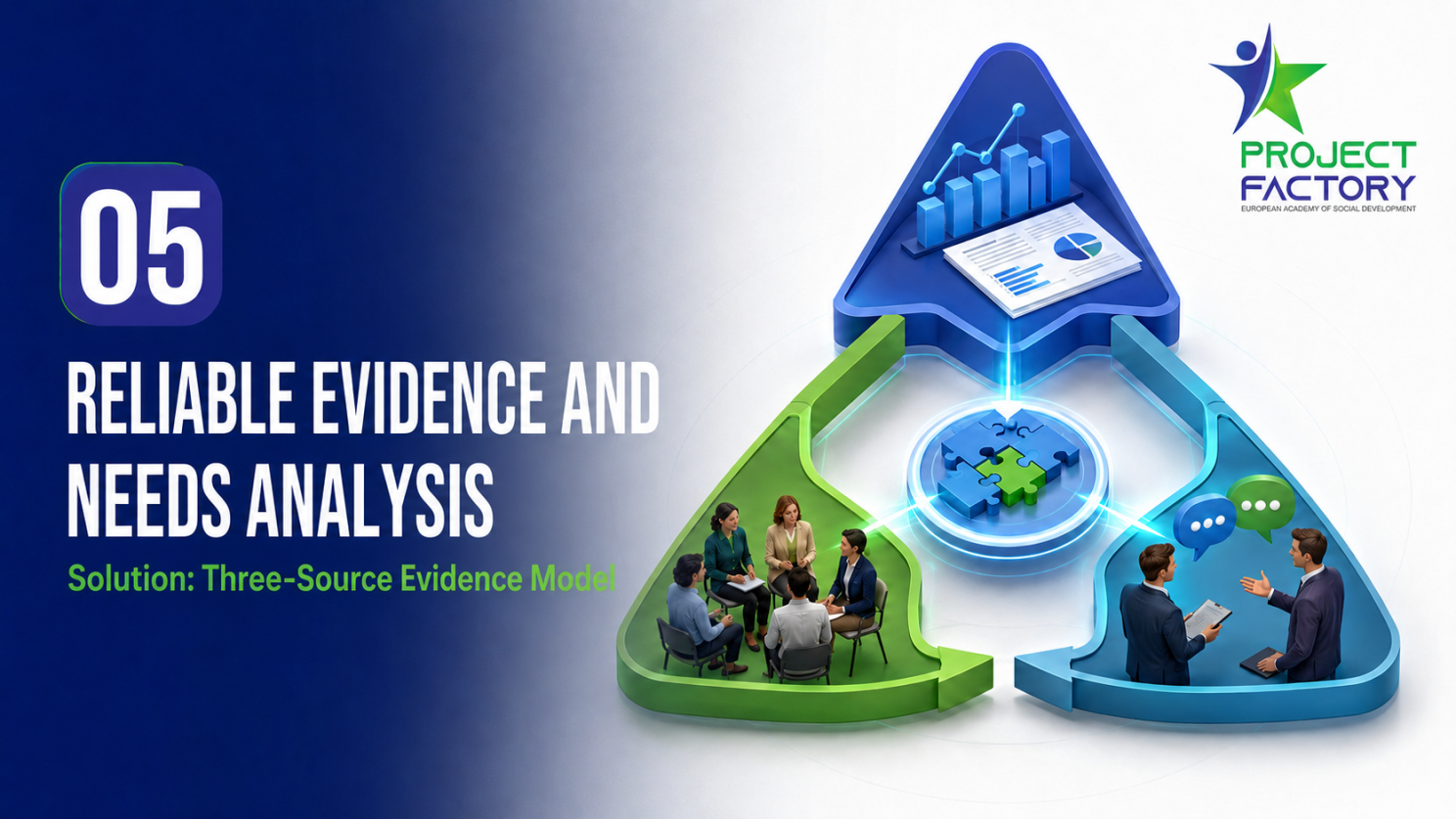
Many project proposals remain weak because they are not supported by sufficient data, even though they address important problems. General statements such as “the older population is increasing,” “disadvantaged people cannot access services,” or “healthcare professionals need training” are not sufficient on their own.
European Union projects are expected to demonstrate the problem through current data, field findings, and the views of relevant stakeholders.
Proposed solution: The three-part evidence model
Project ideas should be based on three types of evidence:
- Desk research: Official statistics, academic publications, policy documents, and existing reports.
- Field evidence: Surveys, interviews, focus group meetings, and institutional data.
- Stakeholder validation: Consultations with public institutions, professional bodies, civil society organisations, service providers, and target groups.
For example, academic literature alone is insufficient for a project on elderly care or home healthcare services. The experiences of older people, family caregivers, healthcare professionals, local authorities, and relevant public institutions should also be incorporated into the project design.
6. Difficulty Building an International Consortium

In European Union projects, bringing together strong institutions is not enough. Partners must complement one another, and each must undertake a meaningful role within the project.
Academics may have individual international connections, but these contacts are not always ready to become project partners. Some institutions may be scientifically strong yet lack capacity in project management, pilot implementation, access to target groups, or dissemination.
Proposed solution: Complementary partnership architecture
The consortium should be built through a balanced combination of the following roles:
- Scientific and academic partners,
- Public authorities and policymakers,
- Civil society organisations,
- Field organisations with access to target groups,
- Technology or digital solution providers,
- Vocational education and capacity-building organisations,
- Communication and dissemination partners,
- Impact measurement and evaluation experts.
For example, in a project on elderly care, an academic specialising in health economics could lead the scientific framework and cost-effectiveness analysis. A public institution could contribute to the policy and service-system dimension; a municipality or healthcare provider to pilot implementation; a civil society organisation to reaching older people and their families; and a technology partner to developing digital monitoring or support tools.
7. Bureaucratic and Financial Processes Within the University

Even when a project idea is strong, signature, authorisation, budget, procurement, staff assignment, ethics committee, data protection, and contractual procedures can cause significant delays. Requiring academics to follow these processes alone leads to a loss of motivation.
In particular, the financial and administrative responsibilities that may arise after project approval can cause some academics to distance themselves from the project during the proposal stage.
Proposed solution: Institutional support through a single point of contact
Instead of requiring academics to communicate separately with different units, universities should establish a single project contact point. This structure should:
- Check eligibility and application documents,
- Manage the institutional approval timetable,
- Prepare budgets and staff costs,
- Review legal and financial risks,
- Plan ethics committee and data protection requirements,
- Support the implementation team once the project is approved.
It is critical to initiate institutional procedures during the concept-development stage rather than leaving them until the final week before submission.
8. Inadequate Incentive Systems
Scientific publications are often more visible than European Union project development activities in academic career assessments. A proposal that is unsuccessful despite months of work may receive limited academic recognition.
This reduces the willingness to apply, particularly to programmes with low success rates.
Proposed solution: Recognising project development efforts
Universities should regard not only approved projects but also the preparation of high-quality proposals that have passed quality control as part of academic performance.
The following incentives can be introduced:
- Temporary reduction in teaching and administrative workload,
- Project preparation support,
- Application and coordination incentives,
- Research assistant or technical staff support,
- Travel support for international partnership meetings,
- Institutional recognition for successful project teams,
- Recognition of project outputs in academic promotion and performance systems.
9. Concerns About Implementation After Project Approval

Some academics are more concerned about the management responsibilities that will arise if a project is approved than about preparing the proposal itself. Financial reporting, meetings, outputs, timelines, partner coordination, and audit procedures can create a serious burden for academics.
Proposed solution: Continuous support from writing to implementation
The project development system should not end when the proposal is submitted. The structure established during preparation should be transferred to the implementation process.
To achieve this:
- A detailed project implementation handbook should be prepared,
- Responsible persons should be assigned for each work package,
- Deadlines and indicators should be monitored digitally,
- Academic and administrative roles should be separated,
- Regular risk and progress meetings should be held,
- Standard templates should be used for reporting.
While the academic focuses on scientific quality and content leadership, the project manager should oversee the operational process.
10. How Can Academics Be Involved in the Project Process

It is not always appropriate for an academic with no previous experience in European Union projects to begin by coordinating a large project. Participation should be designed progressively according to the individual’s experience and level of interest.
First stage: Expert contribution
The academic may contribute to a project’s needs analysis, scientific framework, methodology development process, or advisory board.
Second stage: Task or activity leadership
The academic may be responsible for a specific research activity, training programme, field study, evaluation activity, or policy analysis.
Third stage: Work package leadership
The academic may manage a work package such as research, impact assessment, health economics analysis, an education model, or policy recommendations.
Fourth stage: Institutional partnership leadership
The academic may coordinate all the university’s responsibilities within the project and work directly with international partners.
Fifth stage: Project coordination
Once the necessary experience, team, and institutional support have been established, the academic may coordinate a larger European Union project.
This progressive model enables academics to learn project processes through practice and increase their responsibilities in a controlled manner.
11. Project Factory’s Proposed Cooperation Model
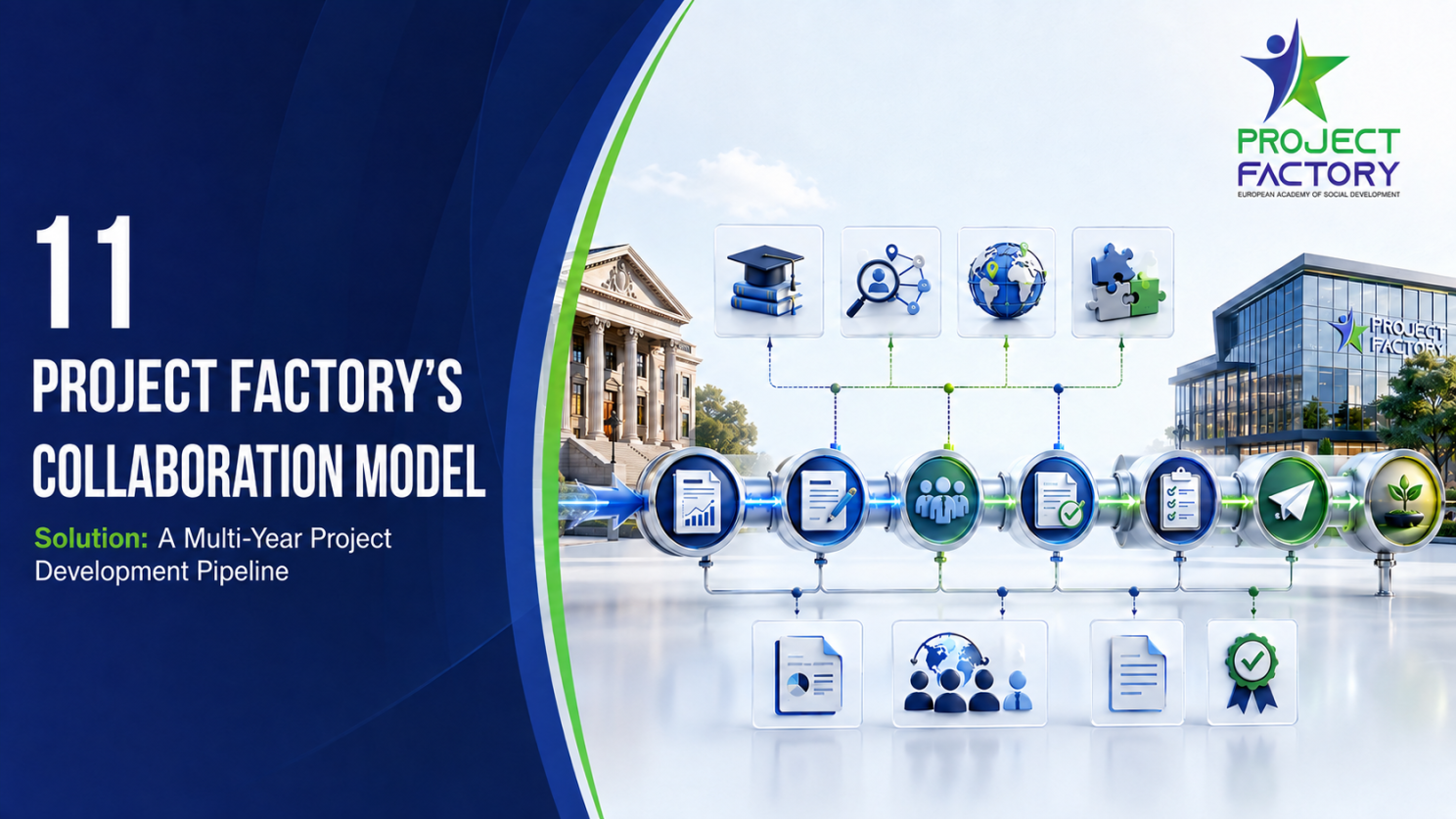
University–Project Factory cooperation should not be based solely on writing a proposal a few weeks before a submission deadline. A more effective model is to establish a multi-year project development pipeline.
The proposed system consists of the following stages:
- Mapping academics’ expertise and project potential,
- Identifying priority thematic areas,
- Matching relevant European Union programmes,
- Conducting needs analyses and stakeholder consultations,
- Preparing short concept notes,
- Scoring concepts against evaluation criteria,
- Establishing the international partnership structure,
- Preparing the detailed proposal and budget,
- Conducting an independent quality and evaluator review,
- Jointly managing submission, implementation, and new project opportunities.
Under this approach, the academic is not left alone. Academic knowledge, project development expertise, institutional support, and international partnership capacity are combined within a single system.
12. A Model Applicable to Health Economics and Elderly Care
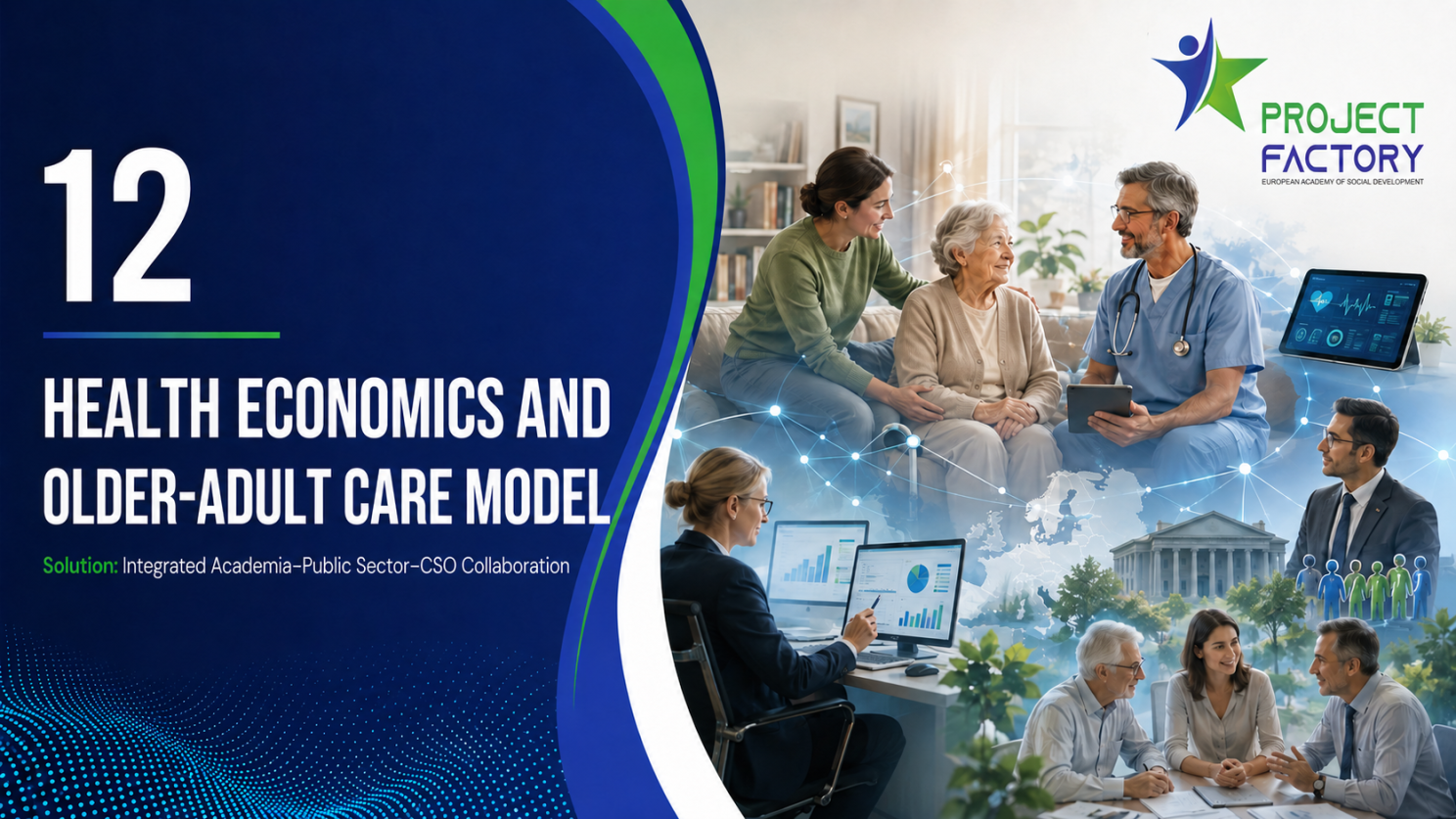
Health economics, elderly care, home healthcare services, and access to services for disadvantaged groups are fields that require cooperation among academia, public authorities, civil society, and technology actors.
A project pipeline developed around these themes could include:
- Cost-effectiveness analysis of home healthcare and care services,
- Measuring older people’s access to health and social care services,
- Reducing the economic and psychosocial burden on family caregivers,
- New training models for healthcare professionals,
- Integrated care models for people with disabilities and older people,
- Access to services in rural areas and disadvantaged communities,
- Digital health and remote support applications,
- Redesigning public services based on user experience,
- Rare diseases and long-term care policies,
- Policy recommendations aimed at reducing health inequalities.
For example, an academic such as Prof. Dr. X Y, with expertise in health economics, pharmacoeconomics, public policy, and healthcare systems, could progressively take part in these projects as a scientific adviser, research leader, lead for health economics analysis, work package leader, or university coordinator.
Conclusion
The fundamental problem limiting academics’ participation in European Union projects is not a lack of ideas or academic competence. The real challenge is the insufficient development of support systems capable of transforming academic knowledge into fundable, feasible, and measurable international project models.
It is unrealistic to expect academics to act simultaneously as scientists, proposal writers, consortium managers, budget experts, and administrative coordinators. Success is possible through appropriate role sharing, early preparation, institutional support, strong evidence, complementary partnerships, and evaluator-oriented quality control.
Av. Ali ULUSOY
Proje Fabrikası Kurucusu / President of Project Factory
Engelsiz ve Mutlu Yaşam Derneği Başkanı / President of Barrier Free and Happy Life Association
Kocatepe Mahallesi Hatay Sokak 4/ 19 - 20,
Sabancı İş Merkezi 5. kat, 06420
Çankaya - ANKARA
Mobil: (+90 530) 363 3120