Introduction
In the competitive landscape of European Union funding programmes, producing a strong, evaluator-ready concept note is not merely a matter of writing. It is a systematic process that combines structured guidance, partner contributions, methodological rigour, and award criteria alignment. At Project Factory (Proje Fabrikası), we have designed and implemented a unique “New Project Writing System”, where AI and human expertise converge. This system ensures that every concept note – even under tight deadlines – reflects both the collective intelligence of partners and the highest standards of Erasmus+ evaluation.
This article traces how a 3000-word KA210 concept note was developed step by step. It highlights the pathways followed, the files and templates activated in the background, and the distinctive Project Factory methodology that turned scattered inputs into a coherent, fundable project vision.
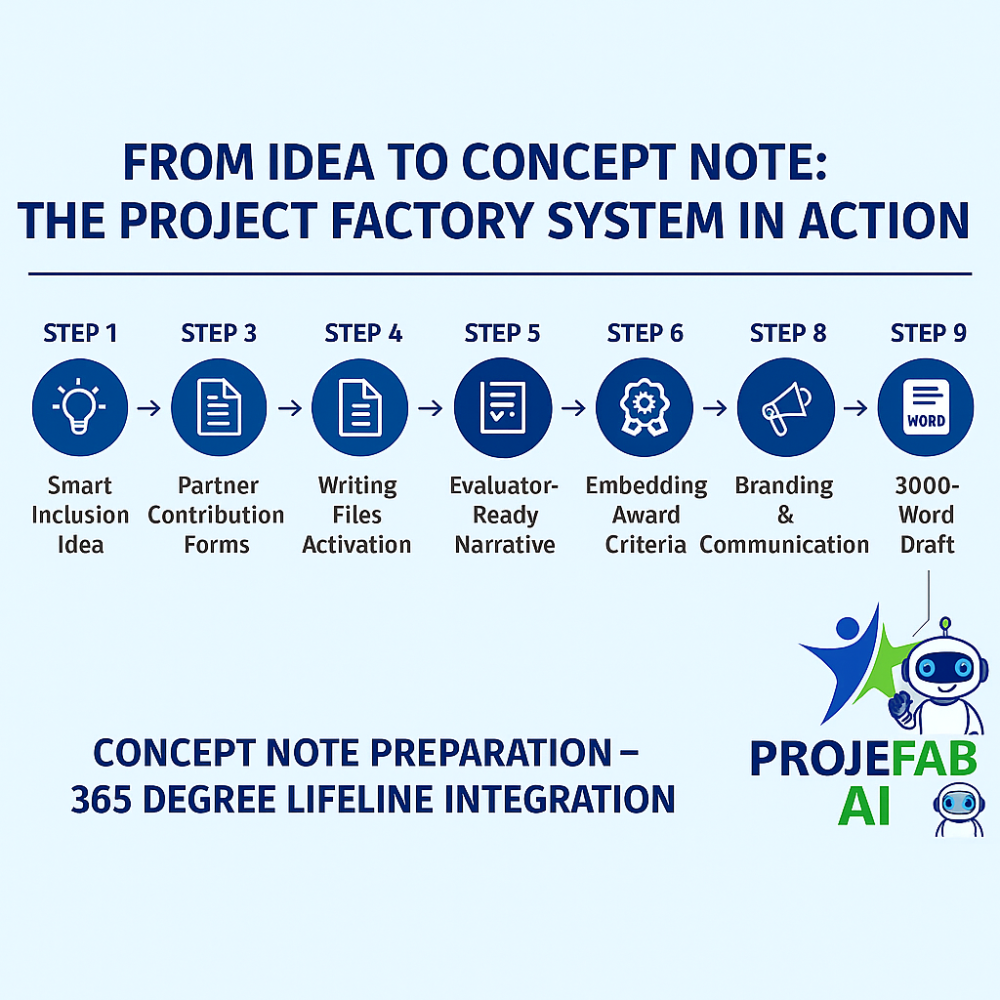
Step 1: Foundation – The Smart Inclusion Idea
The starting point was the document “Smart Inclusion: AI for Migrants & Elderly in Social Integration”. This text captured the raw idea: bridging the digital and social gaps faced by two vulnerable groups – migrants and elderly citizens – through artificial intelligence and tailored learning pathways. It provided a problem statement, identified target groups, and outlined potential activities. However, it lacked the structure, evidence base, and evaluator-oriented framing required by Erasmus+.
At Project Factory, such drafts are treated as the “seed”. Our system does not overwrite the seed but rather nurtures it by embedding it into structured templates, aligning it with EU policy references, and translating it into award-criteria language.
Step 2: Partner Contribution Forms (PIFs) Integration
The second building block came from Partner Information Forms (PIFs):
- EMYD (Türkiye) brought expertise in working with disadvantaged groups and disability inclusion.
- Phoenix Knowledge Wings (Germany) added experience in adult education, integration, and pedagogy.
- Applicant from Malta contributed coordination and dissemination capacity.
- Glandrive (Netherlands) added technological know-how, particularly in AI and digital tools.
In the Project Factory system, PIFs are never used as static background documents. Instead, they are mined for evidence: past experiences, institutional capacity, thematic expertise, and connections to target groups. These elements are then distributed across the concept note to substantiate roles, justify activities, and enhance credibility.
This process is automated by the Partner Contribution Forms Ultimate Pack, which ensures that no partner’s strength is overlooked and that every contribution is tied to a concrete section of the proposal.
Step 3: Activation of the New Project Writing Files
The uniqueness of the Project Factory system lies in the activation of a library of tailored prompts and guides. For this concept note, the following files were central:
- 📍 Full Prompt – Partner Contribution Forms Ultimate Pack ile AI Entegrasyonu.pdf Provided the overall workflow and integration logic.
- Partner_Contribution_Forms_Ultimate_Pack_v30_README.pdf Explained how to translate PIF inputs into proposal-ready text.
- Master_Prompt_Template-v8.pdf Defined the narrative voice: fluent, human-like, aligned with evaluators’ expectations.
- Erasmus+ Master Prompt Guide – Updated 2026.pdf Offered up-to-date framing aligned with Erasmus+ 2026 award criteria.
- UPDATED-KA210 -PROMPT.docx Provided KA210-specific question mapping and activity-based logic.
- 📑 KA210 Small-scale Partnership Prompt Konsept Notu Şablonu (1).pdf Shaped the structure (Background → Objectives → Target Groups → Activities → Impact).
- 📑 365 Degree Lifeline Entegrasyon Rehberi.pdf Ensured logical consistency across Needs ↔ Objectives ↔ Activities ↔ Outputs ↔ Impact.
- 📑 Erasmus+ Bütçe Planlama (KA220 & KA210).pdf Guided the €60,000 fixed-budget narrative and proportional allocation.
By layering these documents, the system created a multi-dimensional writing environment: one file ensured evaluator language, another ensured logical flow, another enforced partner integration, and yet another checked budget plausibility.
Step 4: The Project Factory Logic – Narrative Without AI Traces
One of the major risks in today’s funding environment is the over-reliance on generative AI outputs that evaluators can detect. Project Factory’s system is designed to avoid this pitfall. It employs Master Prompt Templates that force the text into natural, human-like, evaluator-friendly paragraphs.
Instead of listing bullet points or abstract jargon, the narrative flows as a story:
- Why the problem matters.
- How EU policies demand a response.
- What partners can concretely deliver.
- How activities logically generate outputs and impact.
This storytelling-with-evidence style makes the text persuasive while concealing any trace of automation.
Step 5: Activity-Based Planning (not Work Packages)
For KA210 projects, the system avoids the work-package logic used in KA220. Instead, it produces activity-driven plans. In this case, seven activities (A1–A7) were defined:
- Setup and baseline assessment.
- Focus groups and needs validation.
- Co-design and AI assistant development.
- Facilitator clinics and micro-credentialing.
- Community training cycles.
- Transnational peer exchange.
- Dissemination and closing forum.
Each activity included outputs, milestones, and indicators, ensuring measurability and evaluator readiness. This reflects the 365 Degree Lifeline Entegrasyon principle: every activity links back to the chain of Needs → Objectives → Outputs → Impact.
Step 6: Embedding Award Criteria
The concept note systematically embedded the Erasmus+ award criteria:
- Relevance (30%) → Clear link to digital transformation, inclusion/diversity, EU policies (Digital Education Action Plan, European Pillar of Social Rights).
- Quality of Design (30%) → Logical activity chain, appropriate methods (simulate–practice–do), and robust monitoring.
- Partnership & Cooperation (20%) → Complementary expertise proven via PIF data.
- Impact & Sustainability (20%) → KPIs (240 learners, 36 facilitators), sustainability plan (open resources, KA220 scaling).
By pre-structuring the concept note around these criteria, the system ensured maximum scoring potential.
Step 7: Monitoring, Risks, and Sustainability
The Project Factory system requires that every concept note includes:
- A Risk Matrix (recruitment, digital access, trust in AI, drop-out, ethics).
- A Monitoring & Evaluation plan (before/after tests, task checklists, facilitator uptake).
- A Sustainability strategy (open access resources, integration into partner curricula, follow-on KA220 application).
These sections are often neglected in small-scale projects, but the system elevates them as central to evaluator trust.
Step 8: Branding and Communication
Unlike standard applications, Project Factory embeds branding and communication design even at the concept stage. The PROJEFAB AI logo was integrated into infographics, reinforcing the project identity. Communication is not an afterthought but a parallel track: stories of change, policy briefs, and online forums are included as planned deliverables.
Step 9: The 3000-Word Draft
Finally, all inputs were assembled into a 3000-word continuous narrative. The text avoided redundancy, maintained natural flow, and connected every claim with either partner evidence, policy references, or measurable KPIs. The effort was not just to meet the word count but to deliver a coherent evaluator-ready document.
Conclusion: The Project Factory Advantage
Producing a 3000-word KA210 concept note was not a linear writing exercise. It was the outcome of a systematic, layered process where multiple files, templates, and prompts worked together in the background.
The Project Factory System ensures:
- Every partner’s capacity is highlighted.
- Every activity is logically linked to outputs and impact.
- Every sentence is evaluator-ready and human-like.
- Every project aligns seamlessly with Erasmus+ priorities.
This methodology transforms project writing from an art into a science of structured creativity, where innovation, inclusion, and digital transformation are not abstract values but concrete deliverables.
In sum, the preparation of the 3000-word Smart Inclusion concept note demonstrates how the 365 Degree Lifeline Entegrasyon and the Project Factory System together create a reproducible, high-quality pipeline for winning EU projects.
Ali ULUSOY
WhatsApp +90530 363 3120
https://secure.smore.com/n/ar9he-project-factory