
The Country Baseline Trigger Matrix:
A Structured Method for Evidence-to-Design Translation in Transnational EU Projects
Ali ULUSOY Project Factory Email: happykidstr@gmail.com
Draft Manuscript — Version 1.0 September 2026
Abstract
Transnational European projects are routinely expected to demonstrate that proposed interventions respond to genuine needs, reflect the circumstances of participating countries and target groups, add value at European level, and generate results that are transferable across contexts. In practice, however, needs analysis frequently remains disconnected from project architecture. Country statistics may be collected before implementation contexts are confirmed, national averages may be used as substitutes for local evidence, and contextual differences may be described without demonstrating how they alter activities, delivery mechanisms, indicators, or transfer strategies.
This paper introduces the Country Baseline Trigger Matrix (CBTM), a structured method developed within the Project Factory Evidence-Informed Design approach to address this evidence-to-design gap. The method introduces a central rule: the presence of a potential partner in a country does not by itself justify treating country-level information as proposal evidence. A country evidence stream is activated only when an eligible beneficiary, implementation, or pilot context has been sufficiently confirmed.
Once triggered, the framework requires evidence to progress through a structured sequence comprising source selection, national and subnational baseline development, institutional baseline validation, target-group evidence, explicit identification of contextual differences, and translation of those differences into project-design consequences. The proposed logic can be expressed as:
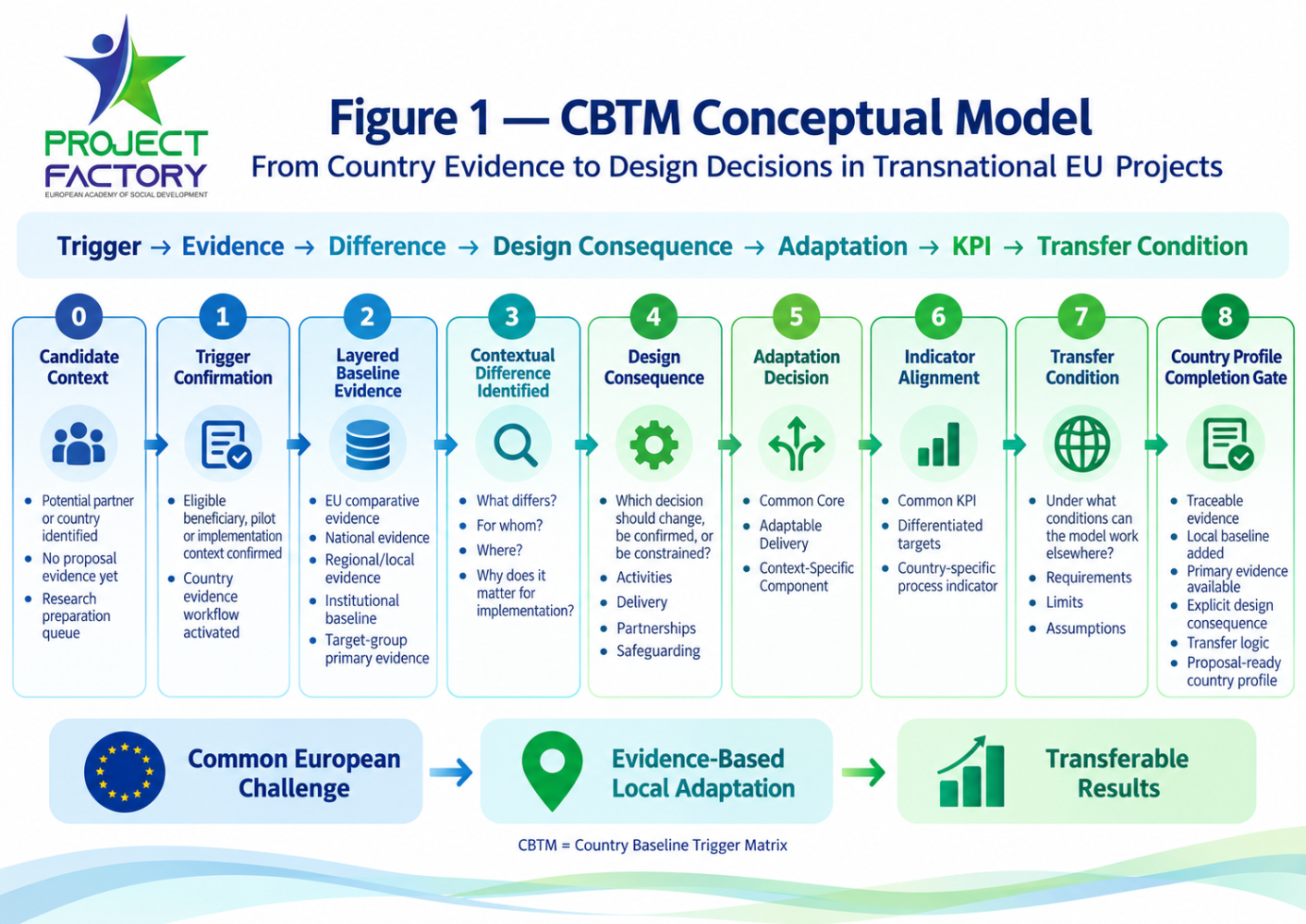
Trigger → Evidence → Contextual Difference → Design Consequence → Adaptation → Indicator → Transfer Condition
The framework is illustrated through its provisional application to transnational youth-project concepts covering rural youth development, artificial-intelligence-enabled entrepreneurship, green employment, media literacy and fact-checking, civic technology, disability and digital participation, peer-support navigation, and migrant-youth integration. These cases demonstrate how a common European intervention architecture may coexist with evidence-based local adaptations.
The paper argues that the quality of transnational project design depends not on the volume of evidence cited but on the traceability of the relationship between evidence and decision. The CBTM therefore proposes a shift from descriptive needs analysis towards decision-oriented evidence architecture. As a methodological paper, it does not claim empirical validation of the framework. It establishes the conceptual model, operational rules, completion criteria, and research agenda required for subsequent testing across European project portfolios.
Keywords: evidence-informed project design; European projects; Erasmus+; needs analysis; country baseline; contextual adaptation; transnational cooperation; transferability; youth projects; project design methodology; implementation context; European added value
1. Introduction
European transnational projects operate in a fundamental tension.
On the one hand, participating organisations are expected to cooperate around a common European challenge, develop shared methodologies, produce transferable outputs, and demonstrate European added value. On the other hand, interventions take place in countries, regions, institutions, communities, and target groups that may differ substantially in demographic conditions, service structures, legislation, labour markets, institutional capacity, accessibility, digital infrastructure, cultural context, and policy environments.
A credible transnational project must therefore answer two questions simultaneously:
- What should remain common across participating countries
- What should change because implementation contexts are different
This challenge is particularly visible in European cooperation programmes. Erasmus+ Cooperation Partnerships, for example, are expected to address common needs and priorities, support transnational cooperation and produce practices and results that can be reused, transferred and scaled. The programme's assessment approach also gives explicit importance to a genuine and adequate needs analysis and to objectives that respond to the needs of participating organisations and target groups.
Yet the presence of needs-analysis requirements does not itself solve the methodological problem of translating evidence into design.
A project proposal may contain numerous statistics while leaving unanswered questions such as:
- Why was this particular statistic selected
- Does a national average describe the actual pilot population
- Is evidence from one country being implicitly generalised to another
- Does the evidence justify changing the intervention
- Which activity should change because of the identified difference
- Should the KPI remain comparable across countries
- Which adaptation preserves intervention integrity
- Which elements must remain common for the project to retain a European character
- What conditions would need to exist for the approach to transfer to another country
The result can be a form of decorative evidence: evidence included in a proposal but weakly connected to the decisions that define the project.
The Country Baseline Trigger Matrix (CBTM) was developed within Project Factory to address this problem.
Its central proposition is straightforward:
Country evidence should not merely describe a project context. It should influence a traceable project-design decision.
This principle changes the purpose of baseline research. Evidence is no longer collected primarily to demonstrate that a problem exists. It becomes an input into decisions concerning recruitment, targeting, intervention content, delivery formats, partnerships, safeguarding, referral systems, accessibility, pilot architecture, indicators, and transfer conditions.
The present paper sets out the conceptual and operational foundations of this approach.
2. The Evidence-to-Design Gap
2.1 From evidence accumulation to evidence use
Needs analysis is frequently understood as an information-gathering exercise.
Project developers collect:
- demographic statistics;
- unemployment or NEET data;
- participation data;
- policy documents;
- strategy papers;
- surveys;
- stakeholder statements;
- institutional statistics; and
- academic or sectoral studies.
However, the existence of evidence and the use of evidence in decision-making are different phenomena.
A proposal containing twenty statistics is not necessarily more evidence-informed than a proposal containing five. The relevant question is whether the evidence explains why the project has been designed as it has.
The distinction proposed in this paper is therefore:
Evidence-rich design ≠ Evidence-informed design
Evidence-rich design contains information.
Evidence-informed design demonstrates:
Evidence → Interpretation → Decision
CBTM extends this into a more operational chain:
Evidence → Contextual Difference → Design Consequence → Adaptation → Measurement
3. Why Context Matters in Transnational Project Design
The importance of context is well established in implementation research.
The updated Consolidated Framework for Implementation Research (CFIR) emphasises that implementation is influenced not only by the characteristics of an intervention but also by its inner setting, outer setting, individuals, and implementation process. Contextual factors may therefore substantially affect whether an otherwise well-designed intervention succeeds in real-world conditions.
Similarly, the Framework for Reporting Adaptations and Modifications-Enhanced (FRAME) provides a structured way to understand what is adapted, when adaptation occurs, who decides it, why it occurs, at what level it occurs, and whether modifications remain consistent with the intervention's core logic.
Realist evaluation approaches add another relevant principle: interventions should not simply be examined by asking whether they work, but by considering what works, for whom, under what circumstances, and why. Context is therefore not background information; it participates in explaining outcomes.
CBTM shares this attention to context while addressing a different stage of the project cycle.
Rather than primarily asking retrospectively:
Why did implementation produce different outcomes
CBTM begins prospectively:
What contextual evidence should influence the intervention before implementation architecture is locked
The framework is therefore primarily a design-stage translation mechanism.
4. The Country Baseline Trigger Principle
The defining rule of CBTM is the trigger principle.
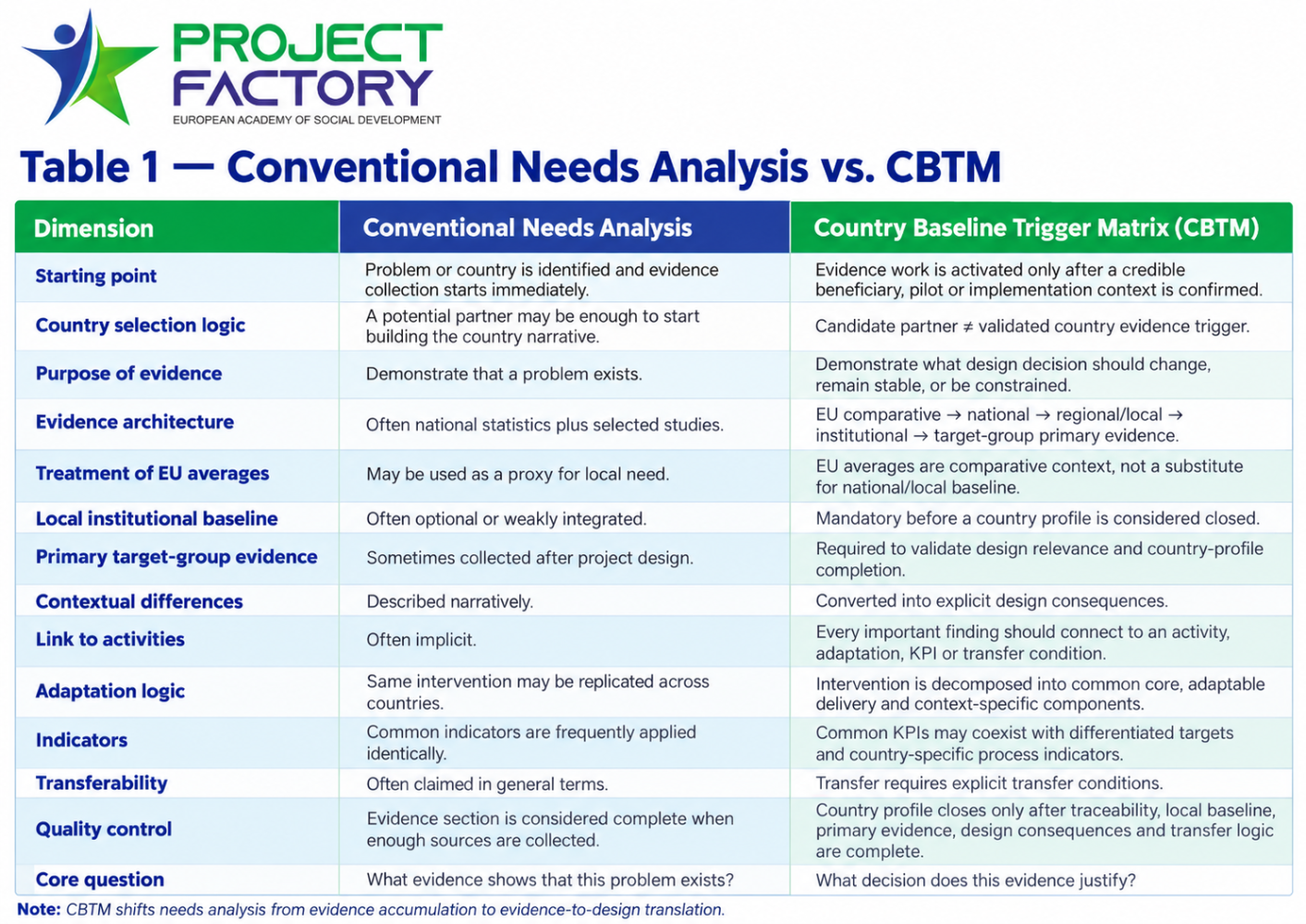
The underlying Project Factory matrix states that country evidence is not considered locked merely because a candidate partner exists. A country profile becomes proposal evidence only after at least one eligible beneficiary or pilot context in that country has been confirmed. Until this point, country research remains a preparation queue rather than validated proposal evidence.
This rule addresses a common problem in consortium development.
Early-stage European project development often involves several possible partners from several countries. If detailed country narratives are created immediately, project architecture may become distorted by countries that ultimately do not participate.
CBTM therefore distinguishes three states:
State 1 — Candidate
A country is represented by a possible organisation or potential implementation opportunity.
No substantive country claim should yet be treated as final proposal evidence.
State 2 — Triggered
A credible project-specific beneficiary, implementation, or pilot role has been provisionally confirmed.
The country evidence workflow may begin.
State 3 — Closed
Country evidence has passed the framework's quality requirements and can legitimately support final design decisions and proposal claims.
This creates an important separation:
Partner identification does not automatically equal evidence activation.
5. The Country Baseline Evidence Standard
Once a country is triggered, CBTM requires a comparable evidence architecture.
The original matrix specifies seven core standards:
- use comparable reference years and age ranges where possible;
- record population, geography, and definitions;
- distinguish national evidence from regional or local evidence;
- add the actual pilot institution baseline;
- state what each source proves and does not prove;
- connect important findings to a design adaptation, activity, KPI, or transfer condition; and
- avoid treating EU averages as substitutes for national or local baselines.
These requirements create what can be described as a layered baseline.
Layer 1 — European comparative context
European-level datasets help establish common reference points and permit cross-country comparison.
Layer 2 — National baseline
Official national evidence identifies country-specific conditions.
Layer 3 — Regional/local baseline
Subnational evidence identifies geographic variation relevant to implementation.
Layer 4 — Institutional baseline
The actual pilot organisation establishes its starting position.
Layer 5 — Target-group primary evidence
Young people, practitioners, employers, families, migrants, persons with disabilities, public authorities, or other target groups contribute direct evidence about needs and implementation conditions.
This hierarchy prevents a national statistic from being treated automatically as evidence about a specific pilot institution or participant group.
6. Source Hierarchy
The Project Factory matrix proposes a source order designed to improve traceability and reduce selective evidence use:
- Eurostat or European Commission sources;
- national statistical offices, ministries, or public authorities;
- relevant national youth, disability, migration, employment, or service data;
- recognised public research institutions; and
- reputable NGO or disabled persons' organisation evidence where official data are absent.
The framework does not imply that lower-ranked evidence lacks value.
Instead, the hierarchy addresses claim-source fit.
For example:
- population prevalence should preferably rely on official statistics;
- lived-experience barriers may require primary qualitative evidence;
- institutional accessibility requires local assessment;
- service-navigation problems may require practitioner and participant evidence;
- policy conditions require authoritative legal or governmental sources.
Accordingly:
The strongest source is not universally the most useful source; it is the source most appropriate to the claim being made.
7. The Country Baseline-to-Design Trigger Framework
The proposed overall framework can be represented as:
Stage 0 — Candidate Context
Potential partner or country identified.
↓
Stage 1 — Trigger
A credible project-specific implementation or beneficiary role is established.
↓
Stage 2 — Baseline Evidence
European → national → regional/local → institutional → primary target-group evidence.
↓
Stage 3 — Contextual Difference
The analysis identifies differences relevant to implementation.
↓
Stage 4 — Design Consequence
The project team asks:
What should change because this difference exists
↓
Stage 5 — Adaptation Decision
Determine:
- common element;
- adaptable element;
- country-specific element.
↓
Stage 6 — Indicator Alignment
Determine whether measurement requires:
- one common KPI;
- common KPI with differentiated targets;
- country-specific supporting indicators.
↓
Stage 7 — Transfer Condition
Specify the conditions under which the intervention could reasonably be transferred.
↓
Stage 8 — Completion Gate
Country profile is accepted as proposal-ready evidence.
The full formula is therefore:
Trigger → Evidence → Difference → Design Consequence → Adaptation → KPI → Transfer Condition
This constitutes the central analytical proposition of CBTM.
8. The Evidence-to-Design Consequence Test
One of the most important elements of the framework is a simple question:
If this evidence disappeared from the proposal, would any project-design decision change
If the answer is no, the evidence may be descriptive rather than decision-relevant.
The test can be operationalised using six questions:
QuestionFunctionWhat does the evidence demonstrate?InterpretationAt what geographic/institutional level is it valid?ScopeWhich target group does it concern?RelevanceWhat difference does it reveal?ComparisonWhich project decision changes because of it?TranslationHow will that change be measured?Verification
This turns needs analysis from a narrative section into a design-control mechanism.
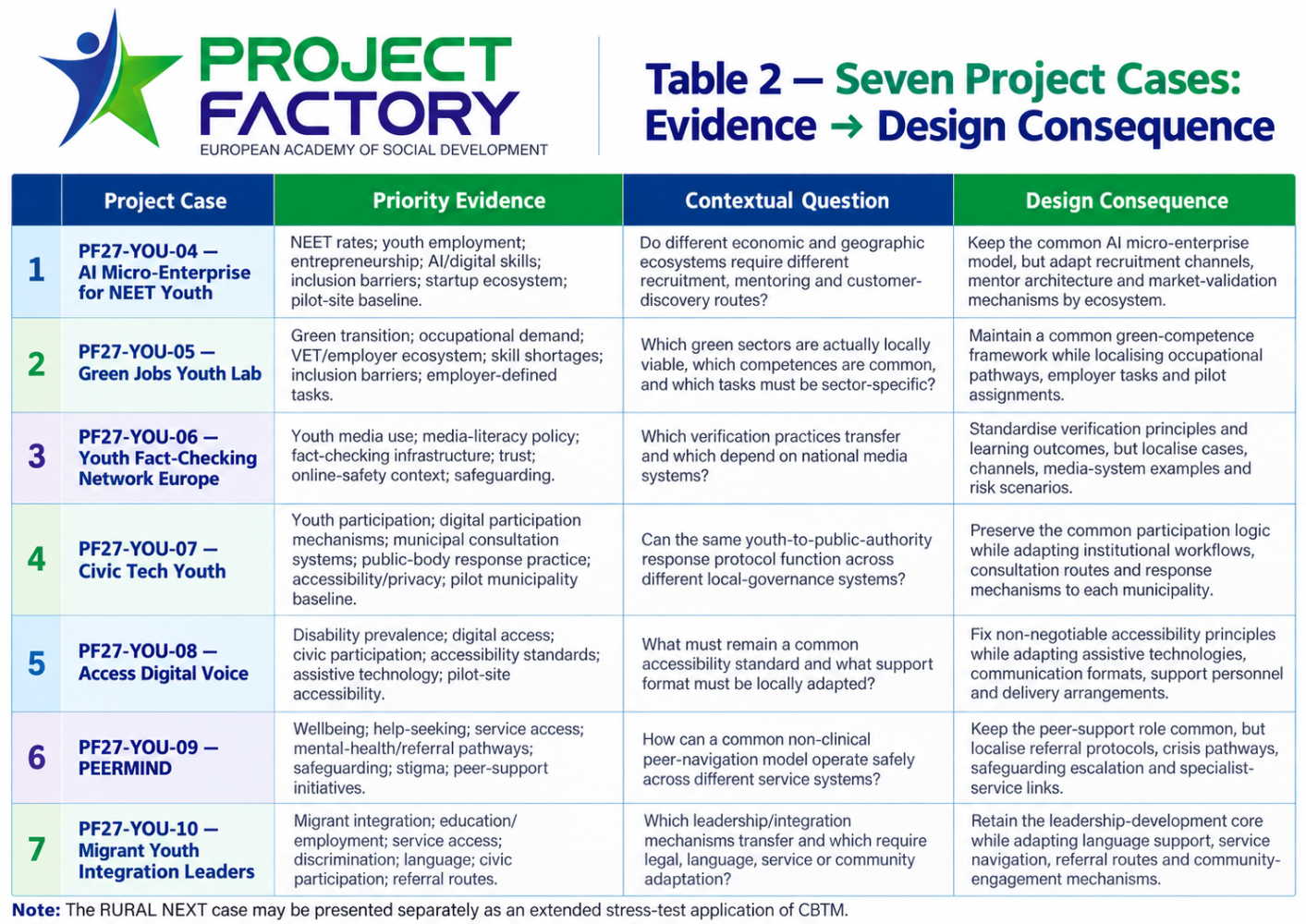
9. Application Across Transnational Youth Project Concepts
The preliminary Country Baseline Trigger Matrix was developed across several youth-project concepts. These should be understood as illustrative design applications, not as completed empirical studies.
9.1 AI Micro-Enterprise for NEET Youth
The provisional concept includes Portugal and Greece.
The baseline queue covers:
- NEET rates;
- age and sex disaggregation;
- youth employment and unemployment;
- transition conditions;
- youth entrepreneurship;
- digital and AI skills;
- inclusion barriers;
- enterprise-support structures;
- pilot-region conditions;
- employer/startup ecosystem access; and
- existing initiatives.
The evidence is not collected merely to demonstrate that NEET youth experience labour-market disadvantage.
The design question is more specific:
Does a common AI-enabled micro-enterprise model require different recruitment, mentoring, and customer-discovery pathways in different economic and geographic ecosystems
A possible evidence-to-design translation could therefore be:
Evidence: weaker access to startup networks in a peripheral area → Difference: participants have fewer opportunities to test products with potential customers → Design consequence: formal customer-discovery partnerships must be built into the pilot → Adaptation: organised market-testing sessions replace informal ecosystem access → KPI: number and diversity of customer-validation interactions.
The fundamental intervention remains shared.
The delivery route changes.
10. Green Jobs Youth Lab
The Green Jobs Youth Lab demonstrates why broad European priorities are insufficient as local occupational baselines.
Its baseline requirements include:
- youth labour-market data;
- sector-specific green transition evidence;
- occupational demand;
- VET and employer ecosystems;
- skills shortages;
- green-skills policy;
- inclusion barriers;
- employer-defined work tasks; and
- existing green-skills initiatives.
The framework asks three design questions:
- Which green-job sectors are actually present locally
- Which competencies are genuinely transferable across countries
- Which pilot tasks must remain country- or sector-specific
This prevents a project from constructing a generic “green jobs curriculum” detached from labour-market reality.
The common European element could be a competency architecture.
Country pilots could then operationalise those competencies through different occupations.
Thus:
Common competence does not require identical occupational application.
11. Youth Fact-Checking Network Europe
Media environments differ across countries.
The provisional baseline therefore examines:
- youth digital and media use;
- media-literacy policies;
- fact-checking infrastructure;
- institutional and media trust;
- disinformation and online-safety policies;
- youth-worker training;
- safeguarding systems; and
- existing initiatives.
The project-design question is whether verification activities can transfer directly or require adaptation to local media systems and information environments.
A common verification methodology may therefore coexist with locally selected cases, information channels, platform behaviours, languages, or misinformation patterns.
12. Civic Tech Youth
Civic-technology initiatives provide an especially clear demonstration of the difference between common intervention logic and local governance architecture.
Relevant baselines include:
- youth civic participation;
- digital participation channels;
- municipal youth councils;
- consultation systems;
- public-body follow-up;
- accessibility and privacy conditions;
- institutional trust;
- existing civic-tech platforms; and
- pilot-municipality capacity.
The core design question becomes:
Can one youth-to-public-authority response protocol operate effectively across different local-governance systems
If one municipality already has a formal youth consultation process while another has no structured feedback route, implementing identical participation activities would not constitute equivalent interventions.
CBTM would therefore require the project to distinguish:
common democratic function
from
locally appropriate institutional mechanism.
13. Access Digital Voice
The Access Digital Voice concept illustrates the importance of preventing national disability statistics from replacing actual accessibility assessment.
Its baseline queue includes:
- disability prevalence in relevant age groups;
- internet and digital access by disability;
- civic participation;
- accessibility legislation and standards;
- public digital-service environments;
- assistive technology;
- participation mechanisms; and
- accessibility conditions inside pilot institutions.
The central design question is:
Which accessibility requirements should constitute a common minimum standard, and which support or communication formats must be locally adapted
This distinction is crucial.
A project should not lower its accessibility principles because national contexts differ.
However, implementing a common accessibility principle may require different:
- assistive technologies;
- communication formats;
- support personnel;
- language arrangements;
- physical accommodations; or
- institutional procedures.
Thus:
Common standards may require differentiated implementation.
14. PEERMIND
Peer-support projects involving wellbeing or mental-health navigation introduce additional requirements because service and referral ecosystems vary considerably.
The provisional evidence architecture therefore includes:
- wellbeing indicators;
- social-support conditions;
- help-seeking patterns;
- service access;
- youth mental-health policy;
- referral pathways;
- crisis systems;
- safeguarding;
- digital help-seeking;
- stigma barriers; and
- existing peer-support initiatives.
The design question is not whether countries experience youth-wellbeing challenges.
It is:
How can a common non-clinical peer-navigation model operate safely when formal service and referral systems differ
This can create a strong design boundary:
common peer-support role
versus
country-specific professional referral pathway.
Such distinctions help prevent inappropriate standardisation in fields involving safeguarding or specialist services.
15. Migrant Youth Integration Leaders
Migration-related projects are particularly vulnerable to overgeneralisation.
The CBTM therefore requires evidence concerning:
- age;
- sex;
- citizenship or country of birth where relevant;
- education and employment;
- NEET conditions;
- migrant and refugee services;
- discrimination and racism;
- language;
- service navigation;
- civic participation;
- referral pathways; and
- existing integration initiatives.
The design question focuses on transferability:
Which leadership and integration mechanisms transfer between host-country contexts, and which require adaptation because of language, law, services, or community structures
This approach also provides a safeguard against treating migrant populations as homogeneous.
The evidence architecture must identify the actual population and distinguish between variables such as migration status, citizenship, age, sex, residence, service eligibility, and local integration context.
16. RURAL NEXT: A Multi-Context Stress Test
RURAL NEXT offers perhaps the clearest conceptual stress test for CBTM.
Its provisional countries include different rural, island, local-action, SME, and public-private governance contexts.
Required evidence includes:
- comparable rural definitions;
- youth employment and education;
- NEET conditions;
- mobility and transport;
- digital connectivity;
- service accessibility;
- entrepreneurship and local innovation;
- youth participation;
- rural governance;
- LEADER/local action structures;
- institutional baselines; and
- existing initiatives.
The explicit comparative question is:
Which elements of the RURAL NEXT Lab Cycle can remain constant across different rural environments, and which require local adaptation
This illustrates a wider principle of transnational design:
European transferability should not be defined as replication without adaptation.
A potentially stronger formulation is:
Transferability = Stable Core + Explicit Transfer Conditions + Evidence-Based Adaptation
17. Common Core and Local Adaptation
CBTM therefore proposes that transnational interventions should be decomposed into at least three layers.
17.1 Non-negotiable Core
Elements defining the identity or integrity of the intervention.
Examples could include:
- learning outcomes;
- ethical standards;
- accessibility principles;
- safeguarding requirements;
- competency frameworks;
- participation principles;
- core process stages.
17.2 Adaptable Delivery Layer
Elements that may change to improve contextual fit.
Examples include:
- recruitment channels;
- communication formats;
- mentoring arrangements;
- meeting formats;
- local examples;
- employer engagement;
- institutional workflows.
17.3 Context-Specific Components
Elements required only in particular environments.
Examples may include:
- referral protocols;
- local-law guidance;
- language mediation;
- transport arrangements;
- specific assistive technology;
- municipality-specific participation channels.
This decomposition is conceptually consistent with implementation literature that distinguishes intervention integrity from contextual adaptation. FRAME, for example, emphasises systematic documentation of what is modified, why modification occurs, and whether adaptations remain consistent with intervention fidelity.
CBTM brings this logic into proposal architecture before implementation.
18. Indicator Design
Evidence-informed adaptation creates an apparent measurement problem.
If pilots differ, can results still be compared
CBTM proposes that adaptation and comparability should not be treated as opposites.
Three levels can be distinguished:
Level A — Common Outcome Indicator
Used where the intended outcome is genuinely common.
Example:
percentage of participants demonstrating increased competence
Level B — Country-Differentiated Target
The indicator is common but starting points justify different targets.
Level C — Context-Specific Process Indicator
Used where a locally required implementation component needs separate monitoring.
For example, two countries may share an outcome indicator for improved civic participation while monitoring different mechanisms:
- municipal response rates in Country A;
- formal youth-council referrals in Country B.
This approach preserves cross-country comparability without pretending that implementation environments are identical.
Implementation science similarly distinguishes implementation outcomes from wider service or participant outcomes. Proctor and colleagues, for example, proposed dimensions including acceptability, adoption, appropriateness, feasibility, fidelity, penetration, cost, and sustainability.
For transnational projects, distinguishing implementation indicators from participant outcome indicators may therefore substantially improve monitoring design.
19. The Country Profile Completion Gate
CBTM does not consider a country profile complete merely because statistical research has been performed.
The provisional framework specifies that a profile becomes CLOSED only when:
- the beneficiary or pilot country is confirmed;
- official sources are traceable;
- age and definition differences are documented;
- the institutional baseline is available;
- target-group primary evidence exists;
- design consequences are explicit;
- evidence avoids unjustified generalisation; and
- transfer logic identifies both common elements and justified adaptations.
This can be interpreted as an Evidence Readiness Gate.
A possible operational checklist is:
GateRequirementG1Country/pilot confirmedG2Official evidence traceableG3Population definitions comparableG4National/local levels distinguishedG5Institutional baseline completedG6Primary target-group evidence availableG7Existing initiatives/non-duplication checkedG8Design consequences documentedG9Indicators linkedG10Transfer conditions articulated
A project team should not consider the evidence package mature merely because G1–G3 are complete.
The decisive stages are G8–G10.
20. A Proposed Evidence-to-Decision Traceability Table
For operational use, every major finding could be registered as follows:
IDEvidenceWhat It ProvesWhat It Does Not ProveContext DifferenceDesign DecisionAdaptationKPITransfer ConditionE01National statisticScale of national issueLocal pilot needCountry differenceRecruitment designChannel adaptedRecruitment KPISimilar outreach structureE02Institutional dataLocal starting pointNational prevalenceSite capacity gapTraining requirementExtra moduleCapacity KPIMinimum staff capacityE03Target-group evidenceUser barrierPopulation prevalenceAccess barrierDelivery formatAccessible optionParticipation KPIComparable support available
This table represents an important development from ordinary evidence banking.
An Evidence Bank answers:
What evidence do we have
An Evidence-to-Decision Register answers:
What decision does each important piece of evidence justify
The second is more relevant to project architecture.
21. Relationship to European Added Value
The framework has implications for the interpretation of European added value.
European added value is sometimes expressed through simple multinationality: several countries conduct similar activities.
CBTM suggests a stronger interpretation.
European cooperation creates additional value when differences between national contexts generate opportunities to:
- identify common structural challenges;
- test a shared intervention under different conditions;
- distinguish core mechanisms from contextual delivery features;
- compare implementation conditions;
- identify transfer requirements;
- generate knowledge unavailable from a single-country intervention.
Under this interpretation:
The value of a transnational consortium is not that participating countries are identical enough to implement the same activity, but that their relevant similarities and differences make structured mutual learning possible.
This corresponds to the wider objectives of Cooperation Partnerships, which emphasise transnational capacity, exchange and development of practices, transferability, and change adapted to organisational contexts.
22. Proposed Research Questions
Future empirical testing of CBTM could address the following questions.
RQ1
Does the use of a trigger-based country baseline framework improve the traceability between needs evidence and project-design decisions
RQ2
Does the framework reduce unsupported generalisation from European or national statistics to local target groups
RQ3
Does explicit identification of common-core and adaptable components improve the transferability logic of transnational projects
RQ4
Does institutional and target-group baseline evidence produce materially different design decisions than national statistics alone
RQ5
Does the Country Profile Completion Gate improve the consistency and quality of evidence packages across project teams
RQ6
Can evidence-to-design traceability improve evaluator perceptions of project relevance, feasibility, and methodological coherence
RQ7
Which categories of contextual evidence most frequently result in actual modifications to project design
These questions transform CBTM from a practitioner methodology into a testable research programme.
23. Discussion
The principal contribution of CBTM is not a new method for collecting statistics.
Its contribution is the proposed governance of when evidence becomes active and what must happen after evidence is collected.
The framework introduces four disciplines.
23.1 Timing Discipline
Evidence becomes proposal-active only when the relevant implementation context is sufficiently confirmed.
23.2 Scope Discipline
European, national, regional, institutional, and participant evidence are not treated as interchangeable.
23.3 Translation Discipline
Important findings must connect to project-design decisions.
23.4 Transfer Discipline
Projects must distinguish common intervention components from justified contextual adaptations.
Together these principles shift the role of needs analysis.
Instead of:
Need → Project
the framework proposes:
Need → Context → Decision → Intervention → Measurement → Transfer
This distinction is important because many implementation failures may not result from misunderstanding the general problem. They can arise because project architecture does not adequately account for the environments in which an intervention will operate. The CFIR literature similarly stresses the importance of contextual determinants in implementation success.
24. Practical Implications for EU Project Designers
CBTM produces several practical rules.
Rule 1
Do not research countries simply because organisations from those countries appear in a partner spreadsheet.
Trigger evidence work after a credible project role exists.
Rule 2
Do not allow EU-level statistics to substitute automatically for national or local evidence.
Use European evidence primarily for comparison and common framing.
Rule 3
Never assume national evidence describes the pilot institution.
Create an institutional baseline.
Rule 4
Do not present contextual differences without explaining their design consequences.
Every significant difference should lead either to:
- a project modification; or
- an explicit reason why no modification is required.
Rule 5
Protect the common core.
Adapt delivery without unintentionally turning one European intervention into unrelated national mini-projects.
Rule 6
Measure adaptation.
Country-specific implementation mechanisms should appear in monitoring architecture where relevant.
Rule 7
Document transfer conditions.
Do not simply claim that an output is “transferable”.
State the conditions required for transfer.
25. Limitations
This paper has several important limitations.
First, CBTM is presented as a methodological framework under development, not as a validated causal model.
Second, the project concepts used in this paper are provisional design cases. They illustrate how the method can operate but do not constitute empirical evidence that CBTM improves project outcomes.
Third, the framework was initially developed in relation to European youth-project preparation. Its applicability to areas such as vocational education, adult education, school education, sport, health, social innovation, research, or development cooperation requires further testing.
Fourth, evidence availability differs significantly across countries and target populations. Comparable disability, migration, youth-participation, rurality, or digital-access data may not always exist.
Fifth, stronger evidence architecture cannot eliminate judgement from project design. The interpretation of evidence and the selection of adaptations still require practitioner expertise and stakeholder participation.
Sixth, CBTM requires additional development concerning weighting, evidence conflicts, version control, documentation of negative evidence, and integration with formal project quality-assurance systems.
These limitations reinforce the need for empirical pilot testing.
26. Future Development
The next stage of the Project Factory Evidence-Informed Design research programme should test CBTM prospectively.
A future study could compare project-development processes using:
Group A
Conventional needs analysis
with
Group B
Trigger-based evidence-to-design architecture.
Potential measures could include:
- number of evidence items linked to explicit decisions;
- proportion of major activities justified by evidence;
- number of unsupported generalisations;
- consistency of country baselines;
- number of evidence-triggered adaptations;
- evaluator assessment of relevance;
- evaluator assessment of methodological coherence;
- pilot feasibility;
- implementation adaptations required after project launch.
This would allow the framework to move from a design proposition to an empirically examined method.
27. Conclusion
Transnational European project design requires more than proving that a social, educational, economic, digital, or participation problem exists.
It requires demonstrating:
- where the problem exists;
- for whom it exists;
- under which conditions;
- how participating contexts differ;
- which differences matter;
- which project decisions those differences influence;
- what must remain common;
- what may be adapted;
- how results remain comparable; and
- under what conditions the intervention can transfer elsewhere.
The Country Baseline Trigger Matrix addresses these questions by reframing country evidence as a controlled design input rather than a descriptive proposal component.
Its core logic is:
Trigger → Evidence → Difference → Design Consequence → Adaptation → KPI → Transfer Condition
The framework therefore proposes a shift:
from evidence collection to evidence translation;
from country description to design consequence;
from assumed replication to conditional transferability;
and
from generic Europeanisation to a stable common core implemented through justified local adaptation.
The central proposition of the Project Factory Evidence-Informed Design approach can consequently be stated in one sentence:
Evidence becomes valuable to project design not when it is cited, but when it changes, confirms, constrains, or justifies a decision.
This proposition provides the foundation for the subsequent papers in the Project Factory Evidence-Informed Design Series.
Proposed Project Factory Evidence-Informed Design Series
Paper 1 The Country Baseline Trigger Matrix: A Structured Method for Evidence-to-Design Translation in Transnational EU Projects
Paper 2 From Evidence to Design Consequence: Building Traceability Between Needs, Activities, Outputs and Indicators in EU Projects
Paper 3 The Common Core–Local Adaptation Model: Designing Transferable Interventions Across European Contexts
Paper 4 Consortium Architecture as an Evidence System: Linking Partner Selection to Capacity, Context and Implementation Logic
Paper 5 The Evidence Readiness Gate: A Quality-Control Model for Needs Analysis in European Project Development
References
Damschroder, L. J., Reardon, C. M., Widerquist, M. A. O., et al. (2022). The updated Consolidated Framework for Implementation Research based on user feedback. Implementation Science, 17, 75. https://doi.org/10.1186/s13012-022-01245-0
European Commission. (2025). Erasmus+ Programme Guide 2026. European Commission.
European Commission. (2026). Erasmus+ Programme Guide: Cooperation Partnerships. Erasmus+ Programme.
Pawson, R., & Tilley, N. (1997). Realistic Evaluation. London: Sage.
Proctor, E., Silmere, H., Raghavan, R., Hovmand, P., Aarons, G., Bunger, A., Griffey, R., & Hensley, M. (2011). Outcomes for implementation research: Conceptual distinctions, measurement challenges, and research agenda. Administration and Policy in Mental Health and Mental Health Services Research, 38(2), 65–76. https://doi.org/10.1007/s10488-010-0319-7
Stirman, S. W., Baumann, A. A., & Miller, C. J. (2019). The FRAME: An expanded framework for reporting adaptations and modifications to evidence-based interventions. Implementation Science, 14, 58. https://doi.org/10.1186/s13012-019-0898-y
Ulusoy, A. (2026). PF27-YOU 2027 — A1 Country Baseline Trigger Matrix. Project Factory. Internal methodological document, 25 September 2026.