Ali Ulusoy
I am Ali Ulusoy. After many years spent moving between the field, the desk, meeting rooms, and application portals, I have learned one thing very clearly: young people often speak as if they know “the right answer,” while older generations make decisions only after passing them through many filters. In project development, this difference becomes even more visible. Because a project is never just about having the right idea; it is about managing time, resources, people, risks, and institutional credibility.
Young minds move fast. They jump directly toward the goal. More experienced minds, however, first test the ground beneath that goal: Will this path hold Can this team carry the load Will the budget survive reality Will this partnership still stand a year from now
I am not writing this to glorify one side and diminish the other. On the contrary, I want to describe what happens when the “certainty of youth” meets the “filters of experience.” Because real success comes when speed meets depth, courage meets caution, and idealism meets accountability. In the project world, winners are rarely those with the brightest ideas; they are those who frame ideas correctly, work with the right partners, choose the right timing, and deliver with discipline.
CTA: If you feel generational tension in your team, start your next meeting not with “Who is right?” but with “What filters are we using?”
Where Does the “I Know What’s Right” Feeling Come From
When young people say “I know,” it is rarely arrogance. It is the nature of speed. Access to information is instant, tools are powerful, and change moves fast. A young team member can read a call, scan examples, watch a few videos, and build a strong conceptual frame within an hour. This is extremely valuable, because the biggest problem many organisations face is not writing badly—but never starting at all.
Yet speed has a shadow. The feeling of knowing “the right answer” can lead to underestimating the invisible layers of project work: compliance, evidence, implementation capacity, stakeholder realities, and reporting logic. Writing a good sentence does not automatically create a working system. Systems do not appear by themselves; they are designed.
CTA: Ask young team members to answer one question before defending an idea: “Where is the real-world proof that this can work?”
The Filter Reflex of Experience: What It Protects—and What It Slows Down
Experienced professionals often appear slow. In reality, they are not slow; they run multiple checks at once. I call this the institutional immune system. Experience is not just a collection of successes—it is also a memory of failures.
Experienced project people silently ask questions like: Have I seen this before Where did it collapse Who failed to deliver What happened on the last day of the portal How did the budget lines behave in practice Will the authority accept this logic
These filters protect projects. They reduce unnecessary risks, ground promises in reality, and test the durability of partnerships. However, filters can sometimes turn into walls. Excessive caution can kill momentum, especially in competitive calls. That is exactly where youthful boldness becomes essential.
CTA: Rule for experienced team members: before saying “no,” propose a smaller, safer version of the same idea.
What Is “Right” in Project Work: A Sentence or a System
In project development, the word right is often misunderstood. For young people, right may mean innovative, ethical, inclusive, and socially meaningful. For experienced professionals, right often means sustainable, measurable, implementable, and auditable. Both are right—and both are incomplete.
Project correctness has two layers. The first is ethical correctness: Why are we doing this Who benefits Is it genuinely needed The second is architectural correctness: With which method, resources, timeline, risk logic, and governance will this actually happen
Without the first, a project becomes a technical exercise. Without the second, it becomes a wish. Young teams tend to be strong in the first layer; experienced teams in the second. Winning projects unite both layers in the same paragraph.
CTA: Reduce every project idea to two equally strong sentences: “Why is this needed?” and “How will it actually work?”
The Field Filter: What Looks Right on Paper Can Fail in Reality
The filter I trust most is the field. In project work, many “right” ideas are born at the desk and die on the ground. Young teams sometimes see the field as abstract; experienced teams see it as the place where promises are tested.
Accessibility strategies may look perfect on paper but fail without the right partners. Digital tools may be elegant, but useless if the target group lacks access. I always ask one basic question: Can this really be done Feasibility is not only technical—it is cultural, economic, and logistical.
CTA: Under every major activity, add one honest sentence: “The biggest real-world obstacle to this activity is…”
The Partnership Filter: Projects Are Carried by People, Not Text
Young teams often fall in love with strong narratives. “This text is excellent—it will be approved.” But projects are not carried by text; they are carried by people. Experience activates another filter: Will this partner actually deliver How fast do they decide How many projects are they already running Do they report on time
Over time, I learned that the most valuable quality in partnerships is not prestige but predictability. A small but reliable partner often outperforms a large but chaotic one.
CTA: Before adding a new partner, prepare a one-page mini-agreement: role, proof of capacity, and timeline.
The Evidence Filter: Good Intentions Are Not Enough
Young teams are often strong in discourse: inclusion, climate action, digital transition, participation. All essential. But in funding ecosystems, good intentions must be reinforced with evidence. Experience brings the discipline of proof: past projects, lessons learned, local data, and policy alignment.
Evidence is not only statistics. Institutional memory and implementation logic are equally persuasive. “We have done this before, achieved these results, and can scale it” is often stronger than numbers alone.
CTA: For every new proposal, extract at least two evidence statements from your organisation’s past: one success, one lesson learned.
The Risk Filter: Courage Needs Safety Mechanisms
Young teams are more willing to take risks—and innovation needs that. But unmanaged risk quickly turns into crisis. Experienced teams identify risks early: financial deviations, participation drops, safeguarding issues, stakeholder conflicts.
Risk management is not fear; it is preparation. Writing risks does not weaken a proposal—it makes it credible. Strong teams combine youthful courage with experienced foresight.
CTA: Integrate at least one realistic risk and mitigation logic into every work package narrative.
The Time Filter: The Timeline Is the Hidden Boss
In project work, one truth is unforgiving: the timeline does not care about enthusiasm. Young teams often see time as flexible; experienced teams know it is sharp. Deadlines, signatures, procurement, reporting cycles—none are romantic, but all are decisive.
Time management is learned in the field. Yet young teams add value by making timelines visible, digital, and efficient.
CTA: Always separate preparation time from implementation time in your planning.
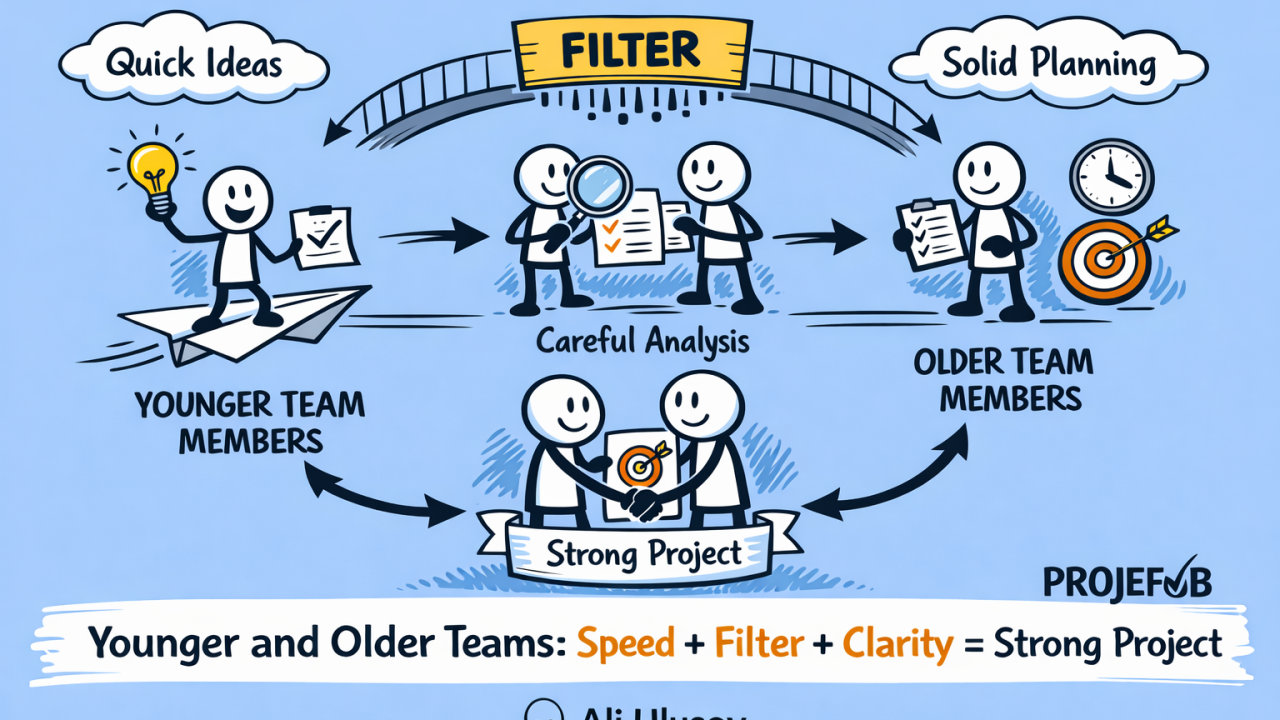
The Golden Formula: Speed + Filter + Clarity
In my ideal team, young members draft fast, experienced members filter carefully, and then the young refine and simplify again. This loop runs several times. Strong texts are not written once; they are shaped.
The biggest mistake is misunderstanding roles. Youth sees filters as barriers; experience sees speed as recklessness. In reality, both aim to protect the project—just from different angles.
CTA: Define roles clearly: draft owner and filter owner. Debate roles, not people.
Final Word: Knowing the Right Answer Alone Is Not Enough
When young people speak with certainty, it often signals potential. When experienced professionals apply filters, it signals responsibility. Project work needs both. We need to combine courage with systems, ideals with reality, speed with sustainability.
I believe that generational tension, if managed well, becomes an innovation engine. One side opens doors by asking “Why not?” The other builds structure by asking “How?” A strong project does both.
CTA: Take one step today: pair one young and one experienced team member, create a one-page Idea + Filter + Plan draft—and build from there.
_____________________________________________________________________________
IT IS TIME TO WRITE "HORIZON EUROPE PROJECTS"
If you'd like to meet Ali Ulusoy, who has been working on building ecosystems and sustainable project structures for many years, you can send him a message via LinkedIn or contact him directly via email. 👉 Connect, let's talk.
YAZIMI BEĞENDİYSENİZ NEDEN PAYLAŞMIYORSUNUZ :)
- -We can add value to your projects with our organizations in Türkiye and Estonia. Would you like to benefit from our contribution in writing your Horizon Europea projects
- Ali ULUSOY
- Proje Fabrikası Kurucusu / President of Project Factory
- Engelsiz ve Mutlu Yaşam Derneği Başkanı / President of Barrier Free and Happy Life Association
- happykidstr@gmail.com https://projehaberleri.com/
- Stay Connected WhatsApp: +90 530 363 3120
- Facebook: mahalleninalisi Twitter / X: Happykidsturke2 LinkedIn: happykidsturkey