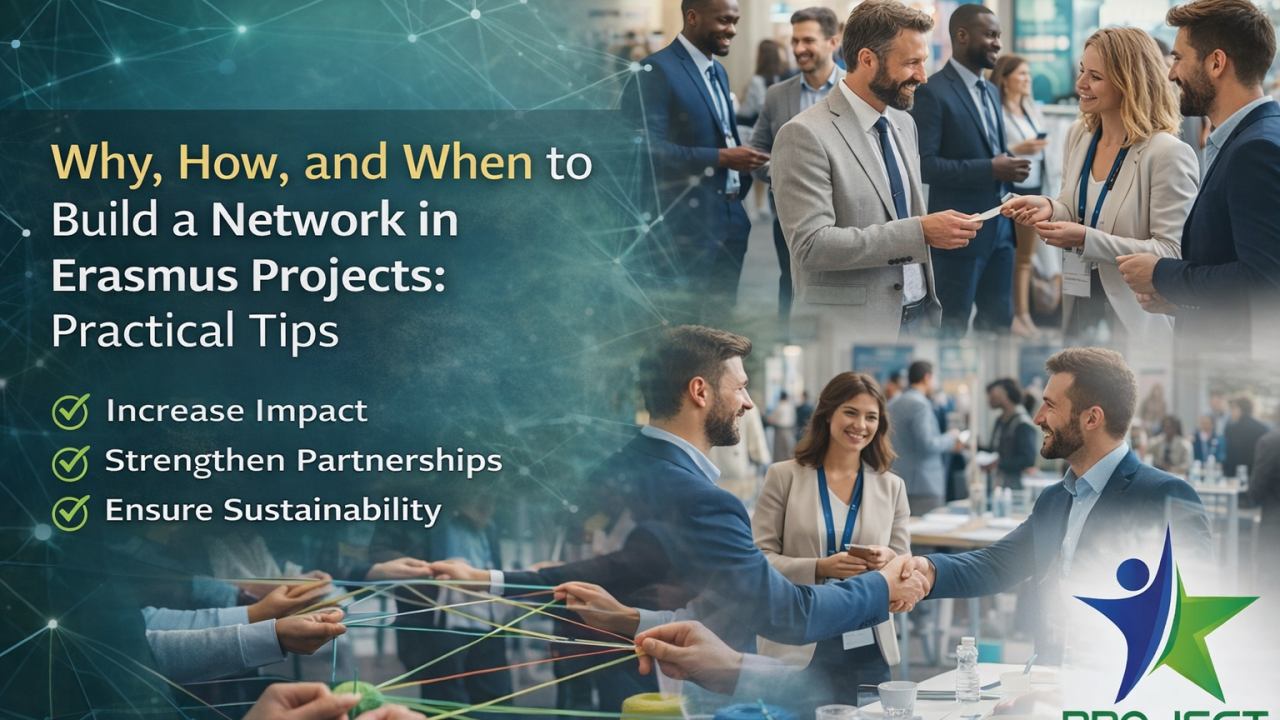
In Erasmus projects, “networking” is often misunderstood as nothing more than exchanging business cards at events. In reality, a strong network is not something that merely helps you write a project; it is a mechanism that secures, facilitates, and scales the project. Erasmus projects—especially under KA2 and SPORT actions—do not reward ideas alone. They reward well-structured partnerships, role alignment, reliable implementation capacity, sustainable impact, and clear European added value. Networking supports all of these dimensions at once: it sharpens needs analysis, completes the consortium, reduces implementation risks, accelerates dissemination, facilitates continuity into new calls, and most importantly enables the creation of a project portfolio rather than one-off successes.
This article explains why networking is essential in Erasmus projects, how it should be approached, and when different networking strategies should be applied throughout the project cycle. Each section concludes with a short, practical CTA (Call to Action) that you can apply immediately.
1) Networking is not an “extra” but the backbone of project design
In Erasmus projects, networking is often equated with “finding partners.” In reality, true networking is about building an implementation architecture. From an evaluator’s perspective, even a well-written proposal becomes risky if the consortium lacks operational alignment or realistic role distribution. Networking addresses exactly this risk: it is not only about who you work with, but how you work together.
For example, in a KA220 project, an academic partner may lead evidence generation and evaluation, a municipality may ensure access to pilot sites and scalability, while an NGO may guarantee trust-based access to target groups and inclusiveness. In a SPORT-SCP project, the challenge is even sharper: within a single priority framework, the consortium must bring together “field, policy, and knowledge” actors. This alignment can only be achieved through structured and continuous networking.
The key point is this: when you treat networking as an integral part of content development—rather than a separate activity—you strengthen both the Relevance and Partnership scores simultaneously. Poorly designed networking leads either to “nice ideas with weak implementation” or to “projects that look generic and repetitive.”
CTA: Before drafting your next Erasmus proposal, write one paragraph answering this question: Which partnership gap does this project fill Use that paragraph as the core of your partner outreach messages.
2) The three core reasons for networking: trust, speed, and scale
The first reason for networking is trust. Project partnerships are not simple contractual relationships; they are complex delivery systems involving shared responsibility. Partners’ work culture, crisis management skills, communication discipline, and ethical standards directly affect project performance. Trust-based networks reduce risks such as last-minute withdrawals, reporting problems, or weak dissemination.
The second reason is speed. Calls come with strict timelines, and time is often scarcer than good ideas. A strong network saves you from starting from scratch when a call opens. It allows you to reach the right partner with the right role at the right time. Speed here is not only about meeting deadlines; it is about maturing concepts earlier and distributing responsibilities more effectively.
The third reason is scale, or European added value. Erasmus projects must demonstrate that local needs are connected across countries and that solutions are transferable. Networking makes this transnational logic organic. Testing similar models in different national contexts turns a “pilot” into a “replicable model,” strengthening the impact narrative—particularly important in SPORT-SCP projects built around a single priority.
CTA: Create a “speed list” for your organisation: for each country, identify two reliable institutions; for each theme, identify two expert organisations. Use this list as your first step when a call opens.
3) When should networking take place Always— but with different purposes
Networking should happen throughout the project lifecycle, but with different objectives at each stage. Before a call opens, networking helps generate and refine project ideas. During the application phase, it completes and balances the consortium. After project approval, it supports quality assurance, dissemination, sustainability, and continuity into new calls.
The most common mistake is networking only when deadlines approach. This often leads to rushed partner selection and unrealistic role allocation. Instead, networking should be structured across three phases: pre-call, during the call, and post-call. Pre-call networking positions you as an idea owner rather than a desperate partner seeker. During-call networking fills strategic gaps. Post-call networking ensures growth and continuity.
CTA: Establish a fixed networking rhythm: each month, connect with at least two new organisations and deepen collaboration with two existing partners—independent of active application deadlines.
4) How to network: focus on value propositions, not meetings
Effective Erasmus networking does not start with “Let’s have a meeting.” It starts with a clear value proposition. This includes the project theme, target group, expected contribution, and what the partner gains in return. Why should this organisation work with you Do you offer field access, academic credibility, dissemination power, policy links, or proven delivery experience
A practical tool is a one-page Partner Brief. This document summarises the project’s single priority, target group, transnational logic, draft outputs, and the expected partner role in a coherent narrative. Especially in SPORT-SCP projects, where focus is critical, this brief prevents dilution and confusion.
CTA: Develop a reusable Partner Brief template and convert each new project idea into this format within 30 minutes. Use it as the core of all networking messages.
5) Networking channels: choosing the right place matters
Networking effectiveness depends on selecting the right channels. KA210 projects require speed and practical capacity; KA220 projects demand experience and quality assurance systems; SPORT-SCP projects require strong field actors and ecosystem links.
Open channels include LinkedIn, the Erasmus+ Project Results Platform, SALTO, National Agency events, and European conferences. Closed channels include existing partners, referrals, institutional networks, and local authority links. The strongest consortia usually combine trusted core partners from closed channels with one or two innovative partners from open channels.
CTA: For your next call, prepare two lists: “trusted core partners” and “innovation partners.” Build your consortium by balancing both.
6) Example 1: Fast networking for a KA210 project
KA210 projects are ideal entry points but require pragmatic networking. The goal is not perfection but deliverability. Imagine a KA210 focused on women’s access to sport. A Turkish NGO provides field access; a Spanish organisation contributes social inclusion methodologies; an Estonian partner manages digital dissemination and evaluation tools. Networking here demonstrates how the same issue manifests differently across countries, justifying transnational cooperation.
The main pitfall is working with partners who want to “do everything.” In KA210, role clarity matters more than institutional size.
CTA: In KA210 partner talks, replace “We would like to collaborate” with “This is the specific role we see for you in this project.”
7) Example 2: Deep networking and role engineering in KA220
KA220 projects require depth. Partners must demonstrate proven capacity, quality assurance mechanisms, and sustainability potential. For example, in a KA220 on digital inclusion in adult education, a university leads research, a municipality pilots solutions, an NGO ensures inclusive access, and a tech partner develops the platform.
Networking here is about showing that the project cannot work without this specific consortium. Each partner’s contribution must be tied to concrete outputs, not generic support.
CTA: Before meeting a KA220 partner, prepare a one-page Role Card clearly defining outputs, responsibilities, and long-term contribution.
8) Example 3: Networking in SPORT-SCP—single priority, strong field logic
In SPORT-SCP projects, the single-priority rule shapes networking strategy. The aim is not to broaden the scope but to deepen impact. For example, under the “healthy lifestyles for all” priority, networking should focus on actors who can strengthen implementation on the ground: sports clubs, municipalities, inclusion organisations, and knowledge providers.
Strong SPORT-SCP networks are not large but well-aligned. Clubs deliver practice, municipalities provide scale, inclusion organisations ensure accessibility, and academic or federation partners support standardisation and evidence generation.
CTA: Lock your SPORT-SCP priority in one sentence, then seek partners who deepen that priority instead of expanding it.
9) Asking the right questions in networking meetings
A good networking meeting produces information, not just familiarity. You should clarify four points: how the partner reaches the target group, which outputs they can realistically own, what resources they can commit, and what they can sustain beyond the project. Alignment of mission and past experience matters more than the sheer number of previous EU projects.
CTA: After each partner meeting, write a four-sentence “fit note” covering role clarity, capacity, access, and sustainability.
10) Making networks sustainable beyond a single project
The strongest networks survive project closure. Sustainability depends on regular contact and joint production: shared trainings, publications, webinars, policy dialogues, or open resources. Networks based only on events fade quickly; networks based on co-creation endure.
Sustainable networks also enable strategic progression from one call to the next, transforming outputs into scalable models.
CTA: At project closure, prepare a “Next Call Map” linking current outputs to future funding opportunities and identifying core partners for continuation.
11) A 30-day action plan to build networking momentum
Instead of trying to expand networks overnight, use a 30-day cycle. Week one: map 20 relevant organisations. Week two: send concise value propositions to eight of them. Week three: hold short role-focused meetings with four. Week four: finalise a balanced consortium and draft a mini concept note. Repeating this cycle builds a pipeline rather than isolated projects.
CTA: Today, list 20 organisations aligned with your theme and write one sentence explaining why each is relevant.
Conclusion: Treat networking as a mechanism, not PR
In Erasmus projects, networking is not about visibility—it is about mechanism building. It strengthens needs analysis, secures implementation, amplifies dissemination, and anchors sustainability. Used strategically across the project lifecycle, networking builds not only successful proposals but also long-term project capacity.
CTA: This week, schedule one strategic partner meeting and attend it with a one-page Partner Brief. Leave the meeting only after roles and outputs are clearly defined.
- We can add value to your projects with our organizations in Türkiye and Estonia. Would you like to benefit from our contribution in writing your central projects
- Ali ULUSOY
- Proje Fabrikası Kurucusu / President of Project Factory
- Engelsiz ve Mutlu Yaşam Derneği Başkanı / President of Barrier Free and Happy Life Association
- happykidstr@gmail.com https://projehaberleri.com/
- Stay Connected
- Facebook: mahalleninalisi Twitter / X: Happykidsturke2 LinkedIn: happykidsturkey