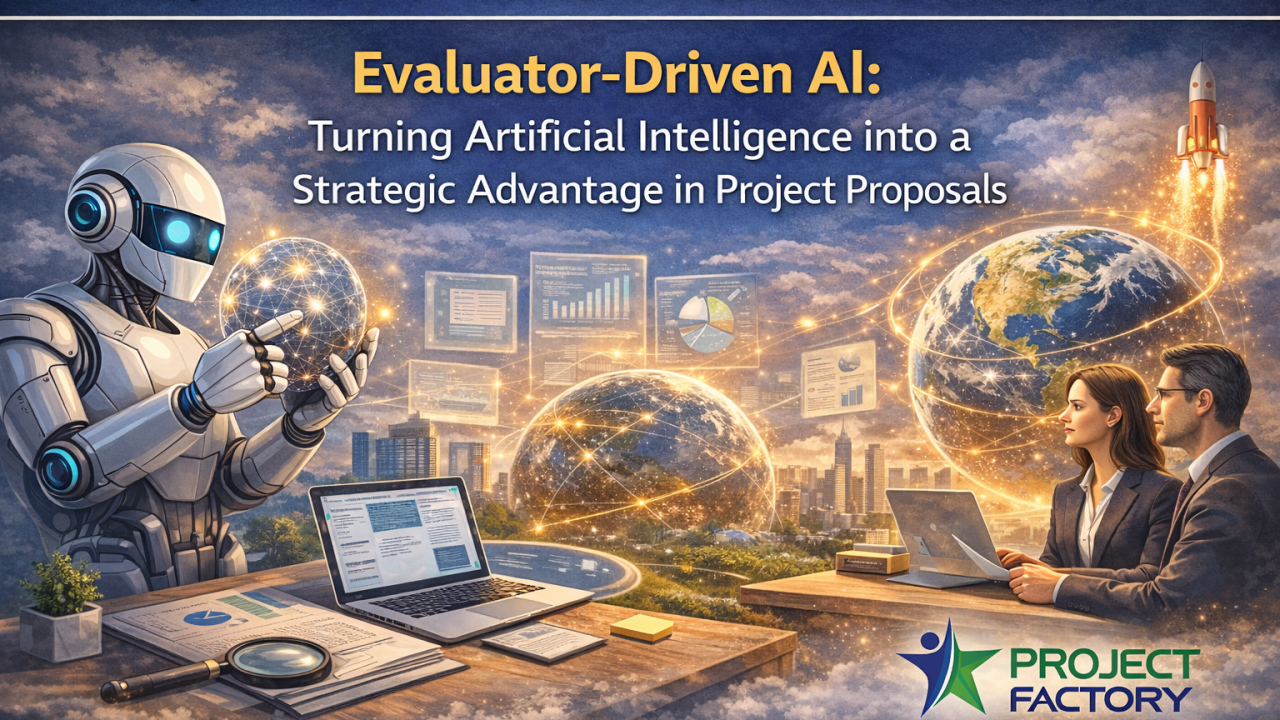
Opening: Why “Sounding Good” Is No Longer Enough
In competitive EU funding environments, a proposal does not win because it is pleasant to read. It wins because it is easy to trust. Evaluators do not reward enthusiasm; they reward design logic, evidence discipline, credible delivery capacity, and measurable impact. This is why many proposals fail even when the topic is relevant and the idea is strong: the text does not behave like a system. It behaves like a collection of well-meaning paragraphs.
Artificial intelligence can either amplify this weakness or eliminate it. If AI is used as a fast writing engine, it often produces smooth but generic language, vague promises, and repeated phrasing that feels detached from real delivery. If AI is used as an evaluator-oriented design partner, it becomes something very different: a strategic instrument that helps you think in the same structure evaluators use when awarding points.
This article explains how to use AI to “write like an evaluator reads.” Not to manipulate, but to align. Because evaluators are not looking for hidden tricks. They are looking for coherence. The strategic advantage appears when you use AI to enforce coherence before the evaluator ever needs to guess your intent.
1. What Evaluators Really Do When They Read a Proposal
To write evaluator-oriented text, you need to understand the evaluator’s cognitive workflow. Evaluators are typically under time pressure, reviewing multiple proposals. They do not read like your future participants will read. They read to check whether your claims are supported, whether your plan can realistically deliver, and whether your project fits the call with strong European added value.
Most evaluators make fast judgements based on signals. These signals are often subtle, but predictable. They include whether you define the problem precisely, whether your objectives are measurable, whether your partnership is logically designed, whether your activities have a credible timeline, and whether impact is more than a marketing slogan.
They also assess risk without always stating it directly. A proposal can lose points simply because it feels “unsafe” in a project sense: unclear roles, weak evidence, unrealistic scale, or impact claims that are disconnected from outputs. Evaluators do not need certainty that you will fail; they only need enough uncertainty to lower your score.
Your aim is to remove that uncertainty. AI becomes powerful when it helps you identify and eliminate uncertainty points systematically.
2. The Four Scoring Lenses: How to Translate Criteria into Writing Decisions
Most Erasmus+ and EU funding calls use scoring criteria that sound familiar: relevance, quality of design and implementation, partnership quality, and impact. Many applicants treat these as headings. Evaluators treat them as lenses. In practice, each lens contains a set of questions.
Relevance is about whether your project is necessary, aligned, and specific. Quality of design is about whether your plan is technically coherent and feasible. Partnership is about whether the consortium is a functional solution to the problem. Impact is about whether results will matter and remain after the project ends.
The strategic mistake is writing each section independently. Evaluators score your proposal as an integrated argument. Relevance should already anticipate impact. Partnership should already anticipate implementation. Design should already anticipate sustainability. When these links are missing, the evaluator has to do mental work to connect them, and mental work under time pressure often becomes doubt.
AI can help you build these links deliberately. The advantage is not in producing more text, but in producing text that does not require the evaluator to guess.
3. Using AI as an “Evaluator Simulator” Instead of a “Draft Generator”
The most useful mental shift is to stop treating AI as a writing assistant and start treating it as a reviewer. You do not want AI’s first draft. You want AI’s diagnostic power.
An evaluator simulator does three essential tasks. It highlights vagueness. It checks logic chains. It tests whether your claims are verifiable. When you prompt AI accordingly, it becomes a disciplined critic rather than an enthusiastic co-writer.
For example, a typical weak sentence in proposals is: “The project will improve inclusion and participation.” An evaluator simulator would respond with questions: inclusion of whom, participation in what, measured how, and improved compared to what baseline A draft generator might polish the sentence. A simulator forces you to strengthen it.
This is the core strategic advantage: AI helps you expose weak claims before the evaluator sees them. In other words, it accelerates your internal quality assurance.
4. The “Evidence Ladder”: How Evaluators Decide Whether to Trust You
Evaluators trust proposals that demonstrate a clear evidence ladder. An evidence ladder is the progression from context data to identified gap to designed intervention to measurable result. Each step should logically follow the previous one. If one step is missing, the ladder breaks and trust decreases.
Many applicants include data only at the beginning and then switch to generic narrative. Evaluators notice this. They may not comment on it explicitly, but it reduces credibility because the proposal starts as evidence-based and becomes promise-based.
AI can help you maintain an evidence ladder by ensuring that each major claim is anchored in something measurable. This does not mean every paragraph needs a statistic. It means key decisions must be supported. Why this target group Why now Why transnational Why this method Why this scale Why this partnership configuration
A strong proposal signals that decisions were made logically, not emotionally. AI can prompt you to justify decisions, then you refine those justifications with your context knowledge and available sources.
5. The “Logic Chain Audit”: Problem → Need → Objectives → Activities → Outputs → Results → Impact
One of the most frequent reasons for low scores is logic chain inconsistency. Applicants often describe a problem, then propose objectives that do not fully match it. Or they propose activities that produce outputs, but outputs are not linked to results. Or they claim broad societal impact without specifying the pathway.
Evaluators are trained to detect these breaks. They do not need to be harsh; the scoring framework pushes them toward lower points when the chain is weak.
AI can perform a logic chain audit if you provide it with your key elements and ask it to test alignment. The result is a structured diagnosis: what does not match, what is missing, and what needs to be clarified. Used well, AI becomes a coherence engine.
The evaluator-oriented approach is to treat your proposal like a system diagram. Every component must connect. The proposal is not a story; it is an argument with moving parts.
6. The “Single Priority Discipline”: Why Evaluators Penalise Overreach
A proposal that tries to solve everything usually solves nothing. Evaluators reward depth, not breadth. When applicants include many themes—digital, inclusion, green, participation, employment—without one clearly dominant axis, the proposal looks unfocused.
The strategic move is not to ignore cross-cutting priorities. It is to place them in a hierarchy. One priority drives the rationale and objectives. The others support implementation quality and widen impact. Evaluators want to see that you understand the call’s scope and have made deliberate choices.
AI can help here by generating alternative framings of the same idea and showing what changes when each framing becomes the main axis. This helps you select the axis that produces the strongest evaluator logic: the one where needs, objectives, partnership, and impact align most naturally.
Once the axis is chosen, AI can help you enforce language consistency across sections so the evaluator repeatedly encounters the same core logic expressed in different ways. Repetition of the central logic is not a weakness; it is a clarity tool.
7. Turning Objectives into Scorable Claims: The Role of Measurability
Evaluators award points more comfortably when objectives are measurable. The reason is simple: measurable objectives reduce uncertainty. They signal that you understand monitoring, that you can manage complexity, and that you can report results credibly.
A common applicant mistake is writing objectives as intentions rather than changes. “To raise awareness” is an intention. “To increase the percentage of participants who can demonstrate X competence by Y” is a change. Evaluators cannot score intentions highly because intentions are not verifiable.
AI can help convert intention language into change language by forcing you to define what will be different, for whom, by when, and measured how. The best objectives often embed indicators implicitly, without making the text feel like a spreadsheet. The wording itself hints at measurement.
When objectives are written this way, the entire proposal becomes easier to score because each later section can reference objective logic without adding complexity.
8. The Implementation Test: Feasibility Signals Evaluators Look For
Evaluators assess feasibility not just through timelines and budgets, but through narrative cues. They look for signs that you have implemented similar activities before, that roles are clear, that methods are realistic for the project duration, and that you have considered constraints.
Feasibility is often communicated through specificity. Vague language sounds like a plan that has not been tested. Specific language sounds like a plan that has been rehearsed. This is why detailed but readable descriptions matter. They reduce perceived risk.
AI can help you identify places where your text becomes vague, especially in implementation sections. It can also propose practical details, but those details must be verified and adapted. The strategic advantage lies in using AI to surface gaps, then filling them with realistic operational choices based on your organisational context.
A feasibility-oriented proposal is not the longest one. It is the one where the evaluator can mentally simulate delivery without encountering confusion.
9. Partnership as a Design Choice: What “Quality of Cooperation” Really Means
Applicants often describe partners by listing experience and reputation. Evaluators care more about functional complementarity. They ask whether the partnership is necessary, whether each partner has a concrete role, and whether cooperation mechanisms are credible.
A high-scoring partnership is not a museum of impressive institutions. It is an explanation of why each partner is a solution component. If the problem is inclusive sport participation, you may need grassroots implementers, disability expertise, municipal access, and knowledge institutions. If the problem is integrity and safeguarding, you may need governance expertise, training capacity, and policy connectors.
AI can help you build a partner role map before you select specific organisations. This is evaluator-oriented because it shows intentionality. Once you have role definitions, you can insert real partners into those roles and write their contributions as part of the solution architecture.
Evaluators also look for cooperation dynamics. Who leads what How is coordination managed How are decisions made How are conflicts handled These details, when written naturally, signal maturity.
10. Impact That Scores: From Visibility to Adoption
Impact sections are where many proposals collapse into generic claims. Evaluators are used to reading statements like “the project will have a positive impact on society.” Such statements do not score well because they are not linked to mechanisms.
High-scoring impact narratives describe adoption pathways. Who will use the outputs What will change in organisational routines What will continue after funding ends Which stakeholders will integrate the results into their systems
Evaluators also distinguish between outputs, results, and impact. Outputs are produced artefacts or activities delivered. Results are changes for participants or organisations. Impact is the broader, longer-term effect. If your text confuses these levels, scoring becomes difficult.
AI can help you structure impact logically by asking you to define each level explicitly and connect them. It can also help you write sustainability mechanisms that are credible: institutional integration, budget allocations, policy protocols, and community ownership.
Impact that scores is not the most ambitious; it is the most plausible and well-mechanised.
11. The Anti-Cliché Strategy: Why AI Text Often Loses Points If Unedited
A hidden risk of AI-generated drafting is stylistic sameness. Evaluators read many proposals. They recognise patterns. If your text is filled with vague buzzwords—innovative, empowering, raising awareness, fostering synergies—without concrete content, evaluators may perceive it as low substance.
This is not because evaluators are biased against AI. It is because cliché language is weak regardless of how it was produced.
The solution is not to avoid AI. It is to use AI for critique and refinement. One effective strategy is to ask AI to identify non-specific language and propose alternatives that include tangible elements: who, what, how, and measured by what.
After that, a human editor still matters. Your experience, your context, and your delivery realism are the elements that turn refined text into credible text.
Evaluator-driven AI is not about producing perfect prose. It is about producing auditable logic.
12. A Practical Evaluator-Oriented Workflow You Can Repeat
The strongest advantage of this approach is repeatability. Instead of relying on inspiration, you use a process that consistently increases quality.
Start by defining the single priority axis and testing it against the call scope. Then build an evidence ladder that connects the problem to measurable needs. Convert objectives into scorable change statements. Map activities to outputs and outputs to results. Use AI to audit the logic chain and identify breaks. Design partnership roles as solution components. Build impact as adoption, not visibility. Finally, run an anti-cliché review and replace vague language with concrete, context-rooted statements.
This workflow does not require more effort than traditional writing. It requires a different sequence. It moves from decisions to text, not from text to decisions.
That is why evaluator-driven AI is a strategic advantage: it reduces wasted writing and increases scoring clarity.
Closing: The Real Competitive Edge Is Clarity Under Evaluator Pressure
In the end, proposals win because they make evaluation easy. Not by simplifying the project, but by presenting it in a way that is coherent, evidence-based, and structurally aligned with award criteria.
Artificial intelligence becomes a competitive advantage when it helps you anticipate evaluator questions and answer them before they are asked. It helps you detect weak logic, tighten measurability, strengthen feasibility, and convert impact into adoption pathways. It forces discipline where proposals usually become vague.
If you use AI this way, you do not merely write faster. You write with fewer hidden risks. And that is what increases scores.
If you want, I can now proceed with the 3rd title in the same format and length (≈3000 words), maintaining the same evaluator-oriented tone and strong readability.
NEXT... Below are 10 strong, shareable article titles focused on AI-supported project development, specifically aligned with Erasmus+ / EU project writing and design:
- From Idea to Funding: The New Logic of Project Development with Artificial Intelligence https://www.linkedin.com/pulse/project-factory-from-idea-funding-new-logic-ali-ulusoy-wiynf/
- Artificial Intelligence That Thinks Like an Evaluator: A Strategic Advantage in Project Texts https://www.linkedin.com/pulse/evaluator-driven-ai-turning-artificial-intelligence-strategic-ulusoy-1omuf/
- From Needs Analysis to Impact: How to Build an AI-Supported Project Structure
- Stronger Objectives, More Measurable Results with Artificial Intelligence
- Using Artificial Intelligence in Project Writing: Copying or a Smart Assistant
- Targeting 95+ Scores in EU Projects: Strategic Writing Techniques with Artificial Intelligence
- Building Work Package Logic with Artificial Intelligence: How Does It Reduce Errors
- Designing Project Mechanisms, Not Just Project Texts, with Artificial Intelligence
- Save Time Without Compromising Quality: Project Development with Artificial Intelligence
- Human Touch + Artificial Intelligence: The New Formula for Winning Project Proposals
- We can add value to your projects with our organizations in Türkiye and Estonia. Would you like to benefit from our contribution in writing your central projects

- Ali ULUSOY
- Proje Fabrikası Kurucusu / President of Project Factory
- Engelsiz ve Mutlu Yaşam Derneği Başkanı / President of Barrier Free and Happy Life Association
- happykidstr@gmail.com https://projehaberleri.com/
- Stay Connected
- Facebook: mahalleninalisi Twitter / X: Happykidsturke2 LinkedIn: happykidsturkey