If you are considering ERASMUS-SPORT-2026 under Not-for-profit European Sport Events, here is the mindset shift that separates “nice festivals” from proposals that feel inevitable to fund.
This action is designed to support sport events with a European dimension, but the evaluators are not buying tickets to your event. They are investing in the societal outcomes your event triggers: inclusion, equality, volunteering capacity, and healthier lifestyles. In other words, your event is the “peak moment” — the real proposal is the system you build around it.
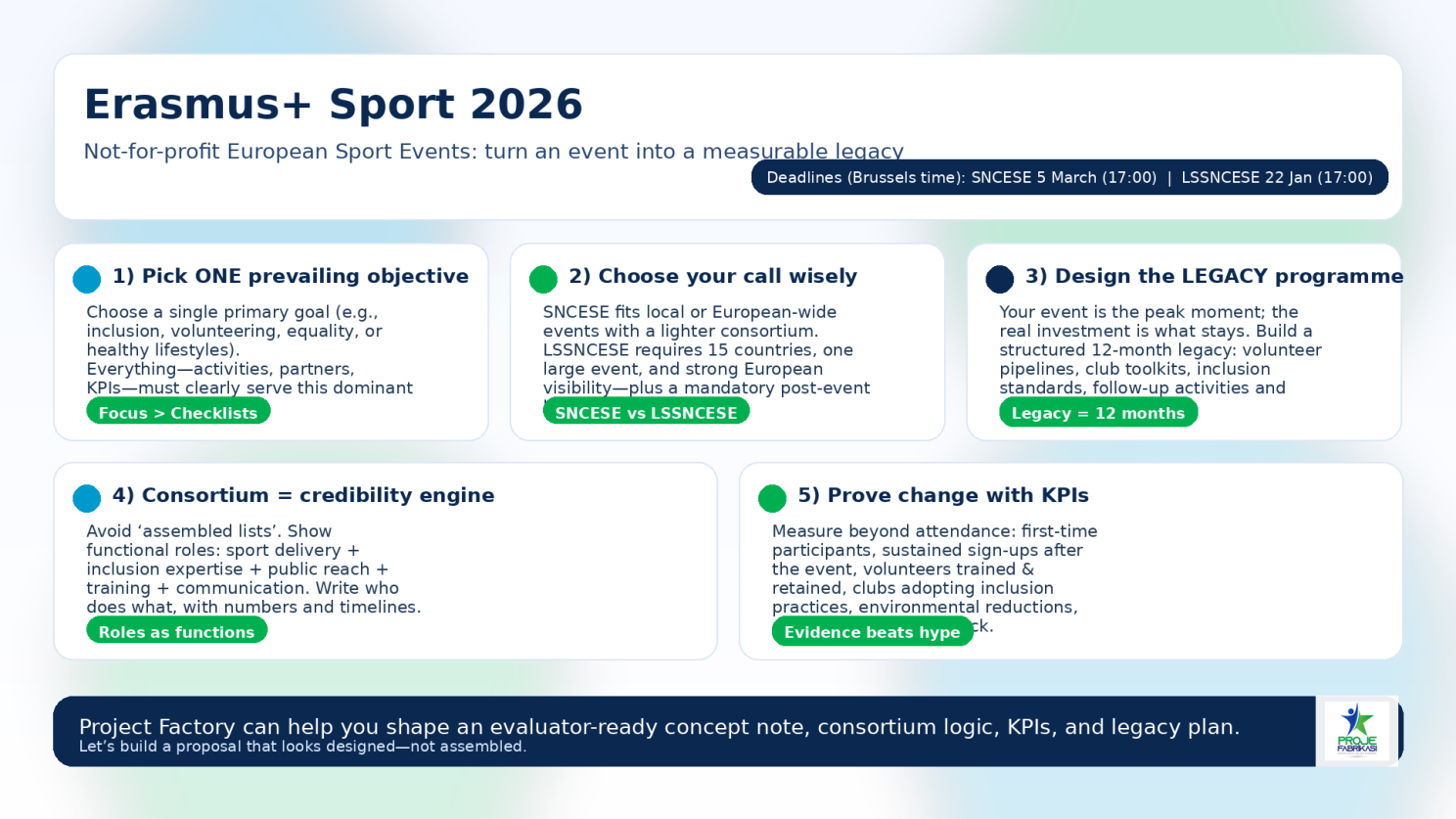
1) First, choose ONE prevailing objective — and build everything around it
The call is very clear: projects should focus on one main objective (you may touch the others, but one must clearly dominate). The eligible objective areas include:
- volunteering in sport
- social inclusion through sport (with a strong emphasis on inclusion of people with disabilities)
- fighting discrimination in sport (including gender equality)
- encouraging healthy lifestyles for all (HEPA, HealthyLifestyle4All, European Week of Sport, etc.)
A strong proposal doesn’t list these as checkboxes. It chooses one, frames a credible need, and then shows why a European-scale event is the right instrument to produce measurable change.
2) Understand the big distinction: SNCESE vs LSSNCESE (and why it changes everything)
There are two main call IDs you’ll see:
- ERASMUS-SPORT-2026-SNCESE (local Type I & II + European-wide events) with a deadline of 5 March, 17:00 Brussels time
- ERASMUS-SPORT-2026-LSSNCESE (Large-Scale European Sport Events) with a deadline of 22 January, 17:00 Brussels time
For Large-Scale (LSSNCESE), the bar rises sharply:
- minimum 15 organisations from 15 different Erasmus+ Programme Countries (MS + associated)
- a single large event showcasing at least 7 different sports
- legacy activities for one year after the event (health/social/educational/environmental benefits + inclusion)
This is why “we will organise a big event” is not a concept. LSSNCESE is a mini-ecosystem intervention with a high-visibility peak and a compulsory post-event legacy runway.
3) What “2026 tone” rewards: proof of change, not celebration
From the 2026 perspective, proposals that win tend to do three things exceptionally well:
They turn legacy into a structured programme. Not a vague “we will keep promoting sport”, but a one-year legacy plan with concrete mechanisms (club toolkits, volunteer pipelines, inclusion standards, follow-up sessions, community activation, partner replication).
They treat sustainability and inclusion as operational design — not marketing. How is the event accessible (physical, sensory, financial) How is safeguarding embedded How do you prevent greenwashing and show measurable environmental action (travel, waste, reuse, procurement, venues).
They quantify the pathway from participation to behaviour change. For example: how many first-time participants, how many sustained activity sign-ups after the event, how many volunteers trained and retained, how many clubs adopt inclusion practices, what measurement tools prove it.
4) The consortium is not a formality — it’s your credibility engine
With 15 countries involved (for LSSNCESE), the evaluator is silently asking: “Is this consortium a real European delivery network, or just a list?”
The strongest consortia usually show a deliberate mix:
- sport organisations (delivery and access to communities)
- inclusion/Disability expertise (quality and safeguarding)
- public bodies (reach, sustainability, policy uptake)
- education/training actors (volunteering pathways, capacity building)
- communication partners (European visibility, replication)
Most importantly, roles must be written as functions, not labels. “Partner X supports dissemination” is weak. “Partner X runs national volunteer recruitment, trains 80 volunteers using a shared curriculum, and reports retention at 3 and 9 months” reads like a fundable system.
5) A simple way to stress-test your concept before you write a single page
Ask these three questions:
- If the event was cancelled, would the project still have value If the answer is “no”, your legacy is too thin.
- Can another country replicate your model with your outputs If the answer is “not really”, your EU added value is not explicit enough.
- What will still exist 12 months after funding ends If the answer is “awareness”, you need institutional anchoring (agreements, adoption plans, annual calendars, partner commitments, local integration).
If you’re building an LSSNCESE application, here’s the practical next step
Start by drafting a one-page “spine” that includes:
- the chosen prevailing objective
- the need statement (EU + partner-country realities)
- the event architecture (7+ sports, inclusivity design, volunteering design)
- the one-year legacy programme
- the measurement plan (KPIs + tools + timeline)
Then write the proposal around that spine, not around a calendar.
We’re ready to partner on your Erasmus+ Sport project—use our proposal-writing experience to strengthen your application Contact: Ali ULUSOY happykidstr@gmail.com | WhatsApp: +90 530 363 3120
Ready to Win Centralised Calls Start with Project Factory! Why Project Factory as Your Solution Provider https://drive.google.com/file/d/10H8fn-O8G2z43UONl5--GVCadPG9pMPV/view?usp=sharing
#ErasmusPlus #ErasmusSport #SportForAll #InclusionThroughSport #DisabilityInclusion #GenderEquality #Volunteering #HealthyLifestyle4All #HEPA #EuropeanWeekOfSport #Safeguarding #GreenSportEvents #ProjectDesign #EUGrants #EACEA