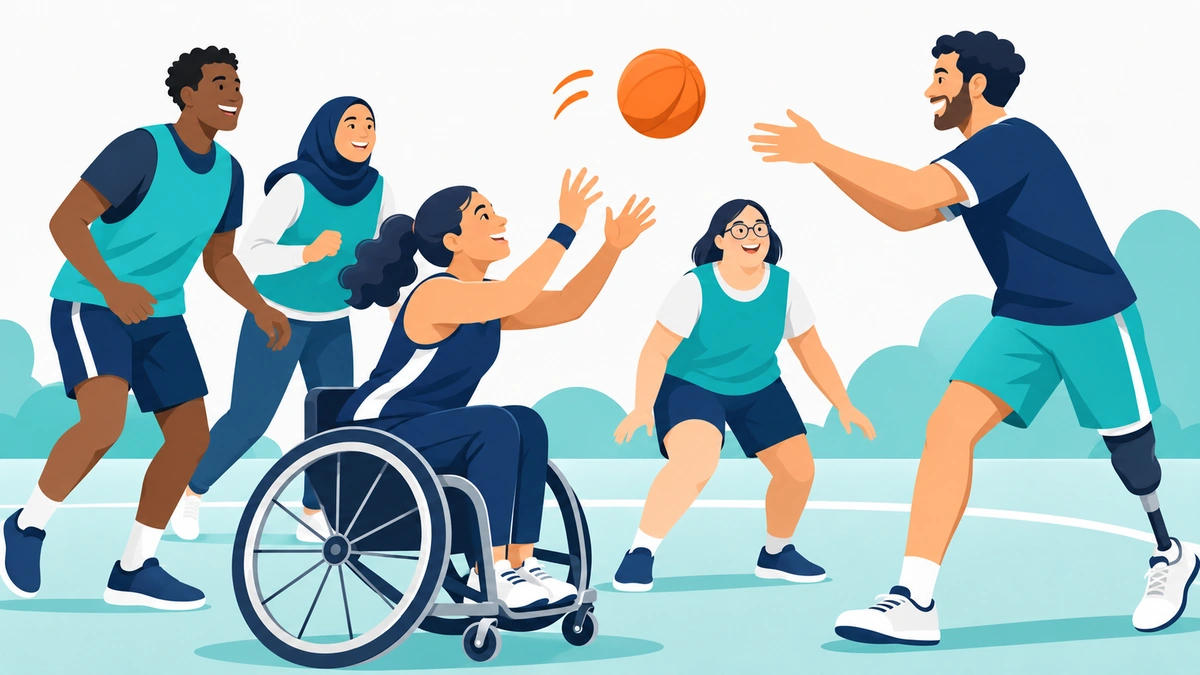
Sport is one of the most dynamic parts of the 2027 Erasmus+ Annual Work Programme. The programme keeps its established priorities — healthy lifestyles, integrity and values, and education through sport — but adds a stronger policy framework around the European Sport Model, international cooperation, inclusion, sustainability and evidence-based sport policy.
One development is especially concrete: the #BeActive Winter initiative will take place for the first time in 2027.
1. A new strategic framework for European sport is emerging
The 2027 Work Programme states that Erasmus+ will support the EU sport policy agenda in line with the EU Work Plan for Sport 2024–2027 and the upcoming European Commission Communication “A Strategic Vision for Sport in Europe: Reinforcing the European Sport Model”.
This signals that sport projects will increasingly be read not only as activity-based initiatives, but also as contributions to wider European objectives: integrity and values, socio-economic and sustainable development, participation in sport and health-enhancing physical activity, and the international dimension of sport policy.
For applicants, strategic relevance therefore becomes more important. A project should explain what system-level issue in sport it is addressing and why transnational cooperation is needed.
2. #BeActive Winter launches for the first time in 2027
The Work Programme explicitly states that the #BeActive Winter initiative will take place for the first time in 2027, showcasing ways people can remain active during the winter season.
This is a genuine 2027 novelty and an important thematic signal. It creates opportunities for ideas linked to seasonal inactivity, outdoor and indoor community sport, older adults, families, people with disabilities, rural areas and inclusive winter physical activity.
Projects do not need to copy the campaign, but they can align with the wider objective of extending active lifestyles across the whole year.
3. Healthy lifestyles broaden beyond organised sport
The programme continues to promote healthy lifestyles for all, but the 2027 policy language explicitly includes all forms of participation in sport and physical activity, including self-organised sport.
This matters. Erasmus+ Sport is not limited to clubs, federations and formal competition. Walking groups, community exercise, informal physical activity, recreational sport and locally organised participation can all fit the policy direction when they are linked to inclusion, health, education or social outcomes.
This creates strong opportunities for municipalities, NGOs, community organisations, disability organisations and local sport networks.
4. Integrity and values become even more visible
The Work Programme continues to address cross-border threats to sport such as corruption, doping and match fixing. It also places major emphasis on good governance, social inclusion, non-discrimination and the fight against violence, harassment and intolerance in sport.
The message for project developers is clear: values should not be treated as a decorative section in the application. Safeguarding, governance, equality, fair play, anti-discrimination and ethical standards should be translated into concrete methods, training and organisational procedures.
5. Sport as a tool for peace, social cohesion and post-conflict recovery
The 2027 framework continues to promote peace through sport, including support to sport organisations working in relation to the consequences of Russia’s war of aggression against Ukraine.
Capacity Building in Sport also highlights social inclusion, cohesion, common values, gender equality, integration of migrants and post-conflict reconciliation.
This strengthens the position of sport as a social and educational instrument, not only a physical activity. Projects that combine sport with psychosocial support, intercultural dialogue, disability inclusion, refugee integration or community rebuilding can therefore have strong strategic relevance.
6. International cooperation becomes more important
The EU Work Plan for Sport calls for a stronger international dimension of EU sport policy. In 2027, Cooperation Partnerships may involve entities from certain non-associated neighbouring countries as partners where their participation brings essential added value and is duly justified.
Capacity Building in Sport continues to support partnerships with eligible third countries, with a focus on strengthening grassroots organisations, inclusion, values, education through sport and cooperation across regions.
At programme level, Switzerland and the United Kingdom are listed among third countries associated to Erasmus+ in 2027, subject to the conditions of their respective association agreements. This also broadens the partnership landscape for sport organisations.
7. Mobility of sport staff is firmly established
Key Action 1 mobility in sport has an indicative allocation of EUR 25 million in 2027.
This confirms that learning mobility is now a substantial part of Erasmus+ Sport. Coaches and other sport staff can use mobility to develop competences, learn from other organisations and transfer methods back into their institutions.
The strongest mobility designs will connect individual learning to organisational development: new inclusive coaching methods, safeguarding practices, community sport models, sustainability, digital tools or governance improvements.
8. Cooperation Partnerships and Small-scale Partnerships remain major routes
The indicative 2027 allocation for Cooperation Partnerships in Sport is EUR 59.243 million, while Small-scale Partnerships receive EUR 10 million.
Small-scale Partnerships remain particularly valuable for grassroots organisations and newcomers. Cooperation Partnerships allow more ambitious transnational development, transfer and scaling of practices.
In both cases, proposals must address at least one programme priority. The sport-specific priorities are encouraging healthy lifestyles for all, promoting integrity and values in sport, and promoting education in and through sport.
9. Not-for-profit European Sport Events keep a strong role
Not-for-profit European Sport Events receive an indicative EUR 15 million in 2027. The action supports European Local Events, European-wide Events and Large-Scale European Events with a strong European dimension and societal legacy.
Relevant themes include volunteering in sport, social inclusion through sport, non-discrimination, healthy lifestyles and health-enhancing physical activity.
The word “legacy” is important. A strong event proposal should show what remains after the event: new participation structures, volunteer capacity, partnerships, inclusion mechanisms, community impact or reusable methods.
10. SHARE 2.0 and evidence-based policy reinforce the ecosystem approach
The Work Programme states that SHARE 2.0 will continue with four communities of practice focusing on access to EU funding, health, innovation and sustainability. The annual EU Sport Forum and evidence-based policy work also continue.
This demonstrates that Erasmus+ Sport is increasingly building an ecosystem around projects — connecting practitioners, policymakers, funders and evidence.
What should Sport applicants do differently in 2027
The strongest proposals will connect physical activity with a wider social objective, demonstrate real inclusion, explain their European added value, build organisational capacity and show a credible legacy. They will also treat safeguarding, values, sustainability and evidence as part of project design rather than as separate compliance themes.
For Project Factory, the key message is this: 2027 Sport proposals should move from “organising sport activities” to “using sport to create measurable European social value”. The launch of #BeActive Winter, the stronger international dimension and the emerging Strategic Vision for Sport all point in that direction.
Source: European Commission, 2027 Annual Work Programme “Erasmus+”: the Union Programme for Education, Training, Youth and Sport, C(2026) 7171, 15 October 2026.
Note: The Annual Work Programme defines policy priorities and indicative allocations. Detailed eligibility rules, deadlines, grant amounts and application procedures are set out in the relevant 2027 Erasmus+ Call for Proposals and Programme Guide
-------------------------------------------------
Warmest regards/ Saygılarımızla,
Av. Ali ULUSOY
Proje Fabrikası Kurucusu / President of Project Factory
Engelsiz ve Mutlu Yaşam Derneği Başkanı / President of Barrier Free and Happy Life Association
Kocatepe Mahallesi Hatay Sokak 4/ 19 - 20,
Sabancı İş Merkezi 5. kat, 06420
Çankaya - ANKARA
Mobil: (+90 530) 363 3120
🌐 Stay Connected
Facebook: mahalleninalisi Twitter / X: Happykidsturke2 LinkedIn: happykidsturkey Instagram: aliulusoy1961
Project Factory Brochure: https://drive.google.com/file/d/1GlrkbrHYqT2_8uFHMlHWlChoBHieZRv_/view?usp=drive_link
PROJE FABRİKASI / PROJECT FACTORY https://secure.smore.com/n/thw8q-proje-fabrikasi
https://drive.google.com/file/d/1K358bMgeGd3AsA7MP95cpPvdpHNydqmF/view?usp=sharing
ProjectFactory-ErasmusCourses File 1 _compressed:
https://drive.google.com/file/d/1oimc68vv6KVU88Z5uqMcCZS7GupsVlsu/view?usp=drive_link
Project_Factory_Erasmus_KA1_18_Courses_English_Deluxe_Catalogue_compressed.pdf:
https://drive.google.com/file/d/1ZUsCdsXlvlD1tjQ58DIDlRVMbuA5LZVO/view?usp=drive_link