
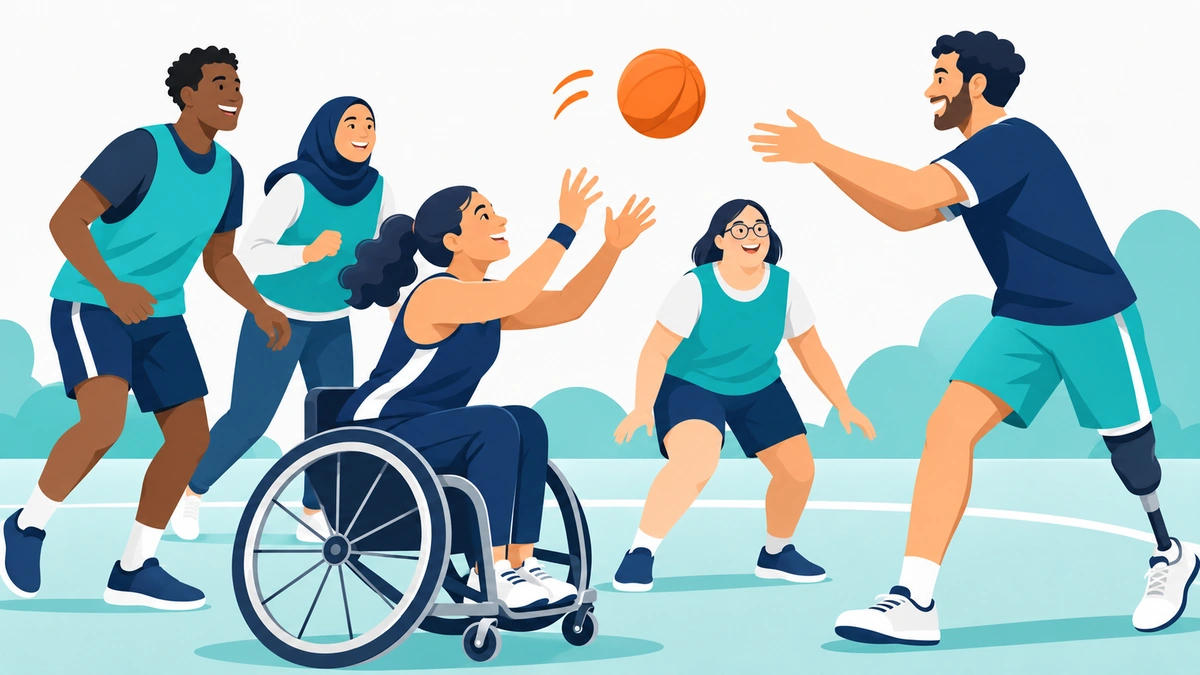
 Thematic Portfolio Illustration
AUTISM ACTIVE CLUBS — Sensory-Friendly Sport Pathways for Autistic Children and Youth
AUTISM ACTIVE CLUBS tackles sensory, communication and predictability barriers excluding autistic children and youth from grassroots sport. Combining a Sensory-Friendly Sport Club Audit, autism-informed coach training and family–club communication protocols across European pilots, this pre-consortium concept actively seeks an eligible Applicant / Coordinator for the 2027 EACEA Sport call.
1. Need, Context and Problem Statement
Across Europe, grassroots sport environments frequently remain sensory-heavy, unpredictable and insufficiently informed about autism, creating persistent barriers for autistic children, young people and their families. Recent cross-country European survey evidence from the SACREE study (540 responses across multiple European countries) demonstrates that 28.8% of autistic respondents report no regular physical activity, while even active participants average roughly 115 minutes per week—often below recommended health benchmarks. Furthermore, because proxy responses from parents and caregivers outnumber direct autistic voices in existing datasets (64.3% versus 25.5%), sport programmes rarely embed accessible consultation with autistic youth themselves. Generic disability awareness materials do not equip clubs or coaches with operational procedures for sensory regulation, structured communication or reasonable adjustments.
2. Project Aim, Specific Objectives and Intervention Logic
AUTISM ACTIVE CLUBS aims to develop, test and validate an inclusion-by-design grassroots sport model centred on sensory accessibility, predictable routines and structured family–club collaboration rather than generic disability messaging. Its specific objectives are to: (1) establish comparable organisational, country and target-group baselines incorporating direct autistic and family consultation; (2) co-design modular club standards, coaching tools and communication protocols tailored to clearly defined youth age bands; (3) strengthen practitioner competence and club readiness for sensory-friendly delivery; (4) pilot and evaluate adapted participation pathways in real grassroots sport settings; and (5) secure formal organisational adoption and European replication through sport bodies and autism networks.
3. Core Activities, Methodology and Work Packages
The proposed methodology follows a structured five-work-package chain linking evidence validation to institutional adoption. WP1 governs project coordination, quality assurance, ethics and safeguarding compliance. WP2 conducts accessible baseline mapping and co-design consultations with autistic children and youth, families, coaches and club staff to document lived barriers before freezing design specifications. WP3 develops the Sensory-Friendly Sport Club Audit, modular autism-informed coaching practice modules and a structured Family–Club Communication Protocol. WP4 prepares delivery staff, establishes site adaptation plans and runs monitored grassroots club pilots measuring participation fidelity, session retention and practice change. WP5 synthesises findings into a validation casebook and supports dissemination, sustainability and cross-border transfer.
4. Expected Results, Concrete Outputs and Target-Group Impact
Planned outputs include the Sensory-Friendly Sport Club Audit, an Autism-Informed Coach Toolkit, a Family–Club Communication Protocol, site-level pilot adaptation plans, a transnational validation casebook and a European replication guide. For autistic children and youth, the model is designed to provide calmer, more predictable and sustained sport pathways with stronger agency in shaping reasonable adjustments. Families gain transparent communication channels and trust in local club safeguarding, while coaches and grassroots clubs acquire role-specific procedures to manage sensory loads, onboarding routines and inclusive group dynamics. Numeric reach, session frequency and retention thresholds remain pre-consortium planning parameters to be locked following WP2 baseline validation.
5. Institutional Adoption, Transferability and Sustainability
To prevent one-off awareness activities that fade after grant completion, AUTISM ACTIVE CLUBS embeds formal adoption gates into pilot implementation. Participating clubs and umbrella sport organisations will integrate sensory-audit checklists, onboarding protocols and reasonable-adjustment workflows into their standard operating procedures and coach induction offers. By distinguishing universal sensory-inclusion principles from local facility and national sport-system adaptations across diverse European contexts, the replication guide enables federations, municipalities, schools and grassroots clubs outside the initial partnership to adopt the model at low operational cost after European funding ends.
6. Sought Applicant / Coordinator Profile and Consortium Structure
This concept is currently at the pre-consortium stage and actively seeks an eligible Applicant / Coordinator organisation—such as a national or regional sport federation, an established inclusive or grassroots sport organisation, a Paralympic or adaptive-sport body, or a university sport-inclusion centre—capable of anchoring European submission under the provisional 2027 EACEA Cooperation Partnerships in Sport call. The indicative consortium architecture combines a sport-system owner, a specialist autism organisation, an academic evaluation partner, at least two grassroots pilot sport clubs and a family-representative organisation, with final partner mandates, countries and lump-sum budget allocations to be co-defined prior to submission.
Sought Applicant / Coordinator Organisation Profile
Seeking Applicant / CoordinatorSought Organisation Type
National or regional sport federation, Paralympic or adaptive-sport umbrella body, established grassroots/inclusive sport organisation or club network, or university faculty/centre specialising in adapted physical activity and inclusive sport.
Expected Thematic Expertise
Demonstrated operational legitimacy in grassroots or adaptive sport governance, safeguarding compliance with children and youth, access to club networks for sensory-friendly piloting, and capacity to coordinate multi-actor European sport partnerships.
Expected Role in Coordination & Proposal Preparation
Lead consortium formation and Part B technical finalisation, submit the centralised application to EACEA as Coordinator via the EU Funding & Tenders Portal, direct WP1 governance, financial and safeguarding controls, and anchor formal sport-sector adoption of the Sensory-Friendly Sport Club Audit.
Official Country & Institutional Eligibility
Any public or private legal entity active in the field of sport and physical activity, legally established in an EU Member State or third country associated to the Erasmus+ Programme, holding a valid PIC on the EU Funding & Tenders Portal, subject to verification against the official 2027 Erasmus+ Programme Guide and EACEA call conditions.
How to express interest: Eligible organisations matching the profile above can submit the form below; the project code and title are automatically attached to your expression of interest.