
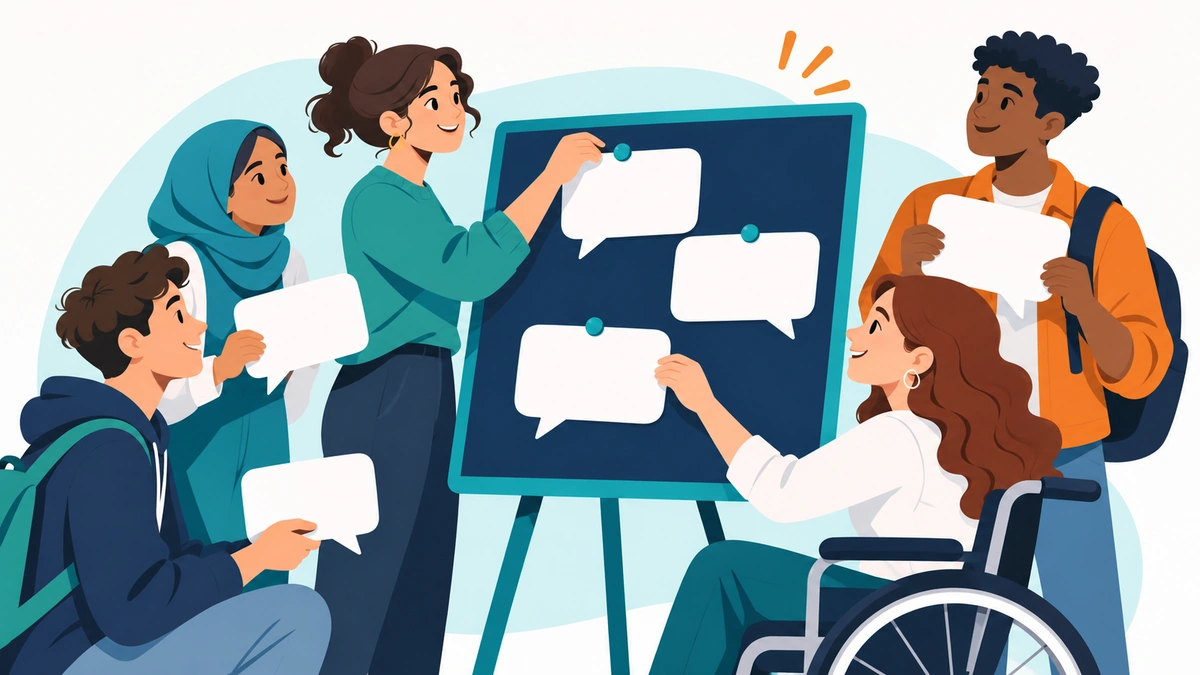
 Thematic Portfolio Illustration
AI AMBASSADORS — Disability Youth Leadership, Peer Education and Inclusive Digital Advocacy Network
Young people with disabilities remain underrepresented in mainstream youth councils and debates shaping digital and AI futures. AI AMBASSADORS builds a disability-led Youth Ambassador Academy, peer-workshop toolkit and civic-alliance model, seeking an eligible Lead Applicant / Coordinator for the 2027 call.
1. Need, Context and Problem Statement
Across Europe, young people with disabilities are frequently addressed as passive recipients of support services rather than visible leaders, peer educators and agenda-setters in mainstream youth organisations, municipal youth councils and digital-policy debates. As artificial intelligence transforms study, social media, creative expression and youth transitions to work, inaccessible participation formats, lack of reasonable accommodation and limited leadership coaching prevent disabled youth from shaping how youth spaces govern emerging technologies. Mainstream youth bodies likewise report uncertainty on how to make councils and campaigns genuinely inclusive across diverse sensory, physical, neurodivergent and communication needs.
2. Project Aim, Specific Objectives and Intervention Logic
AI AMBASSADORS develops, tests and transfers a youth-led ambassador network combining responsible AI literacy, disability rights, public speaking, peer facilitation and structured alliance-building with local and European youth bodies. Provisionally positioned under Erasmus+ Cooperation Partnerships in Youth, the model equips young people with disabilities not merely to attend workshops, but to co-govern the curriculum, lead peer-education sessions and negotiate concrete accessibility commitments with youth councils. Specific objectives cover validating youth participation barriers, training at least 100 disabled youth learners, supporting active peer ambassadors, reforming youth-council governance charters and building a durable European alliance.
3. Core Activities, Methodology and Work Packages
Delivered over an indicative twenty-four-month cycle, five interconnected work packages are reinforced by a physical kick-off meeting and three accessible transnational learning mobilities. Work Package 1 oversees consortium coordination, safeguarding, ethics, reasonable accommodation budgets and lump-sum financial control. Work Package 2 surveys disabled young people on AI concerns and participation barriers, interviews youth councils and decision-makers, and establishes a youth-led Co-Design Board. Work Package 3 produces the Accessible AI and Rights Ambassador Academy, a micro-credential/competence badge concept, a Peer Workshop Kit and an Inclusive Youth-Council Governance Charter. Work Package 4 runs two rounds of ambassador training, peer workshops and local action challenges, while Work Package 5 leads European dialogue and replication.
4. Expected Results, Concrete Outputs and Target-Group Impact
Under indicative pre-consortium planning targets subject to baseline verification, at least 100 young people with disabilities will complete Academy modules, at least forty will step into active Ambassador roles delivering roughly eighty peer-led sessions, accessible youth-led campaigns will reach at least 1,000 peers, and at least eight youth councils or local public bodies will formally engage with youth-authored recommendations. Tangible outputs comprise the multi-format Ambassador Academy curriculum, competence-recognition framework, Peer Facilitation Kit, Youth-Council Accessibility Charter, youth-led campaign assets and an open European Replication Package.
5. Institutional Adoption, Transferability and Sustainability
Sustainability is anchored in permanent governance changes within participating youth organisations and municipal youth councils alongside alumni peer-mentoring cohorts. All facilitation cards, campaign templates and council charters include easy-read, screen-reader-ready, captioned and non-digital formats so youth centres can run inclusive ambassador cycles within routine budgets. Through Work Package 5, common European youth-leadership and safeguarding standards are clearly distinguished from local municipal youth-council statutes, enabling rapid transfer across European youth networks.
6. Sought Applicant / Coordinator Profile and Consortium Structure
We invite expressions of interest from an eligible Lead Applicant / Coordinator—such as a disability-led youth NGO, representative organisation of persons with disabilities with an active youth wing, inclusive youth-work organisation or municipal youth participation body—with direct trust among disabled young people, strong safeguarding standards and Erasmus+ KA220 coordination capacity. The indicative six-partner consortium unites the Coordinator with a mainstream youth-participation NGO, a municipality or youth council, an AI- and media-literacy learning partner, a university youth/inclusion research unit and an accessibility specialist partner.
Sought Applicant / Coordinator Organisation Profile
Seeking Applicant / CoordinatorSought Organisation Type
Disability-led youth organisation, representative organisation of persons with disabilities (OPD) with an active youth structure, inclusive youth-work NGO, or municipal youth participation body.
Expected Thematic Expertise
Demonstrated experience in disability-inclusive youth leadership, non-formal peer education, youth councils or civic advocacy, youth safeguarding and transnational Erasmus+ KA220-YOU project management.
Expected Role in Coordination & Proposal Preparation
Serve as Lead Applicant / Coordinator for proposal finalisation and National Agency submission; lead WP1 governance, youth safeguarding, reasonable accommodation and lump-sum oversight; anchor youth co-design and Ambassador Academy pilots; and sustain the alliance network.
Official Country & Institutional Eligibility
Open to any eligible public or private body active in youth work, youth participation or disability inclusion and legally established in an EU Member State or third country associated to the Erasmus+ Programme under KA220-YOU rules, subject to verification against the official 2027 Programme Guide.
How to express interest: Eligible organisations matching the profile above can submit the form below; the project code and title are automatically attached to your expression of interest.