December 2004 - August 2026
When I think back to the time when I first truly entered the world of European Union projects, I still remember those early days very clearly.
Our first Leonardo Type A project had been approved. The project focused on the inclusion of children with disabilities in early childhood education. A professor from Hacettepe University, a social worker, a child development specialist and I travelled to Stockholm.
At the time, I had no idea that this would become the beginning of such a long journey for me.
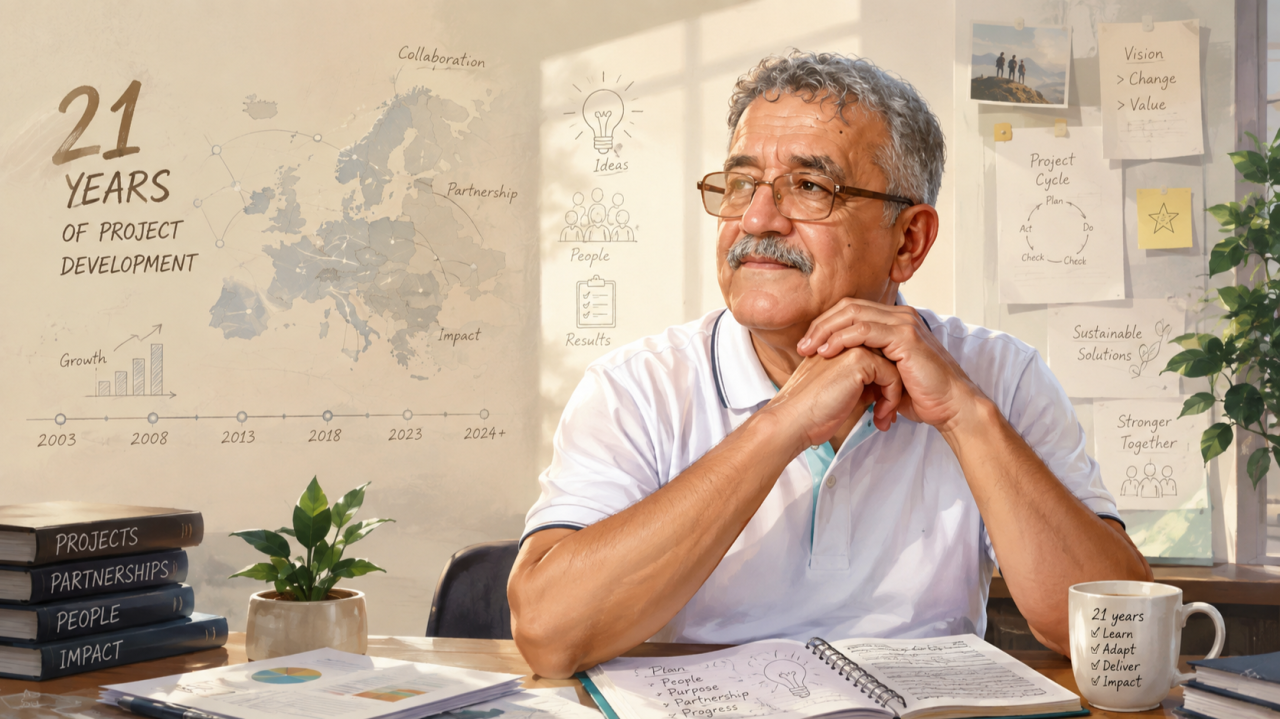
Today, when I look back, more than 21 years have passed.
Over these years, I have been involved in hundreds of project ideas. I have written proposals, searched for partners, joined projects as a partner, coordinated projects, attended meetings and implemented projects. Some of our proposals were approved. Others were rejected. I have seen projects that we believed were excellent fail to get funded. I have also seen projects we were less confident about receive very high scores.
I have had the opportunity to work with universities, municipalities, civil society organisations, companies, public institutions, sports organisations, disability organisations and hundreds of people from different European countries.
And eventually, I learned one fundamental lesson:
Project development is much bigger than writing a project proposal.
1. A Good Project Does Not Start with a Good Idea. It Starts with a Real Problem.
There is one mistake almost all of us make in the early years.
First, we come up with an interesting idea.
Then we start searching for a call that might fit that idea.
Over the years, I learned that the opposite approach is usually much stronger.
First, we need to listen to people.
Why can a young person not find a job
Why is a person with a disability excluded from social life
Why is a woman unable to participate in economic life
Why is a municipality unable to provide the service its citizens need
Why is a vocational education institution unable to respond to labour-market needs
Why is a sports club unable to reach disadvantaged people
What is the real problem
That is where a good project begins.
Because evaluators are not primarily interested in how creative we are. They want to know whether the problem we have defined is real and whether the solution we are proposing genuinely responds to that problem.
Today, when a project idea comes to me, my first question is no longer:
“What are we going to do?”
My first question is:
“What do we want to change?”
2. Project Writing Is Not a One-Person Job
This has been one of the most important lessons of my 21 years.
Good projects are written by good teams.
No single person can know everything.
One person understands the subject deeply.
Another knows the target group.
Someone conducts the research.
Someone understands the budget.
Someone follows European policies.
Someone knows the field.
Someone writes well.
And someone else reads the proposal like an evaluator and sees the weaknesses that the rest of us have missed.
When all of these come together, the project becomes stronger.
That is why, over time, I began to believe that building the right project team is even more important than project writing itself.
At this point in my journey, I believe this:
A project writer’s greatest capital is not writing ability, but the people with whom they are able to create something together.
3. The Right Partner Is More Valuable Than a Well-Written Paragraph
In the past, when looking for partners, the main question was:
“Do we have a partner from this country?”
Today, I know that this is not enough.
Now I ask:
Why is this organisation in the project
What problem will it help solve
Which target group can it reach
Which work package can it lead
What knowledge, network, institutional capacity or pilot environment can it bring
Because a consortium is not a collection of countries.
It is an architecture of capacities.
The European Commission used a very good phrase during the 2026 Erasmus+ Sport Info Day that summarises something I had already learned through years of practice:
“Think of the partners for your project, not for your application.”
In other words:
Do not find partners just to complete the application.
Find partners to make the project work.
4. Partnership Is, Above All, a Relationship of Trust
You can know hundreds of organisations in European projects.
But knowing hundreds of organisations does not necessarily mean you have a strong network.
A real network means this:
When a project idea emerges, there are people you can call.
They know how you work.
You know how they work.
You trust each other.
You do not only answer the phone when things are going well. You also answer when a problem appears.
Over the years, many project partners have become friends.
With some, we worked on one project.
With others, we have continued developing different projects together for years.
And I learned something very simple:
Projects end. Good relationships continue.
And those relationships generate new projects.
That is why, for me, networking is no longer about collecting business cards.
Networking is about accumulating trust.
5. Project Development Requires Patience
This is one of the hardest lessons to learn.
When a project is rejected, it hurts.
Especially if you have worked on it for months.
If you have built the consortium.
Conducted research.
Stayed up late working on the text.
And then the result arrives and you lose by only a few points.
That is not easy to accept.
But over time, I learned:
Not every rejected project is a failed project.
Some projects go to the wrong call.
Some have weak consortiums.
Some have insufficient needs analysis.
Some are good, but the competition is exceptionally strong.
And sometimes we simply made mistakes.
The important thing is not to throw the rejected proposal away, but to look at it again.
Where did the evaluator deduct points
What did we fail to see
Which assumption was wrong
What should we do differently next time
Sometimes, if you read it carefully, a rejection letter can teach you more than an expensive project-writing course.
6. You Cannot Write a High-Scoring Proposal Without Thinking Like an Evaluator
For many years, I looked at projects through the eyes of the writer.
Then something important changed.
I started looking at them through the eyes of the evaluator.
That is a completely different perspective.
The writer thinks:
“What do I want to explain here?”
The evaluator thinks:
“Where is the answer to the criterion I am assessing?”
That difference is enormous.
Today, when I write a project, I constantly ask myself:
Where is the evidence for this claim
Which need does this activity respond to
Which objective is this output connected to
How will this objective be measured
Why is this partner here
Why is this budget necessary
What will actually have changed when the project ends
And perhaps most importantly:
Can the evaluator see all of this within three minutes
Because a good project does not only need to be correct.
It needs to be readable, traceable and evaluable.
7. An Activity Is Not the Same as a Result
It took me years to fully understand this distinction.
Training 100 people is not a result.
It is an activity.
Producing a book is not a result.
Creating a platform is not automatically a result either.
The real question is:
What happened afterwards
Did the person who attended the training change their behaviour
Did the teacher start using the new method in the classroom
Did the municipality adopt a new service model
Did the organisation establish a new procedure
Did access to services become easier for a person with a disability
Did the young person gain new employability capacity
Did an institution allocate a budget
Did a policy or practice change
Today, I no longer think only in terms of:
Activity → Output
I look for:
Problem → Need → Objective → Activity → Output → Outcome → Impact.
That is the real backbone of project logic.
8. The Training–Toolkit–Platform Formula Is Not a Project by Itself
For years, we have seen the same recipe in European projects:
Let us organise training.
Let us prepare a toolkit.
Let us build a platform.
There is nothing inherently wrong with any of these.
But none of them is automatically innovative anymore.
What will people do after the training
Will the institution actually use the toolkit
Who will enter the platform
Why will they come back
Which real decision, service or practice will that platform change
For me today, innovation is not about building another website.
Innovation is about creating a new mechanism that changes the behaviour of people, organisations or systems.
9. A Good Project Requires Imagination — but Its Feet Must Stay on the Ground
A project writer needs to be a little bit of a dreamer.
You need to be able to see something that does not yet exist.
You need to be able to ask:
“What if we did this differently?”
You need to connect different sectors.
Disability with artificial intelligence.
Sport with social inclusion.
Women’s cooperatives with European networks.
Municipalities with democratic participation.
Vocational education with the skills of the future.
But imagination alone is not enough.
The next questions immediately follow:
Who will do it
When
With what resources
With how many people
Using which methodology
How will we measure it
So a good project writer must be both a dreamer and an engineer at the same time.
10. A Proposal Written on the Last Night Usually Looks Like a Proposal Written on the Last Night
Project writing requires attention, care and patience.
Over the years, I have also experienced the final days, final hours and those final minutes when submission systems begin to freeze.
And I learned something very clearly:
Quality projects do not emerge from panic.
A good needs analysis takes time.
Finding good partners takes time.
Collecting partners’ contributions takes time.
Matching the budget with the activities takes time.
Reading the text again and again takes time.
Having someone else review it takes time.
Verifying the evidence takes time.
That is why a large part of project development should actually take place before the application form even opens.
11. A Project Does Not Start with the Application Form
This is one of the lessons I value most today.
If a call opens and only then you begin thinking about a project idea, you are often already late.
The real preparation should begin before the call.
People should already know each other.
Problems should already have been explored.
Project ideas should already be developing.
Partnerships should already be forming.
Institutional capacities should already be known.
Evidence should already be collected.
Potential pilot sites should already be identified.
That is why, over the years, my perspective changed.
I moved from project writing to building a project ecosystem.
The idea behind Project Factory gradually emerged from this understanding.
Not only writing proposals, but:
connecting ideas, people, organisations, expertise and European opportunities.
12. You Cannot Build a Sustainable Project System Without Training New People
After 21 years, one of the most important issues for me is now the development of new project professionals.
Because if all the project capacity of an organisation exists only inside one person’s head, that organisation does not really have project capacity.
Knowledge must be transferred.
Young people need to develop project ideas.
They need to communicate with partners.
They need to attend meetings.
They need to prepare budgets.
They need to experience rejection.
They need to write again.
They need to take responsibility.
Today, I see project development not only as a profession, but as a capacity that must be transferred to others.
13. Artificial Intelligence Will Not Replace the Project Writer — but It Will Change How We Work
One of the newer lessons I have learned in recent years is this.
Artificial intelligence can accelerate research.
It can make call analysis easier.
It can generate alternative project architectures.
It can identify inconsistencies in a proposal.
It can suggest indicators.
It can simulate an evaluator’s perspective.
But there is something it cannot do by itself:
It cannot automatically know the reality on the ground.
It cannot build human relationships.
It cannot truly know whether a partner is reliable without lived experience.
It cannot hear the voice of a target group on their behalf.
It cannot independently build the trust needed to change an institution or policy.
So the best project writer of the future will not simply be the person who uses AI.
It will be the person who knows how to combine AI with human experience, judgement and relationships.
14. The Best Project Is Not Simply the One That Gets Funded
After 21 years, I can say this more comfortably.
Of course, getting a project approved is very important.
But real success lies somewhere else.
What remains after the project ends
A new methodology
New institutional capacity
A partnership that continues
A new job opportunity
A change in someone’s life
A new policy
An improvement in how an organisation works
People who still call each other years later
Sometimes, the most important output of a project is something that was never written in the application form:
Trust built between people.
15. Project Development Is Ultimately About People
This may be the simplest conclusion I have reached after 21 years.
Programmes change.
There was Leonardo, then other programmes followed.
Application forms change.
Budget models change.
Lump sums arrive.
Digital platforms change.
Priorities change.
Artificial intelligence arrives.
But one thing does not change:
Projects are created by people.
One person tries to understand another person’s problem.
A group of people design a solution together.
People from different countries learn to trust each other.
They make mistakes together.
They learn together.
And sometimes, a small project idea becomes the beginning of a friendship or collaboration that lasts for years.
After 21 Years…
When our first project was approved in 2004, I had no idea where this journey would take me.
Perhaps that was a good thing.
Because one of the most beautiful parts of this journey has been learning something new from every project.
Even today, when I see a new call, I still feel excited.
When I hear a new project idea, my mind still starts working immediately.
When I meet someone new, I still find myself thinking:
“What could we create together?”
But now I know that the essence of project writing is not filling in an application form.
It is:
Understanding the problem.
Finding the right people.
Thinking together.
Collecting evidence.
Imagining possibilities.
Planning.
Measuring.
Starting again after rejection.
And, most importantly:
Turning an idea into real change in people’s lives.
My 21 years in project development have taught me hundreds of technical lessons.
But if I had to summarise all of them in one sentence, I would say this:
Writing a good project is not the art of writing good sentences; it is the art of transforming a real problem, together with the right people, into an implementable and measurable story of change.
I am still learning.
And perhaps that is the real reason I still love project development so much.
Every new project means becoming a student again.
Av. Ali ULUSOY
Proje Fabrikası Kurucusu / President of Project Factory
Engelsiz ve Mutlu Yaşam Derneği Başkanı / President of Barrier Free and Happy Life Association
Mobil: (+90 530) 363 3120 happykidstr@gmail.com